


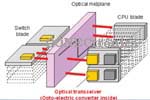
 Data speed and available space for transceivers are current obstacles to realizing the high-performance servers of the future. Fujitsu Laboratories has achieved improvements in the IC circuitry and packaging module structures, enabling transfer speeds of 25 Gb/s over each channel in the next generation of interconnects—a step toward the goal of doubling conventional transmission rates.
This technology enables high-speed, high-bandwidth data communication between CPUs on a server, and between CPUs and peripheral devices. It marks a significant step toward the performance improvements that future supercomputers and high-performance servers will require.
Background
Advances in CPU processing have exponentially increased the data management capabilities of servers.
Now, improved virtualization technology allows a single CPU to handle multiple processes. The volume of data passing through CPUs or from CPUs to peripherals is increasing dramatically. While today's servers use optical interconnects capable of data speeds of 10 Gbps per channel, future servers are expected to be even faster, at 25 Gbps.
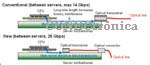
Furthermore, as shown in Figure 1, optical interconnects are also expected to be used not only to communicate data between servers, but also between tables within a server, given the difficulty of achieving high data rates through electrical communications.
 Technological Challenges:
Implementing interconnects on a server requires an optical transceiver to convert electrical signals into optical signals. Current optical transceivers have achieved data rates between 10 and 14 Gbps, so speed has become a barrier to reaching the desired rates of 25 Gbps.
Furthermore, current optical transceivers are physically very bulky, making it difficult to place them near a CPU or other devices. This is problematic because the electrical signal traveling between the device and the optical transceiver encounters losses and interference along the transmission line, which increase with the length of the circuit.
This degrades signal quality and makes it more difficult to increase speed.
Newly Developed Transceiver
: To successfully produce a compact optical transceiver with the necessary optical interconnects for high-speed, high-bandwidth data transmission within servers, Fujitsu Laboratories has developed an opto-electrical converter to transform electrical signals into optical signals using an optical device. More specifically: 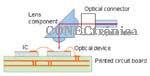
1. High-Speed Circuit Technology:
Fujitsu Laboratories was able to increase speeds through circuit technology in the IC that runs optical devices, creating more pronounced waveforms of the optical signal's rise and fall. This was achieved even in low-cost optical devices with insufficiently fast response times by implementing circuit technology that suppresses the multiple reflections that degrade the signal's waveform. The result is an increase in data rates from the current 10-14 Gbps to 25 Gbps per channel.
2. Compact Coupling Optical Technology
Conventionally, efficient transmission of an optical signal between opto-electric converters and optical fiber required an optical coupling unit. This consisted of a lens component and an optical connector (Figure 3). However, the lens component was large and expensive.
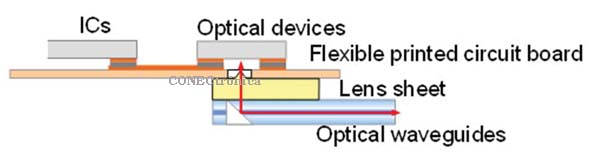
This new design consists of an opto-electrical converter with a flexible printed circuit board equipped with optical devices and integrated circuits, enabling a compact optical transceiver. Furthermore, Fujitsu Laboratories has also developed an effective film-type lens that is stacked on the underside of the flexible printed circuit board, thus resolving the aforementioned problems.






