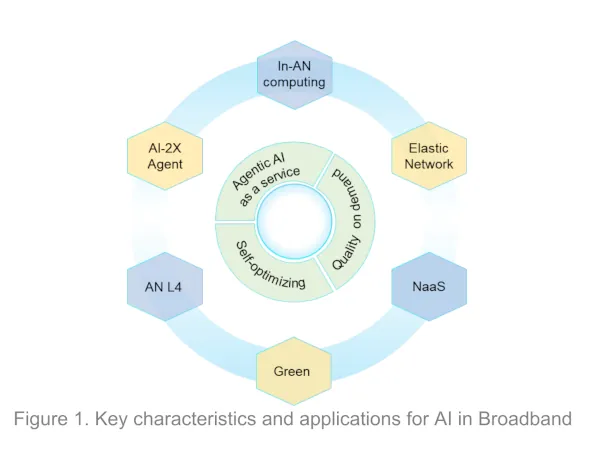
In addition to supporting self-optimizing networks that correct their own faults, predict in advance where maintenance is needed, automatically redirect capacity to where it is required, and save energy,
AI has already demonstrated its transformative potential in various areas, said Manuel Paul, president and director of the Broadband Forum's Service Requirements Working Group. “Given that the technology has the potential to make networks smarter, simplify operations, and open the door to new service and revenue opportunities, it is crucial that the industry adopts the right approaches to deploying it in broadband networks.”
The Broadband Forum's “AI in Broadband Networks” (MR-529) document sets out a vision of how broadband networks should evolve with AI, outlining AI development trends and network characteristics for service-oriented broadband networks, as well as their service requirements. The document explains how broadband service providers (BSPs) can move toward fully autonomous networks that deliver consistent, high-quality customer experiences by establishing a standardized, software-defined foundation.
“For service providers exploring how AI can enhance their service-oriented broadband models, the Broadband Forum’s latest document is the starting point,” Paul continued.
Once the “vision” is established, the Broadband Forum’s work shifts to creating an AI Framework that will ultimately guide service providers in effectively deploying AI in broadband networks. Phase 2 of the project will detail key use cases, requirements, and technical characteristics for applying AI in broadband networks. It will also summarize service-oriented requirements for AI functions across all network elements and offer project roadmap recommendations for AI-enhanced network devices and management platforms within other Broadband Forum work areas.
“AI is essential to our mission of service-oriented broadband, which aims to enable broadband service providers (BSPs) to deliver intelligent, personalized services that improve the quality of experience and customer satisfaction,” said Craig Thomas, executive director of the Broadband Forum. “Broadband Forum standards, including those developed through the CloudCO initiative and its open-source software initiatives, such as OB-CAS, are already providing the standardized foundation that BSPs need to embrace AI in a way that drives innovation and transforms their networks.”
The Broadband Forum's document "AI in Broadband Networks (MR-529)" presents a strategic vision of how artificial intelligence will transform broadband networks in the coming years. The report describes the evolution of the internet toward smarter, more automated infrastructures focused on personalized services.
Key takeaways from the report
: AI will enable the transition from simple chatbots to autonomous intelligent agents capable of interacting naturally with users and performing complex tasks without constant supervision.
Networks will evolve from traditional connectivity models toward integrated architectures of
edge computing,
software-defined networking,
AI platforms,
and Network as a Service (NaaS) models.
The report identifies three major areas where AI will have an impact:
AI-based agent services,
such as virtual assistants, intelligent support, and advanced automation;
Quality on Demand (QoD),
networks capable of guaranteeing bandwidth, low latency, and stability for AI applications, extended reality (XR), smart education, and model training; and
Self-optimizing networks
, infrastructures capable of detecting faults, predicting failures, automatically redistributing resources, and optimizing energy consumption.
Key Technology Trends:
The Broadband Forum anticipates several key transformations:
Shift from centralized training to distributed inference.
Evolution from unimodal interfaces to multimodal interactions.
Integration of native AI within the network.
Increased network programmability and automation.
Complete visibility into the state of the infrastructure.
Open platforms for new services.
Project Objective:
This document serves as an initial roadmap for broadband service providers (BSPs) to adopt AI in a standardized and scalable way. The next phase of the project will develop:
specific use cases,
technical requirements,
implementation frameworks,
and recommendations for AI-managed networks and platforms.
Conclusion
The report argues that AI will not only improve the operational efficiency of telecommunications, but will completely redefine the digital experience, driving autonomous networks capable of delivering personalized, resilient, and high-quality services in real time.