 What is the state of global 5G deployment in 2021?
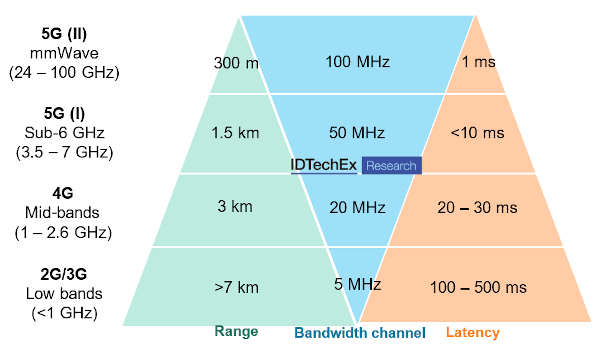
5G is recognized as a crucial infrastructure for both developed and developing countries. By the end of 2021, 79 countries will have commercialized 5G or will be conducting trials with it. Looking more closely at which frequency is most commonly used—according to a study by IDTechEx—it is the sub-6 GHz band. This frequency band is used in more than half of all commercial 5G deployments and trials, with only a small percentage using mmWave. To date, only 9 countries have commercialized 5G mmWave. However, this is not surprising given that the main limitation of mmWave transmissions is their short propagation range. Telecommunications companies would not use the mmWave frequency band for nationwide coverage. If we look at the deployment strategies of telecommunications operators, we can see that low frequency bands (e.g., 700 MHz) are used for national coverage, while bands below 6 GHz are used for city coverage, and millimeter wave is used for megacity access points.
In its latest 5G market research report, "5G Technology, Market and Forecasts 2022-2032," IDTechEx specifically examines the deployment strategy of five key regions: the United States, China, Europe, Japan, and South Korea. For each region, IDTechEx focuses on two aspects: government strategy and telecom operators' strategy for 5G deployment. The following two paragraphs provide a high-level overview of the deployment status in the United States and China.
UNITED STATES:
Government: Compared to other countries, the Federal Communications Commission (FCC) released millimeter wave spectrum well in advance. It wasn't until the beginning of this year that the FCC finally released the frequency band below 6 GHz. Replacing Huawei equipment remains a priority, and the government is funding smaller carriers to do so. Given the lack of dominant 5G telecommunications equipment providers in the United States, the FCC has also supported the development of the Open RAN.
The telecom operators' perspective: Each operator owns a different portion of the 5G spectrum (for example, Verizon holds the most mmWave spectrum). Consequently, each 5G deployment strategy differs. Verizon, for instance, has made significant investments in mmWave deployment, while T-Mobile has prioritized low- and mid-band expansion. T-Mobile currently has the largest mid-band coverage (using 2.5 GHz) as a result of its acquisition of Sprint. Following the C-band auction (frequency below 6 GHz) earlier this year, both AT&T and Verizon announced plans to deploy mid-band service this year, aiming to cover 100 million people by 2022.
China:
The government: The Chinese government is aggressively promoting the domestic development of 5G. The Ministry of Industry and Information Technology of the People's Republic of China (MIIT) published a 5G Application "Navigation" Action Plan (2021-2023) in April 2021, outlining a roadmap for promoting 5G applications. Three key performance indicators (KPIs) have been identified: increasing 5G user penetration to over 40%, raising 5G network access traffic to over 50%, and boosting 5G penetration in large enterprises to over 35%. The MIIT has not yet released millimeter wave spectrum, although it is expected to do so soon, as the Chinese are preparing to use the 2022 Winter Olympics as a testing ground for millimeter wave deployment.
From the telecom operators' perspective: One of the trends observed in China is that operators are collaborating on the construction of shared network infrastructure. Here's an example: By May 2021, China Telecom and China Unicom will jointly build 460,000 5G base stations.
What is the current major technical development/trend in 5G?
Although 5G is commercially available, many technical developments are still underway. In this article, IDTechEx analyzes the four key points:
The race for a lighter sub-6 GHz massive MIMO radio:
A crucial part of deploying a large-scale 5G network using massive MIMO equipment is that the radio must be lightweight and compact, as these characteristics will help operators save a significant amount of money on the overall rollout. This is where silicon comes in. Silicon's performance will have a huge influence on essential aspects of a radio, such as connectivity, capacity, power consumption, product size and weight, and ultimately, cost. In the 5G sector, all of these aspects are critical.
- Small Cell Deployment:
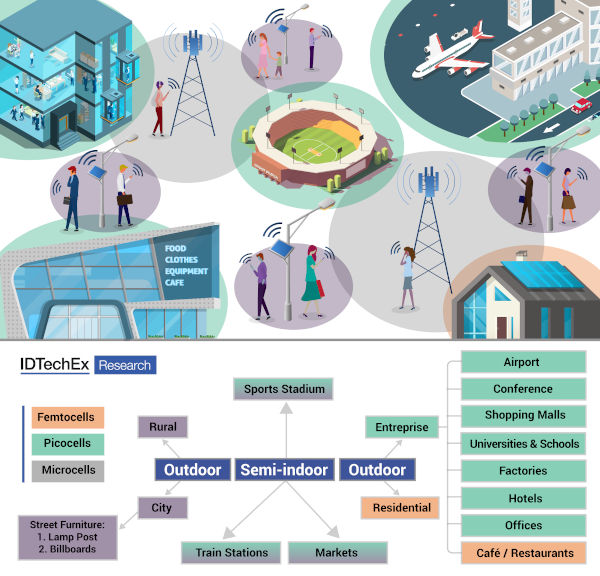
Small cells are proposed to address the challenge of short signal propagation range caused by high frequencies. Creating an ultra-dense network by deploying more small cells plays a fundamental role in 5G, as it complements the macro network and thus increases data capacity. Furthermore, small cell deployment brings 5G to various businesses, facilitating digital transformation (see this recent IDTechEx article for more information on how small cells are enabling connected industries). Small cells can be classified into three types: femtocells, picocells, and microcells, based on their power output. Due to their smaller size compared to macro base stations, the material choices and overall technological trends will differ from those of their macroinfrastructure counterparts.
- Open RAN Development:
Open RAN is an alternative network to the traditional legacy RAN that allows interoperable components (including hardware and software) from different vendors to work together seamlessly. It aims to eliminate the proprietary nature of the radio access network (RAN) system, diversify the supply chain for vendors in the telecommunications industry, further encourage innovation, and reduce the initial and operating costs of RAN deployment. Open RAN development was still in its early stages in 2021, and only a few telecom operators were deploying the 5G Open RAN network on a small scale. Many challenges still need to be addressed before the majority of telecom operators adopt the technology.
- Millimeter Wave Development:
IDTechEx believes it will be several years before the millimeter wave market takes off (see this recent IDTechEx article for a more in-depth analysis). Millimeter wave devices, for example, require low-loss materials with low dielectric constants and tanning losses, as well as improved packaging methods, to avoid excessive transmission loss. Due to the short wavelength of millimeter wave communications, devices are becoming smaller and more integrated, which demands greater power and thermal management.
Outlook for 2022 and beyond?
The 5G market is poised for takeoff. By the end of 2032, consumer mobile services are projected to generate $800 billion in revenue, and 5G macroinfrastructure markets are expected to expand seven times faster than in 2020, according to IDTechEx. Other key points include:
- For many years, sub-6 GHz frequencies will be the main ones for deployment, while millimeter waves will require further technological advancement, as well as a "killer app" to gain market share, which will take years.
The relationship between the United States and China, as well as the development of the open RAN, will influence the dynamics of the actors in the 5G system.
- The Si is fundamental to the advancement of 5G, as its performance has a substantial impact on connection speed, capacity, power consumption, product size and weight, and ultimately, the cost of a 5G system.
Small cells will play a key role in enabling 5G to replace wired connectivity in the industrial environment.
- The trend in millimeter wave research and development is focused on low-loss materials, energy and thermal management, and advanced packaging.