The COVID-19 crisis has forced people around the world to rapidly change their work and social lives, and communities have become more reliant on the internet than ever before. The ever-increasing number of Zoom calls and webinars has highlighted the need to continue advancing the technology that has made it all possible.
For more than 50 years, silica glass optical fibers have been the preferred transmission medium for high-speed optical communications, powering the global internet and cloud-based services used by homes and businesses worldwide. They are also used for oil and gas facility detection, structural monitoring of railways and bridges, medical endoscopes, and many other applications as part of a $40 billion global market.
However, due to the scattering of light within the glass, a fraction of the transmitted energy is lost, a process known as attenuation. This energy loss becomes an increasingly significant problem as the wavelength of light decreases. This greater transmission loss through optical fiber poses a serious limitation to the performance of all applications requiring shorter wavelengths.
In this new study, published in Nature Communications, researchers from the University of Southampton have shown that guiding light through air-filled fibers offers a possible way to overcome this insurmountable attenuation limit set by glass scattering.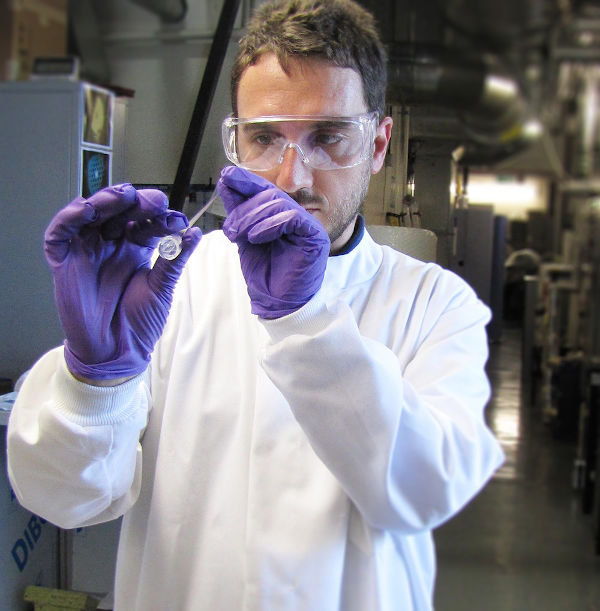
A team from the University's Optoelectronics Research Centre (ORC) has created three different hollow-core fibers with losses comparable to or lower than those achieved in solid-glass fibers at technologically relevant wavelengths of 660, 850, and 1060 nanometers. The lower attenuation in a fiber that guides light through air offers potential for advancements in quantum communications, data transmission, and laser power delivery.
Professor Francesco Poletti of the ORC states: "Since the 1970s, many alternative types of glass and waveguide technologies have been investigated to try to solve this problem, but all has been in vain.".
"Our findings show that hollow-core fibers have the potential to outperform current optical fibers at several wavelengths used in current optical technology. Not only do they have lower attenuation, but they can also withstand higher laser intensities, such as those needed to melt rock and drill oil wells, as well as produce more efficient lasers for manufacturing.".
Professor Poletti added that hollow-core fibers can also transmit undistorted laser pulses with peak power levels so high that they would be unusable if transmitted through standard glass fibers, and they preserve the light polarization needed to produce more accurate sensors and imaging endoscopes.
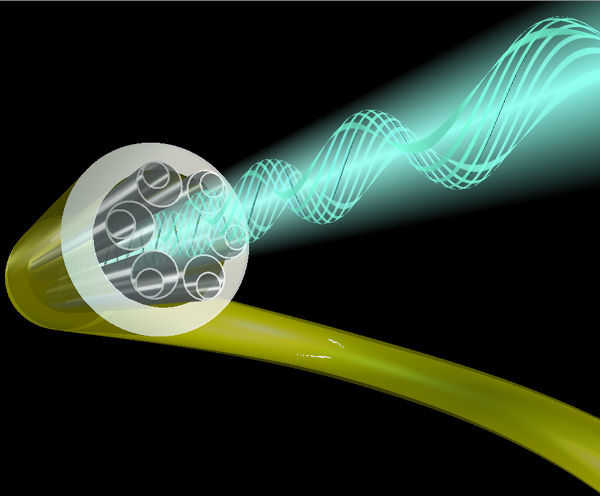
The fibers developed and reported in this paper are the result of more than ten years of research by ORC into the development of Nodeless Antiresonant Nested Fibers (NANF), a special type of hollow-core fiber that confines light within a central vacuum thanks to thin glass membranes surrounding the core. Their first fibers had attenuations of 5 decibels (dB), or only 30% light transmission, per meter of fiber. New physical knowledge, with contributions from the global community, and significant developments in manufacturing technology led by the Southampton team, have resulted in one of the fibers featured in this study improving this by a factor of 10,000, achieving an attenuation of only 5 dB per 10 kilometers.
Professor Poletti continued, "The technology we are developing has the potential to underpin the development of faster data centers with shorter latency for the end user, more precise gyroscopes for interplanetary missions, more efficient laser-based manufacturing, to name just a few.".
The team at the University of Southampton that invented and developed this optical fiber technology with funding from the ERC's Lightpipe project continues to work on improving the optical performance of these fibers, while producing longer lengths at a lower cost.
Professor Sir David Payne, Director of the Centre for Optoelectronics Research, added:
"The transmission capacity of optical fibers is so great that we never thought we'd reach the point where we'd use it all. But in the last five to ten years, we've realized we're close to doing so, and the impact of COVID-19 has accelerated this even further. This means we can no longer modify conventional fibers to extract more capacity; instead, we must resort to the bundle method of installing huge quantities of new fiber optic cables. This is possible, but it increases costs.".
"A faster, more reliable internet with greater bandwidth would help us maintain our current levels of online work and socialization, and would also allow us to take this further in areas such as 3D video conferencing and virtual reality.".
Professor Poletti concluded: "We are convinced that we may have finally identified a solution with the potential to complement, and in many cases replace, the fully solid silica fibers that have been the mainstay of domestic and commercial applications for half a century.".