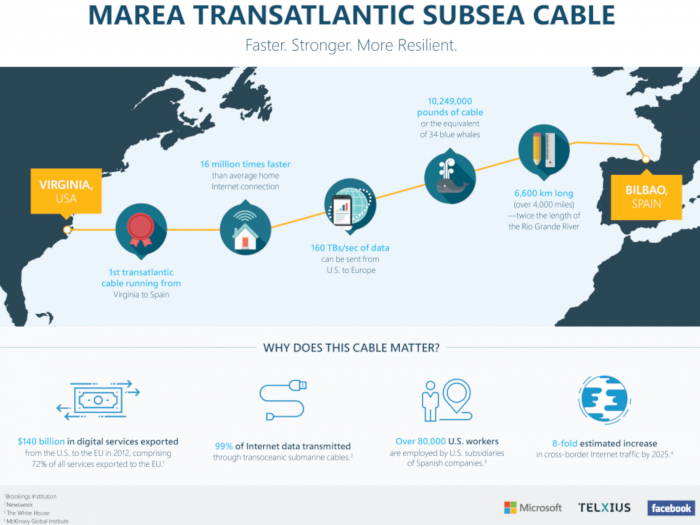
The test involved providing greater transatlantic bandwidth, among other capabilities. Leveraging the flexibility of the NCS 1004 system, various channel capacity combinations were tested to maximize the cable's performance and spectral efficiency, achieving record-breaking results: error-free 400G performance in the Virginia-Bilbao test and channels with a spectral efficiency of 6.445 bps/Hz (bits per second/hertz); and a spectral efficiency of 4.52 bps/Hz in the case of the return loop (from Bilbao to Virginia and back to Bilbao) for a distance exceeding 13,200 km.
 Network operators do not have unlimited bandwidth, so spectral efficiency is the most important metric in submarine deployments. This metric refers to the rate at which data can be transmitted over a given bandwidth, assessing the effectiveness of the physical layer when using a limited frequency spectrum. The spectral efficiency of a communication link can be improved by packing more information, or bits, into a single transmission.
The Cisco NCS 1004 platform has thus achieved a maximum capacity of 26.4 Tbps over the MAREA cable, reaching up to 18.9 Tbps for the transatlantic loopback. “This demonstrates that 24.7 Tbps can be comfortably utilized over MAREA, with up to 18.5 Tbps deployable for twice the distance for the loopback, also with ample margin,” notes Bill Gartner, Senior Vice President and General Manager of Optical Systems and Optics at Cisco.
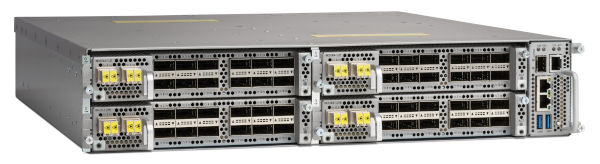
The Cisco NCS 1004 platform is designed to maximize fiber wavelength and capacity in a compact form factor with reduced power consumption. In a 2RU configuration, the system supports up to 4.8 Tbps of client and 4.8 Tbps of trunk traffic. The Cisco NCS 1004 offers DWDM transport capabilities with agility, programmability, and ease of use.