Photon detector with 99% efficiency
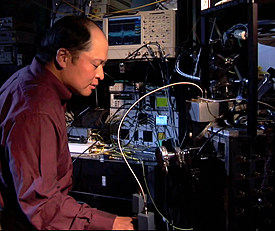
According to team member Sae Woo Nam, the advantage of this unique type of photon detector is that the new detector design not only measures the lowest levels of light ever possible, but does so with remarkable accuracy.
"When these detectors indicate that they have detected a photon, they are reliable. They don't give false positives," says Nam, a physicist at NIST in the Optoelectronics Division. "Other types of detectors have very high gain to measure a single photon, but their noise levels are such that occasionally a glitch is mistakenly identified as a photon. This causes a measurement error. Reducing these errors is really important for those doing the calculations or communications."
The ability to count individual photons is very valuable to designers of certain types of quantum computers, as well as scientists working on quantum optical experiments, which deal with exotic states of light that cannot be described by classical physics. But one of the most promising potential applications of a high-efficiency photon detector is securing long-distance data transmission by preventing unwanted interception. A detector that can identify when a photon that was part of a transmission has disappeared would be a very important defense against information theft.
The team has optimized detection for 810 nanometers, an infrared wavelength, and it still has high efficiency at other wavelengths that are attractive for fiber optic communications, as well as for the quantum optics community. Ironically, the detector is so efficient that it surpasses the ability of current technology to determine its precise effectiveness.
"We can't be sure with direct measurement that we've reached 99 percent efficiency because current metrology isn't able to determine that we're at that percentage," says Nam. "The important thing about our latest breakthrough is that we can measure the detection efficiency almost the same for every device we build."
The team is working to develop evaluation techniques that can measure the detector's capabilities, and Viet notes that the team's creation could also help evaluate other light-harvesting devices.
Unlabeled
-
Apollo and Alcatel-Lucent have announced an industry milestone: a successful demonstration of data transmission at approximately 3 terabits per second (Tbit/s), based on 40 Gbit/s channels, per fiber pair in a submarine network. Apollo is a...
-
Cloud-TM, the EU's cloud computing project, presents an initial prototype
After three years of hard work, the Cloud-TM (Transactional Memory) Platform prototype has been launched. This announcement marks the final stage of one of the largest cloud computing research projects in the European Union.
-
The M2M boom is driving massive growth in the value-added services market
The tremendous expansion of machine-to-machine (M2M) connections in the coming years will cause the market for services associated with value-added services (VAS) to expand by a factor of seven and reach $10 billion in 2017. -
WLAN monetization and 802.11ac, the most important Wi-Fi trends in 2015
Location-based services, social networks as user registration credentials between companies that provide guest access, or Hotspot 2.0 roaming consortia have been some of the most talked-about Wi-Fi trends during 2014.
-
Mateo Valero, awarded an ERC Advanced Grant, which is the most prestigious aid for a scientific project
The European Research Council (ERC) has awarded Mateo Valero, director of the Barcelona Supercomputing Center – National Supercomputing Center (BSC-CNS), an Advanced Grant in the physical sciences and engineering category for his project 'Riding on... -
How does coherent optics increase data speed? - Modulation and polarization multiply the data capacity in optical networks.
In the early days of optical networks, all optical signals relied on a simple mechanism known as on-off keying (OOK). Simply put, this mechanism works by turning a light on and off to transmit data. OOK is a broader term used to describe...
Newsletter
Latest News
The Global Commission "AI for Good" is created to promote responsible, inclusive, and trustworthy artificial intelligence
Rwandan President Paul Kagame; Salesforce President and CEO Marc...
Colt and Ciena achieve the fastest encrypted, quantum-attack-resistant 800GbE transatlantic transmission to date
Colt Technology Services (Colt) and Ciena have carried out one of the data transmissions to...
Indra and UC3M launch the first Dual Degree in Quantum Technologies Engineering in Spain
Indra Group and the Carlos III University of Madrid (UC3M) have launched the new Dual Degree in...
Anritsu and Qualcomm validate 5G NR Rel-17 data compression to improve uplink efficiency
ANRITSU CORPORATION announces verification and support for 3GPP RAN5 Rel-17 test cases...
Spain and Portugal create the Iberian Network of Competence Centers in semiconductors and photonics
The chip competence centers of Portugal and Spain have signed a memorandum of understanding (MOU) for...
Subscribe to CONECtrónica magazine
You can subscribe to the Conectrónica magazine in 2 formats.
Digital Format: 5 downloadable PDF editions at an annual cost of 60 Euros (VAT included)
Paper Format: 5 editions to be received by mail at an annual cost of 180 Euros (VAT included).
Contact our subscriptions department at subscriptions@conectronica.com
Payment via Bizum or bank transfer
Technical Courses and Seminars
Mouser drives IoT development with its LoRaWAN resource center and new wireless connectivity solutions
Mouser Electronics, Inc. highlights its comprehensive LoRa® resource center as the market accelerates...
DataCom: Technical guide for networks, fiber optics and structured cabling
Digital transformation has turned data networks into a critical infrastructure for...
Taoglas launches The Antenna Podcast, a new technical space about antenna design and innovation
Antennas remain one of the most critical and, at the same time, most misunderstood elements in...
ISE 2026 Barcelona: Summits, Megatrends and the most ambitious content program in the AV sector
Returning to Barcelona in February 2026, Integrated Systems Europe (ISE) presents its program of...
E-book: the future of satellite communications
Mouser Electronics, Inc., in collaboration with Qorvo and other technology innovators...
Optical Networks
Televés renews Overlight with more efficient optical transmitters and a Quattro receiver that is 60% more compact
Televés expands its Overlight solution for distributing television signals over fiber optics with a...
VIAVI launches AI Experts: artificial intelligence to accelerate network validation and diagnosis
VIAVI Solutions Inc. has announced the launch of AI Experts, the first addition to its...
The glass box imperative: governance of intent-based automation in AI-native networks
Connectivity is a fundamental infrastructure, and reliability standards continue to rise...
Multidimensional reconfigurable add/delete optical multiplexer for WDM-MDM systems
In the rapidly evolving field of optical networks, the demands for greater flexibility and...
LAN 2026: Standards, Trends and New Developments in Local Area Networks
The local area network (LAN) ecosystem is undergoing a phase of accelerated transformation in 2026, driven by...
Evolution of optical networks: ROADM, OpenROADM and OpenZR+ in the 400G and 800G era
The rapid increase in data traffic is driving the construction of new infrastructure worldwide...
Legrand launches Chroma Link, the fiber optic solution for high-density AI networks
Legrand has announced the launch of Chroma Link™, a fiber optic cabling solution with...