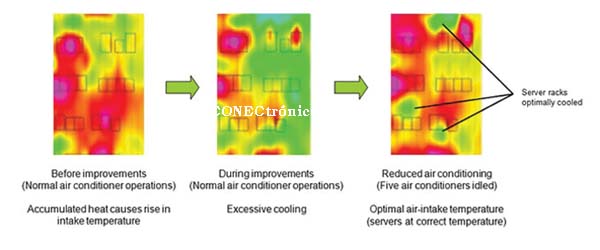
 Using the results obtained from the generated visualizations, the companies have completed a test to optimize the energy consumption of the data center's air conditioning.
The temperature-sensitive fiber optic technology developed by Fujitsu Laboratories is the first of its kind in the world to be deployed on a large scale in a data center. This technology improves the efficiency of data center air conditioning, reducing annual energy consumption by 20%, equivalent to 350,000 kWh and 120 tons of CO2 emissions.
Background:
Tohoku Electric Power has actively pursued energy conservation as part of its business activities and has been working with TOiNX to help maintain stable operations for its internal information systems while saving energy.
ICT equipment is often densely packed within a data center, leading to increased energy consumption and significant heat generation by the infrastructure. As a result, managing the growing power required by cooling systems to maintain operations can be a major challenge.
To properly cool the ICT equipment installed in a data center, an efficient air conditioning supply is necessary, as well as a system that appropriately circulates the hot air exhausted from the equipment, ensuring it does not mix with the fresh air. Furthermore, past efforts to implement improvements based on temperature data collected from a limited number
of detection points have proven difficult.
By applying Fujitsu Laboratories' fiber optic temperature sensor technology to visualize temperature distribution within the data center, the Japanese multinational completed a test that yielded results for optimizing the data center's air conditioning.
Test Summary:
A single fiber optic cable acting as a temperature sensor was installed in front of and behind each server rack, as well as in the ceiling and floor. This allowed the temperature distribution in the data center to be measured at high resolution (in 10-centimeter intervals) and in real time (every thirty seconds). The results of these measurements revealed the following:
Heat accumulated in certain areas near the ceiling, and some of this hot air circulated through the server rack air intakes, heating the upper portions of the racks.
The hot air from adjacent server racks mixed with the cooler air, raising the overall cooling temperature.
Based on these findings, changes in temperature distribution were observed in real time, while measures were taken to optimize the air conditioning system through a trial-and-error approach.
Measures taken
while the data center was operational were implemented without requiring any changes to the facilities or repositioning of equipment.
Enclose the intake port areas, both the roof and the floor, using vinyl sheets to improve the circulation of cold or hot air paths.
Use of airflow control plates to direct the air poured from the racks upwards and isolate it from the cold air on the floor.
Use of airflow outlet that optimizes the direction of air conditioning outlet.
Use of subfloor airflow outlet that modifies and improves subfloor airflow near racks.
Five air conditioning units at rest.
Results and Future Plans
The system was designed to reduce the data center's air conditioning power consumption by 20% in one year, equivalent to approximately 350,000 kWh and 120 tons of CO2.
Fujitsu plans to continue using this technology to optimize air conditioning utilization and enable stable system operation, adapting to different operating conditions.