 Russia has established itself as the undisputed leader in fiber optic deployment in the region. The country added 2.2 million new FTTH subscribers in the second half of 2012 – more than the combined total of the 27 EU member states – reaching a total of 7.5 million homes with installed fiber. These figures represent a remarkable increase of over 42% in FTTH subscribers.
 In the 27 EU member states, the number of FTTH subscribers continued to grow at an accelerated rate of 15% in the second half of 2012. During this period, Europe added a total of 820,000 subscribers, bringing the number of fiber-connected households to 6.24 million. Scandinavia, the Baltic countries, and the Netherlands accounted for 26% of these new subscribers, Eastern European economies for 33%, and France and Portugal for 30%.
The top five “dynamic” economies, where not only was subscriber growth high in the past year, but where new subscribers in 2012 also represented a high proportion of total subscribers at the end of 2012, were Turkey, Ukraine, Spain, Bulgaria, and Russia. In Turkey, the number of subscribers more than doubled compared to the previous year. Spain, which entered the FTTH ranking in June 2012, also confirmed its dynamism.
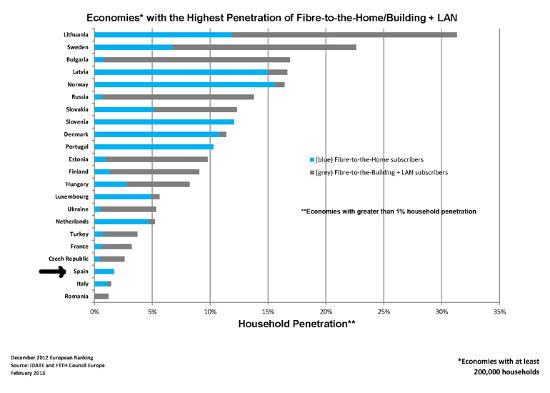
Regarding household penetration, Lithuania continues to be the dominant nation for fiber, already boasting 100% FTTH coverage and over 31% of homes connected to fiber. Sweden ranks second in the European FTTH ranking, with 22.6% of households subscribed to fiber. In the ranking, there are 10 nations that can now claim to have more than 10% FTTH penetration, compared to the seven that existed in June 2012. From highest to lowest they are Lithuania, Sweden, Bulgaria, Latvia, Norway, Russia, Slovakia, Slovenia, Denmark and Portugal.
“Eastern Europe and the Scandinavian countries have strengthened their position as fiber leaders, and the disparity between the most advanced and the least advanced is becoming increasingly visible,” said Karin Ahl, President of the FTTH Council Europe. “These FTTH leaders are gaining a competitive advantage over their less well-connected neighbors. Good communications infrastructure helps retain existing businesses and attracts new ones. Nations connected by fiber have a head start in offering new services such as remote medical care and smart grid technologies. Countries that postpone fiber development are missing a huge opportunity to prepare for their economic future.”
Most of the major Western economies are still taking their time with fiber deployment. Italy and Spain remain at the bottom of the FTTH rankings, and once again, Germany and the UK are left behind. The number of homes connected to fiber in the UK is less than 0.1%.
The FTTH Market Panorama, updated twice a year by IDATE for the FTTH Council Europe, compiles the number of subscribers in each European country and ranks them according to the percentage of households with a direct fiber connection. The panorama includes both FTTH and Fiber to the Building (FTTB), a solution focused on apartment buildings where existing cabling can be used to make the final connection to the customer.
To be included in the FTTH ranking, a country must have more than 1% of its households connected to FTTH and more than 200,000 homes.