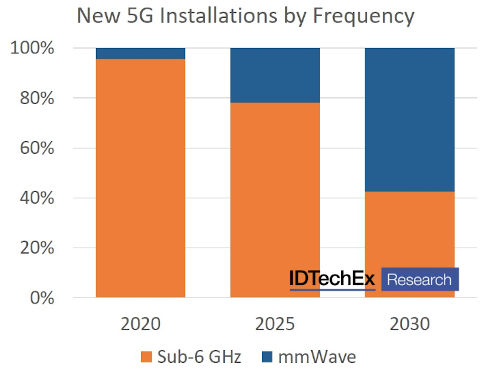
PCMag recently published a report comparing 4G and 5G download speeds across several regions of the United States (PCMag report). They concluded that 5G isn't quite ready yet. Verizon showed the fastest download speed at around 2 Gbps, but found that only 4% of its network has 5G coverage. 5G uses mmWave or sub-6GHz spectrum. mmWave achieves the fastest download speeds but also has the shortest range, hence Verizon's limited 5G coverage. While sub-6GHz has a longer range, testing found that in many cases it was actually slower than 4G in the same region. Although overall download speeds improved starting in 2019, much of this is due to improvements in 4G infrastructure. mmWave is the most technically challenging technology, and as 5G networks evolve, we expect to see a significant increase in mmWave deployments and, therefore, many opportunities for new materials and technologies. Previous tests, however, highlight that while there has been a lot of hype surrounding 5G, there are still many challenges and a long way to go before reality catches up.
 As the 5G infrastructure rollout continues, we are seeing a shift towards mmWave installations, presenting new opportunities for thermal management materials. Full data is available in the IDTechEx report, "Thermal Management for 5G.".
One of the main challenges of 5G infrastructure is thermal management. The higher frequencies used by 5G antennas require increased gain to achieve acceptable range. Furthermore, the mm wave spectrum has very poor propagation through surfaces like walls or windows, so many more individual antenna units are needed to provide sufficient coverage. Higher frequencies also reduce the spacing between antenna elements, resulting in much denser assemblies of electronic components that have to dissipate heat. With a greater number and density of antenna installations within the network, active cooling methods, such as fans or liquid cooling, may not be as viable as they were for previous infrastructure.
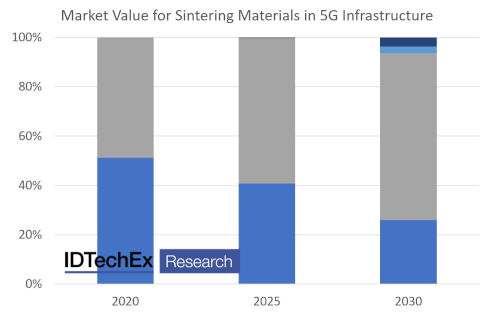
To meet the increased gain requirements, there is a trend toward new semiconductor technologies such as GaN for antenna power amplifiers, but this can bring its own challenges. GaN devices can operate at higher temperatures than silicon-based technologies; this allows for greater power output but necessitates a focus on die-connect technology. The increased adoption of GaN, especially in systems below 6 GHz, is bringing with it a transition from existing die-connect technologies, such as AuSn, to emerging alternatives, such as pressure and pressureless silver sintering.
The market share of different sintering materials/technologies will change drastically in the next 10 years.
Another crucial factor in passive heat dissipation is the use of thermal interface materials (TIMs). TIMs come in a variety of formulations and formats and are used to transfer thermal energy from electronic components to a heat sink. As 5G technology evolves, with increased use of beamforming and massive MIMO (multiple input multiple output), the need for TIMs also increases, not only for densely packed antenna arrays but also for the increased baseband processing and power supply required to handle the significant data throughput.