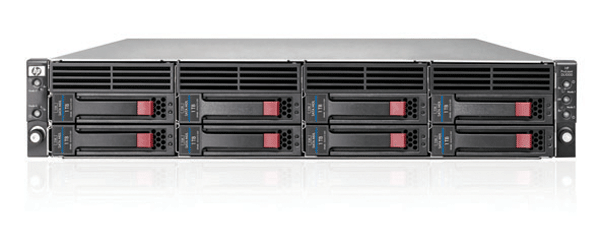
Companies with scalable or "scale-out" business models, operating with thousands of servers, are pushing the boundaries of their current technology solutions. The HP ExSO portfolio includes a new, highly efficient, and lightweight architecture for modular systems, as well as data center solutions, services, and support, helping these customers reduce costs, improve infrastructure efficiency, and significantly accelerate their time-to-market. The portfolio enables these customers to save more than $152.8 million in capital expenditures and $13.7 million in energy costs.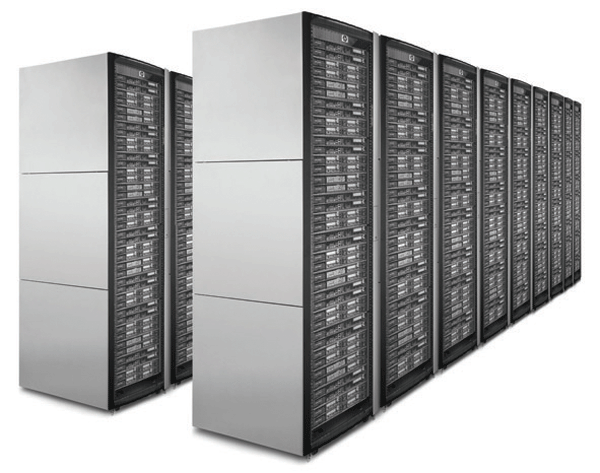 The highlight of the HP ExSO portfolio is the HP ProLiant SL server family, which uses skinless architecture systems that replace the traditional rack chassis with an ultra-lightweight, modular, pull-out tray design. The result is a significant reduction in capital expenditures, space, and shipping costs, while requiring only a fraction of the typical data center footprint. Furthermore, its highly efficient, modular design allows companies to quickly and easily build solutions that meet the needs of large-scale workloads.
With the HP ProLiant SL portfolio, companies can reduce capital expenditures by 10% and energy consumption by 28%, while doubling their computing density.
“Companies with scalable business models need solutions that deliver a return on every dollar, every watt, and every square foot invested in their data center,” says Christine Reischl, senior vice president and general manager, Industry Standard Servers, HP. “The HP ProLiant SL line offers early adopters the most significant design innovations in blade solutions, enabling them to achieve unprecedented economies of scale.”
Extreme Scalability:  The HP ProLiant SL server family represents a significant advancement in server architecture, especially for environments requiring extreme scalability. It offers the following advantages:
Exceptional Energy Savings: Its consolidated power and cooling infrastructure and unique airflow enable energy savings of up to 28% per server, compared to a traditional rack server. This translates to energy savings of approximately $4.1 million annually. Overall, the system saves approximately 52,000 megawatts annually, equivalent to the energy needed to power 4,600 typical U.S. homes for one year.
Ultralight design: Reducing the amount of metal used in manufacturing allows for a 31% weight reduction, which in turn lowers shipping costs, data center space requirements, and overall construction costs. It also eliminates 838.5 tons of server hardware from the scalable data center—the equivalent of 4.5 Boeing 747s.
Modular configurations: The removable trays are interchangeable, facilitating rapid installation and deployment. This new design doubles the density, supporting up to 672 processor cores and 10 terabytes of capacity per 42U rack. Built to industry standards, these servers allow users to mix and match computing components to meet their application needs.
Reduced scalability costs: Packaging volume is reduced, so users requiring thousands of server nodes will also see reduced acquisition costs. For a scalable data center, this represents a capital expenditure savings of $14.5 million.
Intelligent Data Center:
To further maximize savings in scalable environments, businesses need tools that provide greater visibility and control over their operations. The HP Data Center Environmental Edge solution offers comprehensive visual mapping of environmental variables, enabling users to quickly identify the least efficient areas of their data center and take appropriate action. This translates to energy savings of up to $2.4 million annually and a return on investment within twelve months.
The HP Data Center Environmental Edge utilizes a system of wireless sensors distributed throughout the data center to measure variables such as temperature, humidity, atmospheric pressure, and energy consumption. These systems provide real-time visualization of environmental variables, allowing administrators to analyze them concisely and accurately and develop strategies to reduce operating costs.