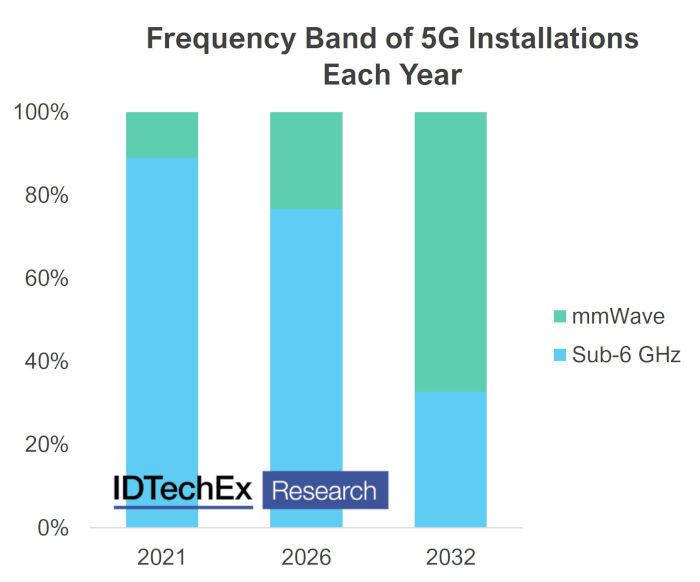
Although sub-6 GHz 5G doesn't deliver the blazing speeds and applications often touted for 5G, it plays a crucial role in achieving coverage across large areas. Some of this coverage is achieved in the lower bands, more comparable to those of legacy 4G, but as we move beyond 4 GHz, legacy LDMOS (laterally diffused metal-oxide semiconductor) power amplifiers begin to experience efficiency issues. This is where broadband semiconductors like GaN (gallium arsenide) begin to shine. We've already seen players like Huawei adopt GaN in their 4G infrastructure. We expect GaN to gain a larger market share in 5G, and with GaN comes a transition in array-fixing technology. In fact, IDTechEx predicts that GaN power amplifiers will see a fourfold increase in annual demand over the next 10 years for 5G infrastructure. AuSn is the typical die-fixing material for GaN today, but we foresee an opportunity for sintered pastes as a replacement with their improved thermal performance, as discussed in the latest IDTechEx report, "Thermal Management for 5G 2022-2032".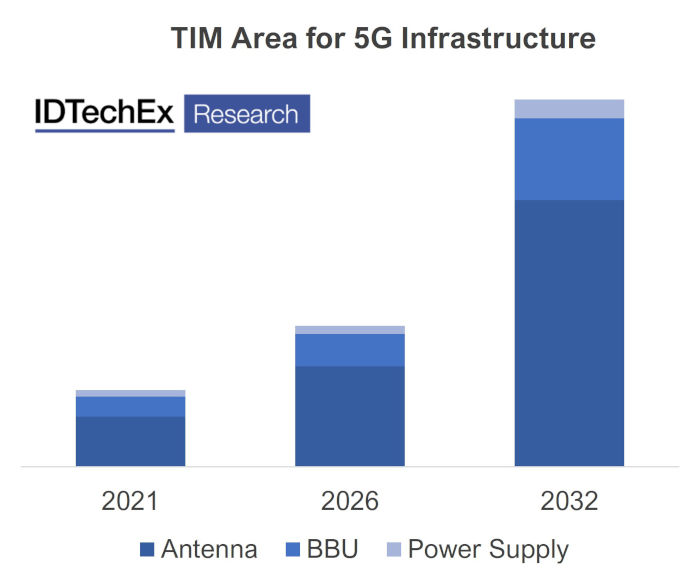
mmWave is the high-frequency technology that can deliver the potentially amazing applications of 5G with incredible download speeds and ultra-low latency. The challenge lies in signal propagation, as signal attenuation increases with frequency, leading to reduced range and easy blockage by walls, windows, and even adverse weather conditions. To increase antenna gain, the number of antenna elements will increase, but thanks to the shorter wavelength, the antenna units themselves will be smaller. This results in a much more tightly packed array of power amplifiers and beamforming electronics, and consequently, a greater challenge in thermal management. While the increased number of antenna elements can reduce the power demand of each amplifier, the highly compact nature of the electronics will lead to greater component integration and likely a greater reliance on silicon-based technologies. However, small millimeter-wave cells will require a greater number of deployments to provide sufficient coverage and, due to their deployment scenarios, are unlikely to be able to use active cooling methods, which, combined with the densification of beamforming components, will present greater requirements for solutions such as thermal interface materials.
Another popular 5G technology is massive MIMO, which allows the infrastructure to serve more terminals on the same frequency band. This increases the number of RF chains per installation, beamforming capacity, and the number of antenna elements used in the networks. The result is an increase in the materials required for antenna printed circuit boards, power amplifiers, and beamforming components, among others. Massive MIMO also increases data transfer rates and channels, leading to a greater need for baseband processing units, higher power consumption, and thus greater market opportunities for thermal interface materials.