This is according to the Cisco Annual Internet Report, which analyzes the evolution of mobile, Wi-Fi and fixed broadband networks with quantitative forecasts on the growth of users, devices and connections, as well as network performance and other relevant trends between 2018 and 2023.
In Spain, 5G networks will support more than 15% of all mobile connections in 2023. There will be 17.2 million 5G connections, and the average 5G speed will be 655 megabits per second, 7.5 times faster than the average mobile connection (83.2 Mbps).
Each decade over the past 50 years has ushered in a new generation of mobile technology with significant innovations. Mobile bandwidth requirements have evolved from voice calls and text messaging to ultra-high-definition (UHD) video and various virtual/augmented reality (VR/AR) applications. Consumers and businesses continue to generate new demands and expectations for mobile networks, especially with the adoption and use of mobile applications. Social networking, video streaming and downloading, business productivity, e-commerce, and the gaming segment will drive the continued growth of mobile applications, with nearly 300 billion apps expected to be downloaded by 2023 (2.4 billion in Spain).
 “The report reveals exponential growth in internet users, devices, and connections, with network capacity demands we couldn't have imagined,” said Roland Acra, Senior Vice President and Chief Technology Officer (CTO) at Cisco. “The findings and forecasts in the Cisco Annual Internet Report help service providers prepare their networks for the unstoppable growth of connections and consider new opportunities to monetize their technological innovations and strategic investments.”.
Key takeaways from the Report
1. - Internet Users in 2023
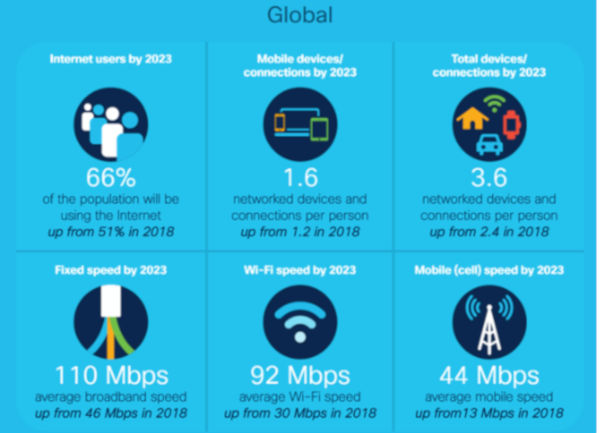
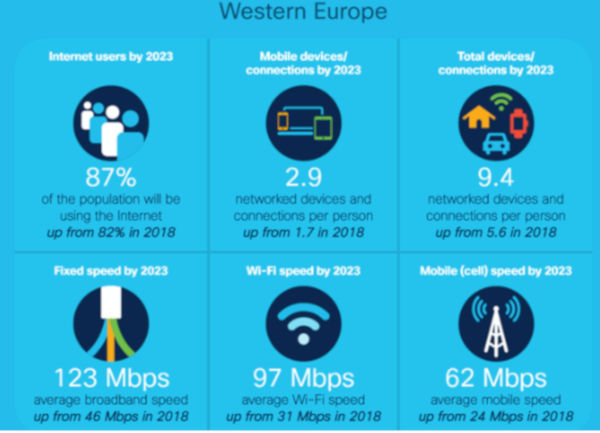
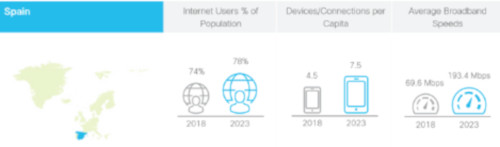
• 66% of the world's population (5.3 billion people) will be internet users. In Spain, there will be 36.5 million internet users (78% of the population), up from 34.8 million (74% of the population) in 2018.
• More than 70% of the world's population (5.7 billion people) will have mobile connectivity (2G, 3G, 4G, or 5G). In Spain, there will be 40.5 million users (87% of the population) with mobile connectivity (2G, 3G, 4G, or 5G).
2. - Devices and Connections in 2023
• There will be 29.3 billion connected devices/connections worldwide (3.6 per person and almost 10 per household). In Spain, there will be 350.1 million connected devices (7.5 per person), up from 211 million in 2018 (4.5 per capita); 110.8 million will be mobile devices (70 million in 2018) and 239.3 million will be fixed/Wi-Fi (141 million in 2018).
• Almost half (47%) of all devices and connections will have video processing capabilities.
• Machine-to-Machine (M2M) connections, which support a wide range of IoT applications, will account for nearly 50% (14.7 billion) of all connections and devices globally. In Spain, M2M modules will represent 62% (217.2 million) of all connections and devices.
3. - Mobile Forecasts for 2023
• 45% of all connected devices globally will have mobile connectivity (3G or lower, 4G, 5G, or Low Power Wide Area [LPWA]), and 55% will connect via fixed networks or Wi-Fi. In Spain, 32% of all connected devices will have mobile connectivity (2G/3G, 4G, 5G, or LPWA), and 68% will connect via fixed networks or Wi-Fi.
• 5G connections will account for 10.6% of all mobile connections globally, compared to 0% in 2018. In Spain, 5G connections will account for 15.5% of all connections (0% in 2018), 4G connections for 48.3% (51.7% in 2018), and 3G/2G connections for 7.4% (38.6% in 2018).
• LPWA connections will represent 14.4% of all mobile connections globally, compared to 2.5% in 2018. In Spain, LPWA connections will represent 28.8% of all mobile connections (9.7% in 2018).
 4. - Wi-Fi Forecasts for 2023
• Wi-Fi access points will quadruple globally between 2018 and 2023. There will be 628 million public Wi-Fi access points worldwide, up from 169 million in 2018. In Spain, public Wi-Fi access points (including home access points) will increase fivefold between 2018 and 2023 to 14.3 million (2.9 million in 2018). Wi-Fi access points will increase from 2.7 million to 14.1 million between 2018 and 2023, a fivefold increase.
5. Network Performance (Mobile, Wi-Fi, and Fixed Broadband) by 2023
• The average speed of mobile connections globally will more than triple between 2018 and 2023, from 13 Mbps (2018) to 44 Mbps (2023). In Spain, the average speed of mobile connections will increase 3.3 times between 2018 and 2023, from 25.3 Mbps (2018) to 83.2 Mbps (2023).
• The average speed of Wi-Fi connections globally will more than triple, from 30 Mbps (2018) to 92 Mbps (2023). In Spain, the average speed of Wi-Fi connections will increase 3.9 times, from 43.8 Mbps (2018) to 169 Mbps (2023).
• The average speed of fixed broadband connections globally will more than double between 2018 and 2023, from 46 Mbps (2018) to 110 Mbps (2023). In Spain, the average speed of fixed broadband connections will increase 2.8 times between 2018 and 2023, from 69.6 Mbps (2018) to 193.4 Mbps (2023).
6. - Cybersecurity Trends (2018-2019)
• The frequency of distributed denial-of-service (DDoS) attacks increased by 39% globally between 2018 and 2019.
• The maximum size of DDoS attacks increased by 63% year-over-year globally.
• The average size of DDoS attacks is 1 Gbps, with 23% – almost one in four – being larger; attacks between 100 Gbps and 400 Gbps grew by 776% year-over-year.
Cisco
Annual Internet Report includes global, regional, and national predictions and trends that assess digital transformation, replacing the previous Cisco Visual Networking Index (VNI) study. The report analyzes fixed broadband, Wi-Fi, and mobile networks (2G/3G, 4G, 5G), providing quantitative forecasts on the growth of internet users, devices, and connections, as well as network performance and new application requirements. It also offers qualitative analysis and assessments in four strategic areas: applications, security, infrastructure transformation, and employee and team training.
Cisco Annual Internet Report Methodology:
The Cisco Annual Internet Report 2018-2023 is based on research from independent analysts and Cisco. Like its predecessor (Cisco VNI), the Cisco Annual Internet Report provides industry metrics on Internet growth for national governments, network regulators, academic researchers, telecommunications companies, technology experts, and media and analysts worldwide. A more detailed description of its methodology is included in the full report.