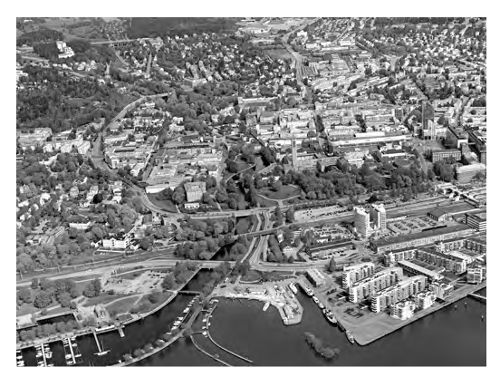
Sweden was the first country in Europe to develop a broadband policy, so perhaps it's not surprising that it's also a leader in FTTH deployment. In 1999, the Swedish city of Västerås decided to build its own municipal fiber optic network. The reason was simple: the local authorities wanted to develop a communications infrastructure for their own use and to attract new businesses to the city. At the time, it was cheaper to lay your own fiber optic cable than to lease fiber optic capacity from existing operators. Thus, in July 2000, Mälarenergi Stadsnät was created, 40% owned by the industrial company ABB and 60% owned by the utility company Mälarenergi, which in turn was owned by the people of Västerås. (Today, the company is a wholly owned subsidiary of Mälarenergi, which bought ABB's stake in the business three years later.).
 The concept of open access was new, but common sense, according to Per Norrthon, CEO of Mälarenergi stadsnät. "The investment was substantial, and the only way to make it happen was to find a large user base and a wide range of services," he explained. "We decided to combine the needs of the business and private sectors and create a high-performance asset infrastructure to be used by everyone for every need: data communication, television distribution, telephony, and future services, whatever they may be."
Mälarenergi understood from the outset that effective marketing is vital to success. The initial marketing campaigns targeted commercial properties, focusing on a single area and getting as many businesses as possible to sign up. In addition to promoting the benefits of fiber optics, the campaign pointed out that connecting to the network would cost more at a later stage. The strategy was highly successful, with over 95% of businesses registering for connection. Everyone agreed to pay their connection fee upfront, which kept the company's cash flow positive in the first year.
Implementation
Network Size in Västerås, including Hallstahammar and Eskilstuna:
• 2,200 connected businesses
• 8,300 utility connections (municipal administration, schools, elderly care, etc.)
• 47,000 residences and 22,000 subscribers
• 250 WiMAX customers
Technology/Architecture: Ethernet. Circuit-connected access switches. Links in the transport network are 1 Gbps, customer connections are nominally 100 Mbps, actual transmission speed depends on the selected service.
Implementation Method: Conduit and fiber installed simultaneously, with more fiber blown later if needed.
Implementation Time: Began in 2000, with 60% coverage of the city.
In 2003, new campaigns were launched to service residential properties. The first customer connected was the municipally owned real estate company, Mimer, and the second was the city administration.
These important agreements allowed the network to be extended across different areas of the city, and from there, connections could be sold to individual homeowners. "A great deal of effort was made to promote our offering to the market," said Norrthon. "We created different customer groups—business users, real estate agency owners, consumers, and so on—and invited them to seminars and meetings to explain the advantages of our product. We also used ambassadors—people in the customer area—who understood the benefits of our solution and recommended it to their colleagues and neighbors."
Mälarenergi realized it couldn't recoup its investment within a reasonable timeframe based solely on wholesale fees unless these were set at an exceptionally high level. Instead, a business model was created whereby the homeowner pays the city network for the physical installation of the fiber optic cable, and when the customer purchases a service from any of the providers on the network, the city network also receives a share of the fees paid by the customer from the service provider. Historically, a homeowner has paid 30,000 Swedish kronor (around €3,200) to connect to the city network. Mälarenergi Stadsnät has agreements with several banks to offer a loan using the home as collateral. "Our colleagues in other countries think it's strange that we can sell these connections, but we do," commented Norrthon. Despite the relatively high initial cost, subscribers are attracted by the fact that it adds value to their property and provides lifetime access to a wide range of services at lower prices than other networks. Today, there are over 35 service providers on the network, including major operators like Telia and Tele2, and more than 185 different services to choose from.
The service menu extends beyond basic telephony and internet to include IPTV, alarms and surveillance services, local systems for booking laundry or garage spaces, and community services such as health and communication support for the elderly. Plans to launch a broadband television service are also well advanced, which will provide end users with up to 250 channels without the need for a new set-top box. More than €40 million has been invested in the city's network over the past 10 years, but thanks to its innovative business model, Mälarenergi Stadsnät has been profitable for several years since 2004. "It should be possible to achieve a return on investment within 10 years, but it also costs money to continue building the network," said Norrthon. In 2008, Mälarenergi Stadsnät took over operation of the network in the neighboring town of Hallstahammar, and in 2009 it reached an agreement to build the fiber optic network in the nearby town of Eskilstuna. Other investments are also being made in Västerås: as part of an upgrade program, customers are being invited to register if they are interested in receiving a 1 Gbps connection.