 Once established, the new lowest value obtained becomes the new maximum speed for that connection.
Interference: Fast-moving vehicles, solid walls and buildings, and bad weather can hinder wireless signal transmission in outdoor environments. Reduced signal strength will decrease system performance, as the wireless system reduces transmission speed to maintain the connection.
Multiple users: Wireless is fundamentally a shared medium (over the air). The total bandwidth available from a single access point or base station must be shared among multiple users, resulting in lower speeds in practice. In busy areas, such as city centers and football stadiums, network capacity can easily be overwhelmed by the large number of users unless the operator installs more mobile transmitters to cope with the exceptional demand.
Despite their limitations, wireless networks have become an essential part of modern communications. They have revolutionized the way we use computers and mobile devices, both at home and in the office, as well as when we are out and about.
However, we believe that wireless networks should be promoted primarily for their virtues – the ability to provide Internet connectivity on the go – and not as a direct replacement for fixed access networks.
These assumptions also assume the availability of high-capacity networks, which may not always be the case. The fastest mobile networks have limited geographic coverage. LTE networks have been deployed primarily in a selection of major cities; although deployment began 10 years ago, 3G networks have yet to reach many rural areas.
In some countries, LTE deployment has been slow to get underway because adequate spectrum must first be allocated. Spectrum is a scarce resource (a single optical fiber has greater capacity than an entire radio spectrum), and national regulators often have to remove regions of the spectrum to make way for new technologies and services.
The Mobile Backhaul Challenge:
A wireless network is only wireless at its ends.
Backhaul refers to the act of transporting communications traffic from a distributed node, such as a Wi-Fi access point or a mobile base station, to a more centralized node. In the mobile space, backhaul corresponds to the portion of the network between the base stations and the nearest point of aggregation, typically a radio network controller.
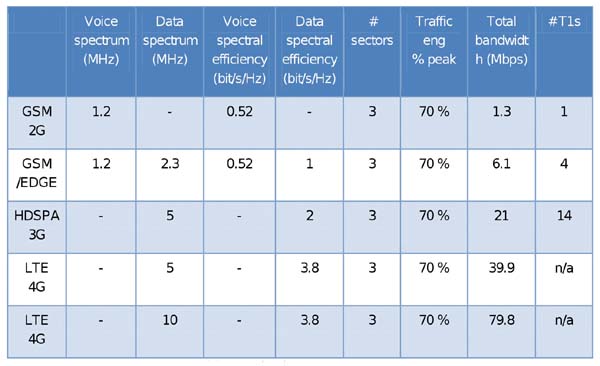
As mobile data rates increase, a corresponding increase in mobile backhaul capacity is required. As shown in the table below, a cell site carrying only GSM voice would typically need a bandwidth of approximately 1.3 Mbps. Bandwidth requirements for a cell site based on the 2.75G EDGE architecture would increase to approximately 6 Mbps, 3G requires around 21 Mbps, and LTE would need as much as 80 Mbps. If a mobile operator has more spectrum available or uses MIMO antennas to increase capacity, then backhaul requirements would increase even further.
Traditionally, base stations are linked to their core networks with leased T1/E1 lines (the North American T1 rate is equivalent to 1.544 Mbps and the European E1 rate is equivalent to 2.048 Mbps). For many years, when an operator needed more capacity, it simply provisioned more leased lines. With LTE, this approach will no longer suffice.
Mobile network operators are already under financial pressure. Over the past decade, they have invested heavily in deploying 3G networks. It is natural that they are looking to minimize further investment in LTE network deployment to meet the growing demand for mobile bandwidth. Therefore, mobile operators will need to leverage existing infrastructure whenever possible.
The cheapest option is to use their own installed connections, but, as we have seen, the dramatic increase in backhaul requirements generated by LTE makes this an unfeasible policy.
Some operators are already using fiber optics to connect mobile base stations. When a new connection is required, it makes sense to install fiber optics. Fiber optics has virtually unlimited capacity and can support future upgrades without the need for new cables.
Fiber optic networks employ one of two basic architectures: point-to-point (P2P) systems or point-to-multipoint (P2MP) systems, commonly known as passive optical networks (PON).
Peer-to-peer (P2P) networks are generally Ethernet-based networks with bidirectional capacity of 100 Mbps or 1 Gbps.
There are several different PON standards. The primary choice worldwide is Gigabit Passive Optical Network (GPON), which offers 2.488 Gbps of downstream bandwidth and 1.244 Gbps of upstream bandwidth. A 10-Gbps upgrade to GPON, called XG-PON1, is also available, offering 10 Gbps of downstream bandwidth and 2.488 Gbps of upstream bandwidth over the same configuration. Future standards will enable these systems to operate at 40 Gbps. Fiber optics also supports Radio over Fiber (ROF) technology, which allows the use of small, low-cost base stations in cellular systems. ROF systems are now widely used to improve cellular coverage inside buildings, such as office buildings, shopping malls, and airport terminals.
In ROF systems, wireless signals are carried optically between the central station and the base station before being radiated through the air. The light is modulated directly by a radio signal and then transmitted through the optical fiber. (Although radio-over-fiber transmission can be used for other purposes, such as in cable television networks, the term RoF is generally applied when this technique is used for wireless access.).
The RoF architecture uses a high-frequency radio frequency (RF) signal (typically above 10 GHz) imposed on a light wave. This allows wireless signals to be optically distributed to base stations directly at high frequencies and converted from the optical to the electrical domain at the base stations before being amplified and radiated by an antenna. No up/down frequency conversion is required at the various base stations, resulting in a simple and cost-effective base station deployment.
RoF is fundamentally an analog transmission system, as it distributes the radio waveform directly at the radio carrier frequency from a central unit to a radio access point. RoF supports broadband signals such as UMTS and WiMAX. (Note that although this transmission system is analog, the radio signals are still digital.).
The Role of Wi-Fi Technology in This New World.
Up to now, we've been talking about mobile communications and, in particular, the growth of the mobile network. So, what is the role of Wi-Fi technology in this new world?
It's clear that Wi-Fi has an important role to play, especially in buildings where it's used for distributing residential and business broadband signals to homes and offices. Studies on mobile data usage show that a large number of people use their phones at home. Therefore, the industry has developed software that allows users to seamlessly switch between mobile and Wi-Fi networks, enabling consumers to benefit from lower data usage costs while reducing the load on the mobile network.
The other integrated benefit is for the user, who effectively has mobile access within the building, instead of being limited by fixed wired systems. As more and more devices, such as smartphones and tablets, only have wireless interfaces, the option to connect directly to a fixed telephone network is no longer available, and therefore wireless becomes the only option.
Mobile operators can also extend coverage inside buildings with femtocells—tiny base stations that can communicate with a mobile device over a range of up to 10 meters, with the home broadband network providing backhaul. A hybrid device that combines both Wi-Fi and femtocell technology offers the best of both worlds.
Wi-Fi is becoming increasingly popular outside of buildings, particularly in areas with high demand for mobile services. Wireless networks are appearing in many major cities, offering users the opportunity to switch off their mobile networks for cheaper and faster download speeds.
Other areas seeing the benefits of Wi-Fi are rural regions where the cost of building an FTTH/FTTB network can be prohibitive, while Wi-Fi equipment is cheaper and relatively easy to install.
However, as with any mobile communications network, Wi-Fi networks still need data backhaul to the primary or core network, and therefore the problem of providing adequate backhaul capacity remains applicable.

The capacity of Wi-Fi networks will soon be diluted if copper-based telephone networks are used to provide backhaul. A typical example of this would be a city café offering free internet access, where the Wi-Fi network provides 54 Mbps, but the building's broadband connection only reaches 24 Mbps (downstream). Wi-Fi networks will also need fiber optic backhaul to keep pace with the growing demand for consumer data.
Conclusions:
Mobile service providers are seeing a surge in data traffic across their networks from users who increasingly expect easier access to data-intensive online services without being tied to a fixed location. The greater availability of mobile broadband services, coupled with the proliferation of dual-mode 3G and Wi-Fi smartphones, affordable data plan prices, and new online services, has fueled the growth of wireless user data traffic. Mobile broadband
networks have evolved over time, but they have now reached the point of saturation, necessitating a thorough overhaul to ensure they are robust enough to support future demand. This presents a dilemma: having invested so heavily in the past, mobile network operators have little incentive to undertake another round of substantial capital investment, yet the existing infrastructure will struggle to meet demand.
The answer lies in network improvements and the exploitation of fiber infrastructure for wireless backhaul, which can provide the very high bandwidth capacity needed to meet ongoing growth, making it an ideal medium for a robust and future-proof network.
There are obvious synergies between building fiber-based access networks and fixed-line telephony and wireless backhaul. One example is the Swedish city of Stockholm, which already supports two LTE mobile operators and has a third on the way, believed to be a direct result of the citywide availability of fiber optics.
In our opinion, wireless technology should be considered complementary to fiber optics, rather than a competing technology, with the following considerations:
• Wireless networks in all their forms should be promoted for their strengths—nomadic computing and networking with limited service and bit rate requirements—and not as direct replacements for demanding residential and business connections. Legacy wireless networks will struggle to meet large data transmission demands, especially when multiple users share the network.
• An exception to this general rule is service in very sparsely populated areas where deploying new wired networks may not be commercially viable. In these areas, coverage with wireless access networks can be provided relatively quickly and at a relatively low cost, at least during a transitional period.
• When combined with wireless networks, wired services can provide alternative backhaul capabilities to meet the increasing demand for mobile data.
The question for mobile network operators is how to provide a service that meets broadband market demand while maximizing return on investment. To answer this question, we've come full circle: to provide a mobile service that offers the highest bandwidth for backhaul, a fiber optic infrastructure is essential.
If fiber optic infrastructure already exists, then it makes sense to use it to minimize capital expenditures. If it's a new build, then deploying fiber infrastructure will be capital-intensive, so it must be done in a way that minimizes costs. There's a compelling argument for capital sharing by deploying FTTH for fixed broadband access and mobile backhaul simultaneously.
References
1. Chris Ziegler (2011), 2G, 3G, 4G, and Everything in Between: An Engadget Wireless Primer: http://www.engadget.com/2011/01/17/2g-3g-4g-and-everything-in-between-an-engadget-wireless-prim/
2. Terrence P. McGarty (2005), Broadband Alternatives, Synergies of Fiber and Wireless: http://www.telmarc.com/Docu-ments/Papers/2005%2010%2006%20Broadband%20Alternatives%2002.pdf
3. Cisco and/or its affiliates (2011), Broadband Access in the 21st Century: Applications, Services, and Technologies: http://www.cisco.com/en/US/solutions/collateral/ns341/ns525/white_paper_c11-690395.html
4. Cisco (2012), Visual Networking Index: http://www.cisco.com/en/US/solutions/collateral/ns341/ns525/ns537/ns705/ns827/white_paper_c11481360_ns827_Networking_Solutions_White_Paper.html
5. IDATE Consulting (2012), FTTH: The Solution for Mobile Broadband, study on behalf of the FTTH Council Europe and FTTH Council APAC
6. Cisco (2012), 802.11ac: The Fifth Generation of Wi-Fi Technical White Paper http://www.cisco.com/en/US/prod/collateral/wireless/ps5678/ps11983/white_paper_c11-713103.html
7. Fujitsu (2009), 4G Impacts to Mobile Backhaul: http://www.fujitsu.com/downloads/TEL/fnc/whitepapers/4Gimpacts.pdf
8. Rysavy Research for 4G Americas (2012), Mobile Broadband Explosion: http://www.4gamericas.org/documents/4G%20Americas%20Mobile%20Broadband%20Explosion%20August%2020121.pdf
Author:
Contributors: Stephen Hough - Sterlite Technologies Ltd, José Salgado - PT Inovação Jim Crowfoot -
Senko Advanced Components, Didi Ivancovsky - Broadcom Wolfgang Fischer -
Cisco Pauline Rigby - freelance editor.