Research into improving optical fibers is key to enabling progress in numerous photonic applications. Above all, it would improve internet performance, which relies heavily on optical fibers for data transmission, where current technology is beginning to reach its limits.
A small portion of the light emitted into an optical fiber is reflected back as it propagates, a process known as backscattering. This backscattering is generally undesirable because it attenuates the signals propagating through the optical fiber and limits the performance of many fiber-based devices, such as the fiber optic gyroscopes used in aircraft, submarines, and spacecraft.
However, the ability to reliably and accurately measure backscatter can be beneficial in other cases, such as characterizing installed fiber optic cables, where backscatter is used to monitor the condition of a cable and identify the location of any breaks along its length.
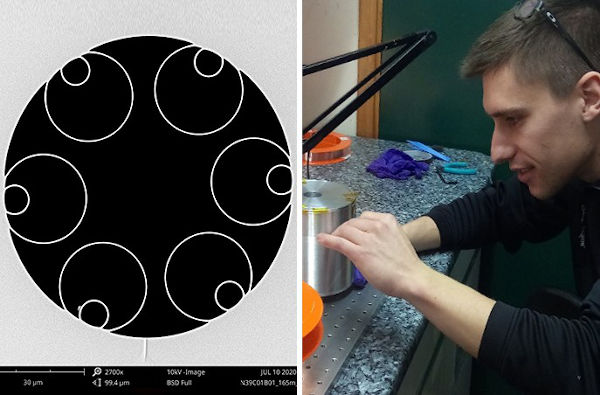
The latest generation of nodule-free antiresonant hollow fibers (NANF), pioneered by the Southampton-led LightPipe research program and applied to new fields of application within the Airguide Photonics program, exhibits such low backscatter that it could not be measured until now.
To solve this problem, researchers from the Optoelectronics Research Centre (ORC) at the University of Southampton teamed up with colleagues from the Centre for Optics, Photonics and Lasers (COPL) at Quebec Laval University, who specialize in research on high-sensitivity optical instrumentation.
They developed an instrument that allowed the team to reliably measure the extremely weak backscattered signals in the latest hollow-core fibers manufactured by ORC, confirming that the dispersion is more than four orders of magnitude lower than in standard fibers, in line with theoretical expectations.
Professor Radan Slavik, head of the Optical Coherent Signals Group at the ORC, says: “I am very fortunate to work at the ORC, where the long-term, world-class research of my design and manufacturing colleagues has resulted in the lowest loss, longest hollow-core fibers ever made. My work has focused on measuring the unique properties of these fibers, which is often challenging and requires collaborations with world-leading measurement groups, such as the UK’s National Physical Laboratory, and instrumentation groups, such as Université Laval.”.
Dr. Eric Numkam Fokoua, who carried out the theoretical analysis at ORC to support these results, states: "The experimental confirmation of our theoretical prediction that backscatter is 10,000 times lower in our latest hollow fibers than in standard all-glass fibers demonstrates their superiority for many optical fiber applications.
"Furthermore, the ability to measure such low backscatter signal levels is also fundamental to the development of hollow fiber technology itself, as it provides a critical pathway for detecting distributed faults in manufactured hollow fibers and cables, as needed to drive improvements in their manufacturing processes. Current technology is simply not sensitive enough to work with these radical new fibers, and this work demonstrates a solution to this problem.".