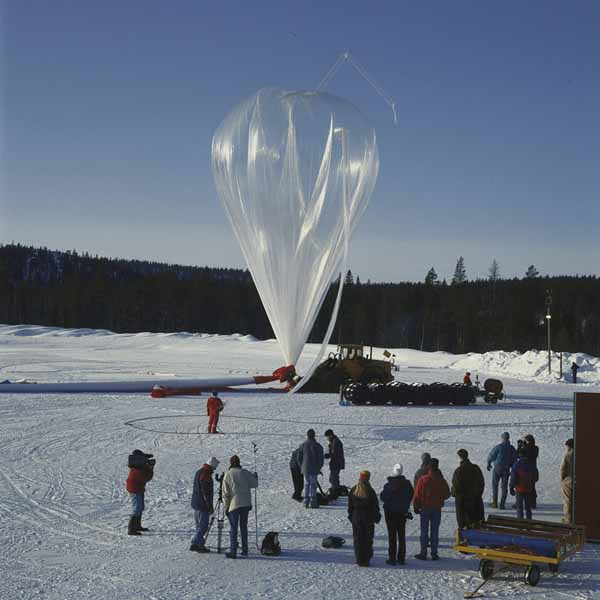
Once the tests were completed, the 100,000-cubic-meter balloon was lowered by three parachutes. The Esrange Space Centre has launched more than 550 stratospheric balloons since 1974. A new feature of this launch was the integration of an Axis Communications network camera, specifically an AXIS Q-6034-E, into one of the parachutes. This allowed researchers to validate the parachute system's operation and the balloon's landing from Earth with high-quality, real-time images. The balloon finally landed in northern Finland, requiring the wireless network to reach a range of 400 kilometers.
“Axis’s outdoor-ready video solutions are designed to withstand extreme weather conditions and provide reliable remote monitoring at all times. Being able to manage and deliver images in -73°C conditions for three hours, with a minimum temperature reaching -90°C, is truly satisfying and demonstrates the robustness of our products,” said Erik Frännlid, Director of Product Management at Axis Communications.
Researchers at the Esrange Space Centre were very pleased with the test. “The ability to see images of what is happening in real time, combined with other recorded data, is very valuable to us and allows us to evaluate how the parachutes behave and where the balloon lands. This will enable us to perform more reliable and safer landings,” explained Per Baldemar, head of the launch team at the Rocket & Balloon Systems Division of the Swedish Space Corporation.
Apollo and Alcatel-Lucent break the speed barrier in underwater communications networks
Apollo and Alcatel-Lucent have announced an industry milestone: a successful demonstration of data transmission at approximately 3 terabits per second (Tbit/s), based on 40 Gbit/s channels, per fiber pair in a submarine network. Apollo is a...