On July 7, 2025, ESA marked a historic milestone by establishing its first optical communication link with a spacecraft in deep space. The link was established with NASA’s Deep Space Optical Communications (DSOC) experiment aboard its Psyche mission, which is currently at a distance of 1.8 astronomical units, approximately 265 million kilometers.
This is the first of four links planned for this summer.
This achievement marks another milestone in the long history of mutual support between space agencies, and demonstrates the potential for interoperability between ESA and NASA in the field of optical communications, something that until now had only been achieved with radio frequency systems.
“The first successful demonstration of optical communication in deep space with a European ground segment represents a real leap forward in bringing high-speed, terrestrial-like connectivity to our spacecraft in deep space. This joint achievement, together with our colleagues and partners in industry and academia, ESA’s Technology Directorate, and NASA/JPL, underscores the importance of international cooperation,” says Rolf Densing, ESA’s Director of Operations.
"It's an incredible success. After years of technological advancements, international standardization efforts, and the adoption of innovative engineering solutions, we have laid the foundations for the Internet in the solar system," says Mariella Spada, ESA's Head of Ground Systems Engineering and Innovation.
The transmission campaign begins in Greece, where ESA has transformed two observatories into high-precision optical ground stations.
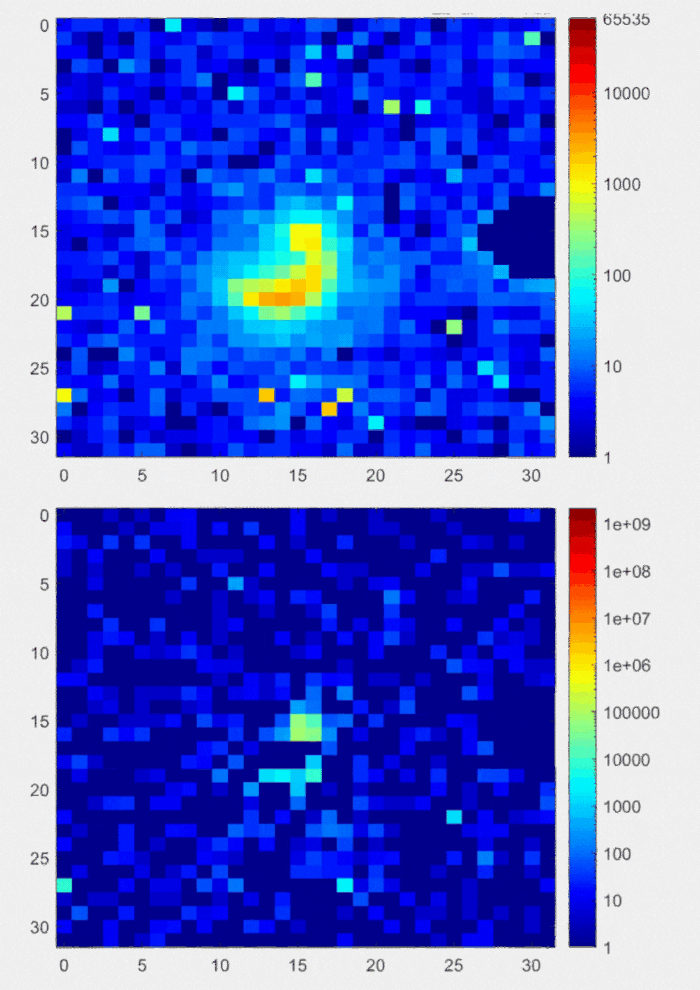
From the Kryoneri Observatory in southern Greece, a powerful laser is aimed at NASA's Psyche spacecraft. Although it doesn't carry data, the laser is designed to be so precise that the DSOC experiment aboard Psyche can lock onto it and send a return signal to Earth. That return signal is received by the Helmos Observatory, located 37 km away on the summit of a nearby mountain.
"To make this bidirectional optical exchange possible, it has been necessary to overcome two major technical challenges: developing a laser powerful enough to reach a distant spacecraft with millimeter precision and building a receiver sensitive enough to detect the faintest return signal, sometimes just a few photons, after a journey of hundreds of millions of kilometers," explains Sinda Mejri, project manager of ESA's ground-based laser receiver system.
The Aristarchus telescope at the Helmos Observatory
Mission controllers at NASA's Jet Propulsion Laboratory (JPL), which developed and manages both DSOC and Psyche, provided the spacecraft's position using powerful navigation techniques, including Delta-Differential One-Way Ranging (Delta-DOR ), a technique also used by ESA for interplanetary missions, to accurately determine the spacecraft's trajectory.
Next, flight dynamics experts at the ESA Space Operations Centre (ESOC) compensated for variables such as air density, temperature gradients, and planetary motion. This process is similar to that used in global satellite navigation systems, but with the added complexity of deep space distances and the need for ultra-precise orientation.
To ensure safety during laser transmissions, some sections of Greek airspace were temporarily closed.
The success of the link was the result of years of preparation and collaboration , during which optical transmission and reception ground stations were built.
The ground-based laser transmitter integrates five high-power lasers with ultra-precise steering controllers into a special 6-meter-long container with a lifting platform. This protects the sensitive equipment from sunlight during the day and lifts it outdoors after sunset.
The ground-based laser receiver consists of a sophisticated optical array so sensitive that it can detect individual photons. This single-photon-sensitive receiver is securely mounted on the back of the 2.3-meter Aristarchus telescope, located 2,340 meters above sea level at the Helmos Observatory.
In April, the team conducted a test campaign by sending a single low-power signal to Alphasat satellite . Located in geostationary orbit at an altitude of 36,000 km, the satellite is an ideal testbed for optical communications technologies, thanks to a custom-built optical communications terminal manufactured by the German space agency DLR.
“Despite the complexity of the task, the final installation of the lasers, electrical wiring, and cooling systems was successfully completed shortly after their delivery that same morning,” said Clemens Heese, ESA’s Head of Optical Technologies and ESA’s DSOC Demonstrator Project Manager. “Achieving laser installation and safe laser beaming into the sky in a single day is remarkable proof of the team’s precision, coordination, and dedication.”.
Moments later, the final tests allowed the team to review all procedures and conduct a live laser test to optimize timing and coordination.
Fewer than 20 people participated in the operation: 7 on Kryoneri and 12 on Helmos. Operations of the Psyche spacecraft and the DSOC flight terminal were conducted in the United States at JPL, which also sent two experts to Greece to assist with ground operations.
This demonstration is more than a technical feat. It's a glimpse into the future of deep space communications.
“Optical links promise data speeds 10 to 100 times faster than current radio frequency systems. Combining this technology with our existing radio frequency communications technology is essential for transmitting the ever-increasing volume of data from missions exploring the universe,” said Andrea Di Mira, ESA’s Ground-Based Laser Transmitter System Project Manager at ESOC.
“We are proud that ESA is participating in the Deep Space Optical Communications (DSOC) experiment aboard our Psyche mission. It is a clear example of what can be achieved through international cooperation and a glimpse into the future of deep space communications,” says Abi Biswas, DSOC project technologist at NASA’s JPL.
The success also lays the groundwork for ASSIGN (Advancing Solar System Internet and Ground) , which will be presented at the ESA Council meeting at ministerial level (CM25) in November.
"ASSIGN will aim to federate existing and future radio frequency and optical networks into a secure, resilient and interoperable network of networks for ESA missions, as well as institutional and commercial missions, and to foster the competitiveness of European industry for its implementation and future exploitation," says Mehran Sarkarati, Head of ESA's Ground Station Engineering Division and ASSIGN Programme Director.
ESA's participation in the DSOC demonstration is made possible by a consortium of European companies, including qtlabs (AT), Single Quantum (NL), GA Synopta (CH), qssys (DE), Safran Data Systems (FR) and NKT Photonics Ltd (UK), and by the National Observatory of Athens (GR), which has enabled the conversion of its Helmos and Kryoneri observatories into deep space optical ground stations and has provided the necessary infrastructure.
The project is funded by ESA's General Support Technology Programme and Technology Development Element .
Looking ahead, ESA is currently studying an electric towing capability for Mars, called "LightShip," which would transport passenger spacecraft to Mars. After dropping off the passengers, LightShip would move to a service orbit where it would provide communications and navigation services via the MARs Communication and Navigation Infrastructure (MARCONI ) payload, which will include an optical communications demonstrator as part of the roadmap to support future crewed missions.