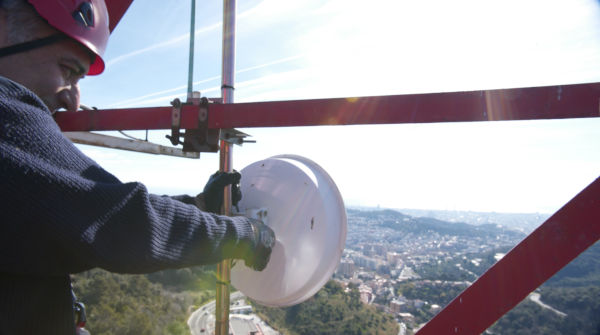
guifi.net began in 2004 in the Osona region of Catalonia. It is a grassroots project, driven by citizens and with the goal of creating a free, open, and neutral network based on a commons model. Local residents volunteered to deploy the network in various locations using radio links and routers, providing internet access to homes, offices, farms, public buildings, and more.
To give the project legal standing, the community created the “Private Foundation for the Open, Free and Neutral Network, guifi·net”. In 2008, through the guifi·net Foundation, the guifi·net project was registered as a telecommunications operator.
 The Gurb City Council has committed to deploying fiber optic cable throughout the municipality using a small, flexible, high-density conduit within the existing water infrastructure. With this system, any resident connected to the municipal water network can also access the fiber optic and internet network through any telecommunications provider willing to share this common network.
The first fiber optic rollout began in August 2009. As of November 2018, guifi·net already had more than 35,000 operational nodes, mostly in Catalonia but also in Valencia, the Balearic Islands, Madrid, Andalusia, Asturias, and the Basque Country. Currently, hundreds of homes and offices access the internet through guifi·net fiber connections, and thousands more via radio links. It is estimated that more than 50,000 people receive services through the commons-based network.
The project's governance rules define the terms and conditions under which companies can profit from operating the guifi·net network.
guifi·net is a comprehensive initiative in which stakeholders cooperate to plan, deploy, and operate the network infrastructure, which is considered a common good.
The development of this shared infrastructure generally facilitated access to quality telecommunications at reasonable prices and broadband internet connections. It also generated a collaborative economic activity model based on proximity and sustainability. The growth of the shared network infrastructure was made possible by the parallel development of guifi·net, conceived as a social project within the telecommunications sector.
The entire community participated in the project. This included volunteers working individually or through user associations and cooperatives; freelancers and professional companies that implement and maintain networks and offer commercial services through them; users who subscribe to a telecommunications service; different levels of public administration that promote the deployment of the network based on a commons-good model to serve their citizens; and private and public organizations and institutions. Among the many community networks in Europe, guifi·net appears to have the largest number of nodes and participants.
Compared to conventional telecommunications infrastructure models, guifi·net is a socially and economically effective model: socially, because it is based on non-discriminatory and open access principles (Footnote 3) that empower people and preserve infrastructure independence; and economically, because the shared commons paradigm on which it is based maximizes resource utilization (such as using existing infrastructure for fiber deployment). It also has the advantage of having many (more than 30) microservice providers competing for customers using a single shared infrastructure while simultaneously collaborating to build and maintain it.
(Footnote 3) When the network owner or administrator does not provide services for the network; these services must be supplied by a retail service provider.
Best practices in project planning
✓ Consider the plan's impact on territorial cohesion (sustainable development of the local economy).
✓ Map existing passive public infrastructure (poles, conduits) and examine whether and under what conditions it can be used.
✓ Consider the types of measures adopted to leverage synergies between different infrastructures and establish cooperation among relevant stakeholders in terms of construction and investment in high-capacity infrastructure.
✓ Consider the scalability, robustness, resilience, and ease of maintenance of the infrastructure.
✓ Consider the direct and indirect socioeconomic impacts achieved by the project, including the impact on the accessibility of services for end users, taking into account the quality of services offered (e.g., price/quality; price/speed).
✓ Pay attention to project coordination and management.
This project demonstrates that a complex and ambitious endeavor can succeed when its three main components – technological, economic, and social – are managed coherently.
* Internet Exchange Point (IXP): The physical infrastructure through which Internet Service Providers (ISPs) and Content Delivery Networks (CDNs) exchange Internet traffic between their networks.
** A telecommunications company established as a former monopoly that still holds a dominant market share. Source (https://ec.europa.eu/newsroom/dae/document.cfm?doc_id=66461)
Núria Coromina, nuria.coromina@guifi·net (formerly Roger Baig, Project Manager)
+34 660134419 (formerly +34 607326657)
nuria.coromina@guifi·net (formerly roger.baig@guifi·net)
https://fundacio.guifi·net/es_ES (in English https://fundacio.guifi·net/en_US/)