PRIME-6G (Pilot for Resilient Industrial Manufacturing Environments with 6G Technologies), a €7.76 million project funded by the European Union under the Horizon Europe program through the Smart Networks and Services Joint Undertaking (SNS JU), has officially launched. This pioneering initiative, in which IMDEA Networks is participating, aims to bring next-generation 6G technologies to real-world industrial manufacturing environments, laying the foundation for a new generation of smart manufacturing.
PRIME-6G aims to accelerate the adoption of next-generation 6G technologies in industrial manufacturing by developing and validating a platform that integrates 6G connectivity, artificial intelligence, robotics, cloud-edge computing, and real-time sensing.
PRIME-6G (Pilot for Resilient Industrial Manufacturing Environments with 6G Technologies), a €7.76 million project funded by the European Union under the Horizon Europe program through the Smart Networks and Services Joint Undertaking (SNS JU), has officially launched. This pioneering initiative, in which IMDEA Networks is participating, aims to bring next-generation 6G technologies to real-world industrial manufacturing environments, laying the foundation for a new generation of smart manufacturing.
Shaping the Future of Smart Manufacturing:
Factories are constantly evolving, but the pace and complexity of this transformation are accelerating. Legacy infrastructures, fragmented systems, and connectivity limitations continue to hinder manufacturing environments from reaching their full potential.
PRIME-6G envisions a future where factories become fully interconnected, autonomous, and adaptive ecosystems, powered by seamless 6G communications. By combining deterministic communications, industrial automation, and computational intelligence, the project will help develop more flexible, sustainable, and people-centric manufacturing, capable of responding in real time to operational challenges, production variability, and emerging market needs.
Over the next 30 months, PRIME-6G will develop a comprehensive and sustainable cloud-edge continuous platform that will enable the agile and transparent deployment of services in smart manufacturing environments. The platform will integrate 6G connectivity, AI-based optimization, cloud-edge computing, robotics, and real-time sensing capabilities into a system designed for reliable and efficient operation.
PRIME-6G Concept and Vision
: Pilot Demonstrations - From Lab to Factory.
The development of PRIME-6G is structured as a progression from controlled laboratory environments to a fully integrated industrial demonstrator in a real-world setting.
The project revolves around two complementary use cases: AURORA (Advanced Unified Robotics Operations via Resilient Automation) and SENTINEL (Sensing-Enhanced Network Twin for Intelligent Environments in Manufacturing). Its key technologies will be developed and validated at Technology Readiness Levels (TRLs) 5-6 in two partner laboratories: NEXTONIC in Madrid and Siemens AG's facilities in Munich, respectively.
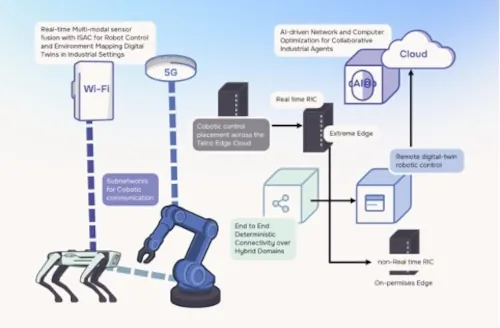
AURORA investigates how deterministic 6G connectivity can reliably connect virtualized robotic control systems with industrial robots, meeting the stringent latency and reliability requirements of real-time automation. It achieves this by combining AI-based network management, collaborative robot subnetworks, digital twins, and AI agents that optimize control location and resource allocation, enabling more agile, autonomous, and scalable industrial automation.
“In PRIME-6G, IMDEA Networks is leading the SENTINEL use case, where we are using 6G sensing capabilities to build a real-time digital twin of the production plant without needing to deploy dedicated sensor infrastructure. By reusing the existing communications network to perceive the environment, we can significantly improve the safety and efficiency of human-robot collaboration in manufacturing. This is a clear example of how 6G goes beyond connectivity to become a key enabler of smart industrial systems,” explains Joerg Widmer, Research Director at IMDEA Networks and principal investigator of the project at the institute.
SENTINEL (Sensing-Enhanced Network Twin for Intelligent Environments in Manufacturing) uses multi-sensor fusion to build real-time digital twins of dynamic industrial environments. By repurposing existing 5G/6G infrastructure for continuous environmental monitoring, SENTINEL improves situational awareness, optimizes robot coordination, and reduces the need to deploy specific sensors, contributing to smarter, safer, and more efficient factories.
Both use cases, AURORA and SENTINEL, will be integrated into a unified platform with a Technology Readiness Level (TRL) of 6-7 at ARENA2036 (Stuttgart), one of Europe's leading research centers for smart manufacturing. There, they will demonstrate how 6G-enabled autonomous logistics and real-time environmental sensing can function as a single, coherent system in a real-world industrial environment.
A European consortium united by a common vision,
PRIME-6G brings together 13 partners from six European countries, combining expertise in telecommunications, industrial automation, artificial intelligence, robotics, and research.
The project is coordinated by Carlos III University of Madrid (Spain) and includes the participation of ARENA2036 eV (Germany), AUSTRALO (Estonia), the Centre Tecnològic de Telecomunicacions de Catalunya (Spain), Fivecomm (Spain), IMDEA Networks (Spain), InCites Consulting (Luxembourg), Nokia (Hungary), Robotnik Automation (Spain), Siemens AG (Germany), Telefónica (Spain), The Laude Technology Company (Spain), and the University of Amsterdam (Netherlands).