
According to Widmer, the project has been successful primarily for three reasons. The first has been the close collaboration between the project partners—the Wireless Networking Group at the IMDEA Networks Institute and the research groups at Carlos III University of Madrid and the University of Alcalá—and the project's synergy with other ongoing research. The second has been the prototype used to demonstrate the real-world advantages of the proposed solutions. The third, in his opinion, is that the researchers focused on formulating the right research questions and rigorously designing the experiments based on the ambitious vision of the project established from the outset. The results of this research have been published in leading scientific journals and presented at conferences.
The prototype presented some of the project's biggest challenges, says Widmer. “Designing the prototype really tested both our team and our technology. We had to be incredibly patient, persistent, and work incredibly hard, but ultimately, we were able to develop and test the correct operation of platforms such as location system testbeds, openVLC, a D2D mobile network prototype based on a field-programmable gate array (FPGA), and openLEON.”
Researchers at IMDEA Networks have made pioneering contributions in the fields of millimeter waves, visible light communications (VLC), and device-to-device (D2D) communications. Widmer explains, “These technologies represent alternative solutions to increasingly frequent traffic demands that are now challenging legacy solutions in sub-6GHz bands.” We have also been able to pioneer techniques for measuring and predicting future mobile network traffic demands in order to optimize network resource utilization.”
The work in the scientific research areas addressed by TIGRE5-CM will now continue with the TAPIR-CM project, which aims to design 5G network architecture solutions based on artificial intelligence and machine learning.
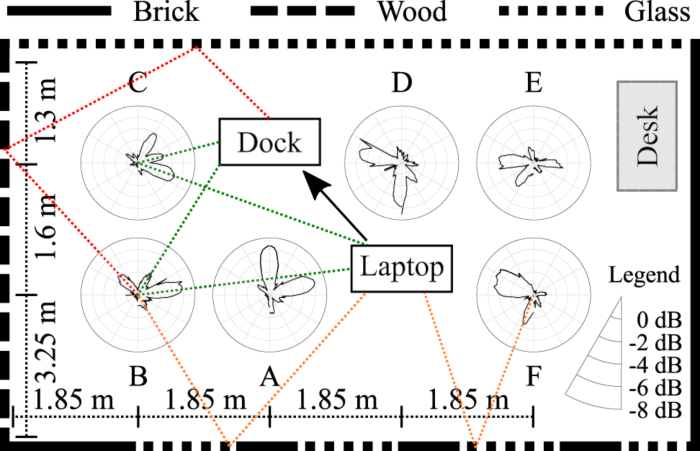
Figure 1: Analysis of the impact of reflection patterns in a realistic millimeter-wave wireless setup (conference room). The dotted lines show examples of line-of-sight paths, as well as first- and second-order reflections. The TIGRE5-CM results highlight that these second-order reflections can still be strong; therefore, MAC layer designs should take advantage of them to improve system performance.
Figure 2: Data transmission through a millimeter-wave channel exclusively via a reflected path. Note that the angular energy profile does not include any lobes in the line-of-sight propagation path.
Additional Sources:
Project website: http://www.tigre5-cm.es/.
IMDEA Networks research projects: TIGRE5-CM.
WNG-IMDEA Networks Group: http://wireless.networks.imdea.org.
Bibliographic References:
Claudio Fiandrino, Hany Assasa, Paolo Casari, Joerg Widmer (January 2019)
Scaling Millimeter-Wave Networks to Dense Deployments and Dynamic Environments (Accepted for publication) [PDF ]
Proceedings of the IEEE. IEEE. ISSN 0018-9219.
Guillermo Bielsa, Adrian Loch, Irene Tejado, Thomas Nitsche, Joerg Widmer (October 2018)
60 GHz Networking: Mobility, Beamforming, and Frame Level Operation From Theory to Practice
(Accepted for publication) [PDF ]
IEEE Transactions on Mobile Computing. IEEE Communications Society. ISSN 1536-1233.