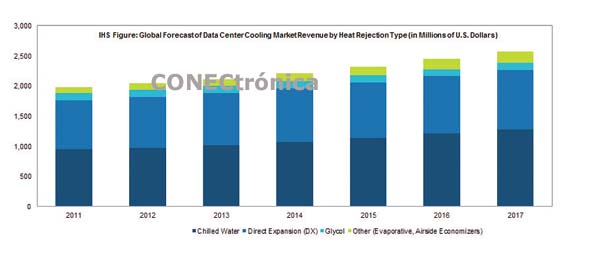
 These savings are becoming critical, as operating expenses within data centers continue to rise, due not only to increased power density, but also to the growing importance of IT operations in business activities, according to the report titled “World Market for Data Center Cooling- 2013 Edition”.
“Cooling equipment generally accounts for 30 to 50 percent of the total energy consumption of a typical data center,” says Andrés Gallardo, research analyst for data centers and critical infrastructure at IHS. “The equipment is necessary to operate a data center, but it doesn’t have a direct impact on a company’s revenue. However, cost-reduction strategies could significantly reduce this expense and allow companies to allocate resources to revenue-generating activities.”.
Meanwhile, emerging cooling technologies are expected to grow at nearly three times the forecast rate of the overall data center cooling market, even though they still represent only a small portion of the market. These technologies include water and air economizers, evaporative and adiabatic cooling, and custom air controllers.
“Call them what you will, the fact is that data center managers and designers are looking for ways to reduce operating costs,” Gallardo added. “This is just the tip of the iceberg, and that’s why the installed base is so low. The ‘meat-locker’ mentality is starting to disappear, and people are realizing that it’s possible to reliably run a data center at 72 degrees Fahrenheit, or even 90 degrees—as opposed to 50 degrees. These technologies could eventually reach the mainstream.”.
The Americas and EMEA regions have a compound annual growth rate slightly above the market average, driven by the adoption of new technologies in the United States and Western Europe. Growth in the US will be fueled by the latest standards published by the American Society of Heating, Refrigerating and Air-Conditioning Engineers (ASHRAE). ASHRAE's current standard, 90.1, mandates the adoption of data center cooling-free technologies. The group is currently working on a new standard that will not require the use of a specific technology, but rather allow data center operators to choose their preferred method for improving power usage effectiveness (PUE) in a data center.
“While it may seem contradictory to think that the new standard will help emerging technologies, the truth is that the emphasis on PUE will require data centers to be more creative in their server cooling strategies,” Gallardo continued. “This will translate into growth for other emerging technologies, such as adiabatic cooling, or even niche technologies like immersion cooling. Furthermore, this measure will be easier to implement, so local jurisdictions will adopt this standard sooner.”.