An architecture that can add or change content while processing large volumes of IoT data, without interruption. It also enables the management and processing of data in discrete units, from both people and objects, including pedestrians, vehicles, roads, and buildings, which are constantly changing in the real world. This allows for the digital replication of the situation, including other vehicles. It also offers users the flexibility to add and change services that must operate without interruption, such as real-time risk prediction for connected cars.
In the future, Fujitsu plans to roll out the service in regions outside Japan, including North America and Europe. Background: The mobility industry is currently undergoing one of the biggest transformations of the century, as the number of connected cars is expected to increase exponentially from 2020 onward. Big data from these vehicles, including images collected by car sensors and CAN bus data, will play a significant role in delivering mobility services such as traffic monitoring, mapping, and insurance, as well as in vehicle design.
Simultaneously, these systems will analyze automotive big data, which will be grouped for each service and overlap in development functions and resources, creating the need for a solution that can implement multiple services flexibly and efficiently at the same time. In this context, Fujitsu is promoting digital twin technology for the mobility space, based on the idea of digitally replicating information about vehicles and roads in real time. To create a digital twin for use in a mobility context, the multinational has launched its new data processing platform that supports the development of various services and leverages automotive big data to contribute to the realization of a safe and convenient mobile society. About the technology.
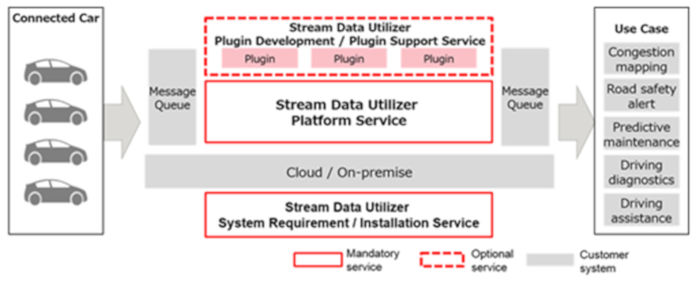
The company offers a data processing platform based on Dracena technology. Data and processing programs are managed as objects in an in-memory system(³), in a flow processing environment for pedestrians, vehicles, roads, buildings, and other real-world objects. In parallel, content can be added and modified quickly while the system is running, giving providers the ability to respond flexibly to analytics and prediction services across various use cases, while delivering safe and convenient mobility services for drivers and carriers on the road.
Following its initial availability in Japan, the solution will be subsequently implemented in North America and Europe. Success Story: By analyzing the driving conditions of each vehicle in real time, the technology creates a virtual simulation of road conditions, providing users with near-instantaneous traffic information, including congestion and driving hazards. By assessing and predicting current, past, and future conditions, the continuously flowing data is processed and the results are stored in memory. The technology offers services such as driving diagnostics and battery failure prevention, among others.
By improving existing services and adding new ones, without disrupting existing functionality, it is possible to support new services such as risk prediction for connected cars and driving assistance, which must operate continuously.
Service Details: The new platform consists of essential and miscellaneous optional services, including a service for managing and running plugins for individual objects such as pedestrians, cars, roads, and buildings; a system requirements service to gather desired functional and non-functional requirements and assist in preparing definition and systematization documents; and an installation service to build user environments according to these documents.
[1] Dracena (Dynamically Reconfigurable Asynchronous Consistent Event-processing Architecture)
Developed by Fujitsu Laboratories Ltd., is a stream processing architecture that can add or change content while processing large volumes of IoT data without stopping.
[2] Controller Area Network.
This is a type of on-board network communication method, mainly used for transmitting and receiving data, such as dashboard gauges, body and engine control, etc.
[3] In Memory System
A system that stores data in a server's memory and provides high-speed processing.