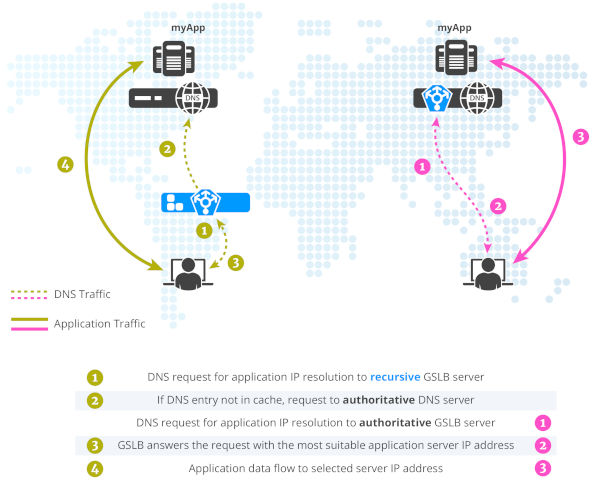
GSLB is a traffic distribution method for potentially geographically dispersed servers. By combining DNS and GSLB functionality on a single server, it reduces capital and operating expenses for businesses, simplifying deployment across the entire enterprise infrastructure. Enabling GSLB on EfficientIP DNS servers eliminates the need to move DNS domains to dedicated load balancing solutions, such as ADCs. All DNS zones and records remain in a single management system, facilitating the transition to load balancing while centralizing administration and reducing costs.
A standard GSLB relies on authoritative DNS services deployed in data centers. Implementing GSLB on recursive DNS servers adds exceptional functionality, enabling application traffic routing decisions to be made much closer to each user by allowing native geolocation.
As a result, application response times are accelerated, improving the user experience in distributed topologies with users across multiple sites. To ensure application availability, DNS GSLB includes continuous health check functionality. Consequently, load balancing strategies are enhanced, as they can be based on the current state of all application nodes and, on a per-application basis, on a more comprehensive level.
Ensure app availability and speed up response time
The fact that the perimeter GSLB can be deployed in remote locations increases resilience and expands fault detection coverage to include failures in data centers, WANs, GSLBs, and servers. This ensures disaster recovery and business continuity thanks to its automatic or manual failover capabilities.
Finally, the edge GSLB offers simplicity in implementing application traffic routing management, which is particularly important for today's multi-regional data centers and multi-cloud environments. And by adding IP Address Management (IPAM) functionality, businesses can manage their cloud and on-premises applications from a central repository, resulting in significant time and cost savings.