Meanwhile, the density of supporting infrastructure is growing rapidly, highlighting two design priorities: effective thermal management and robust shielding against electromagnetic interference (EMI). These considerations are increasingly influencing both facility architecture and equipment-level design decisions.
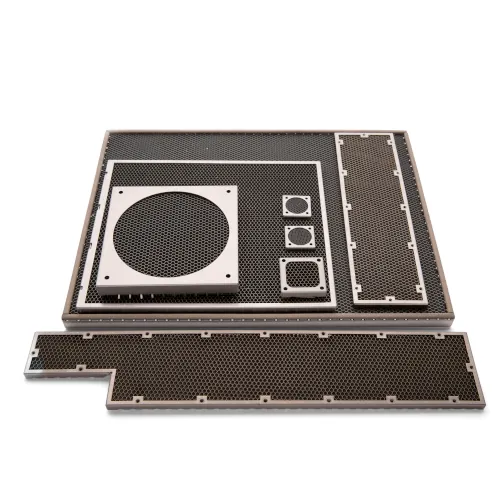
Since data centers typically handle sensitive or classified information, many incorporate secure areas and/or shielded rooms. These spaces require solutions that protect electronic equipment and information without compromising airflow or operational efficiency. EMI-shielded ventilation panels, commonly known as honeycomb ventilation panels, play a critical role in meeting these requirements. By combining high shielding effectiveness with optimal airflow performance, honeycomb ventilation panels promote both environmental control and protection against electromagnetic interference throughout the data center infrastructure, from large-scale air handling systems to plate-level cooling applications.
A Breath of Fresh Air for Data Centers:
Large data centers rely on extensive air handling and cooling systems to maintain stable operating conditions for thousands of servers and racks spread throughout the facility. These systems must simultaneously move large volumes of air efficiently while minimizing openings that create vulnerabilities to electromagnetic interference (EMI). In secure facilities or shielded rooms, even small gaps can compromise the integrity of the EMI protection. Honeycomb ventilation panels directly address this challenge.
Installed directly over these large openings, honeycomb ventilation panels maintain continuous airflow while providing effective shielding against electromagnetic interference. The honeycomb structure creates a conductive path that attenuates electromagnetic signals, preventing interference. This capability allows data centers to meet stringent shielding requirements without resorting to restrictive airflow designs that increase pressure drop or power consumption.
The inherent flexibility of the honeycomb design further enhances its suitability for use in data center environments. Panel size, panel thickness, overall dimensions, and material selection can all be tailored to meet specific performance requirements. Aluminum honeycomb vents, for example, can feature a plated surface to achieve the desired level of electrical conductivity or corrosion resistance (depending on the operating environment). Multiple panels can also be combined within a single frame to cover very large openings, enabling a scalable and modular data center design as facilities expand or undergo phased upgrades.
As an additional point of interest, the panel design with angled metal honeycombing provides line-of-sight protection. This concept preserves airflow and shielding effectiveness while preventing direct visibility into secure rooms or equipment cabinets—an important consideration in high-security data center facilities.
General Advantages:
While airflow throughout the facility is crucial, thermal management challenges become even more pronounced at the rack and board levels. Modern data centers house thousands of servers, each with densely packed motherboards, processors, memory modules, and power supplies, all of which generate significant heat. Without effective cooling, key metrics such as performance, reliability, and lifespan will be negatively impacted. The result is an increased risk of unplanned and costly downtime, as well as potential data loss concerns.
Forced air cooling remains a widely adopted and effective strategy for managing heat at the device level. Fans draw cool air through heat-generating components and expel hot air from the system, helping to maintain consistent operating temperatures. However, integrating cooling hardware introduces additional EMI considerations, especially when ventilation openings are located near sensitive electronic components.
Honeycomb vents integrate seamlessly into these configurations. Mounted directly on the server chassis, rack cabinets, or in front of board-level fans, they provide shielding against electromagnetic interference (EMI) in otherwise open spaces. By minimizing non-conductive gaps while maintaining a large open area, the vents strike a delicate balance between airflow efficiency, pressure drop, and EMI protection—a critical factor in modern data center design.
Excessive airflow restriction reduces cooling efficiency; unshielded openings increase the risk of interference. Honeycomb vents overcome both challenges simultaneously, allowing fans to efficiently distribute air around racks and circuit boards while maintaining shielding continuity throughout the equipment's lifecycle.
Quiet Life
Beyond airflow control and electromagnetic interference reduction, honeycomb ventilation panels offer an often overlooked advantage: noise reduction. Data centers are typically noisy environments, with numerous high-speed fans operating simultaneously. A single server can house multiple fans, multiplied by dozens of servers per rack and thousands of racks per facility.
Internal research by Parker Chomerics—along with customer feedback—indicates that honeycomb ventilation grilles can reduce noise from cooling and air circulation systems. In fact, preliminary data suggests reductions of between 6 and 10 dB can be achieved, a significant improvement in environments where even small decreases in noise levels can improve working conditions and reduce mental fatigue. This acoustic benefit further strengthens the argument for honeycomb ventilation grilles as a multifunctional design element, rather than a single-use component.
The Importance of Material:
Material selection plays a key role in the performance and durability of honeycomb ventilation grilles. While aluminum and metallized plastic options are readily available and viable solutions for some data centers, stainless steel offers distinct advantages for demanding applications.
Manufactured by welding stainless steel tape in a precise honeycomb pattern, these grilles provide exceptional mechanical and impact resistance. This high level of robustness reduces the risk of damage during routine maintenance tasks, such as fan replacement. In contrast, metallized plastic grilles can warp or bend, reducing airflow and cooling efficiency. Stainless steel also offers inherent corrosion resistance, eliminating the need for additional coating processes and ensuring long-term reliability under a wide range of operating conditions, including humid environments or those with temperature variations.
Another advantage is that stainless steel solutions allow for a larger open surface area (>93%) within the ventilation panel, further improving airflow characteristics compared to other options.
Continuity of Supply:
Advances in automation contribute significantly to the availability and consistency of honeycomb ventilation products. Parker Chomerics' automated and continuous manufacturing processes enable tighter tolerances, repeatable quality, and significantly reduced lead times.
Prototyping can be completed in one to two weeks, and production parts are available in four to five weeks, which is substantially faster than what other vendors offer, where the typical lead time is 20 to 25 weeks. These shorter lead times allow data center operators and equipment manufacturers to respond more quickly to evolving design requirements and implementation schedules, without delaying commissioning milestones.
A customized approach.
No two data centers are identical, nor are their thermal and electromagnetic interference (EMI) management requirements. Effective solutions depend on factors such as facility layout, security rating, airflow volumes, environmental exposure, and integration with existing infrastructure.
Therefore, a collaborative and application-specific approach is critical to project success. By working closely with customers, Parker Chomerics' experienced engineering teams can develop bespoke honeycomb ventilation solutions that precisely meet dimensional constraints, shielding effectiveness targets, assembly methods, and environmental protection requirements. This level of customization ensures that the solutions support overall system performance rather than imposing compromises in other areas of the design.
As data centers continue to grow in size, complexity, and importance, the adoption of multi-functional system solutions becomes increasingly relevant. Honeycomb ventilation grilles exemplify this trend, offering airflow management, electromagnetic interference (EMI) protection, acoustic benefits, and mechanical durability in a single, adaptable solution. For secure, high-performance data center environments, they are an integral part of a resilient, future-proof infrastructure.
More information at: EMI Armoring - Chomerics Division | Parker USA.
Author: Ben Nudelman, Global Marketing Director at Parker Chomerics
About Chomerics:
Chomerics is a division of Parker Hannifin Corporation and part of its Engineering Materials Group. It is a global leader in the development and application of electrically and thermally conductive materials in electronics, transportation, and alternative energy systems. For more details, visit www.parker.com/chomerics
About Parker Hannifin:
Parker Hannifin is a Fortune 250 company and a global leader in motion and control technologies. For more than a century, the company has driven engineering advancements that lead to a better future. Learn more at www.parker.com or @parkerhannifin.