Quantum technologies can be entirely pure if they are based solely on qubits (using quantum-chips/computers, quantum-memory-with-rondeau-crystals, quantum-key-distribution/QKD, quantum-money, communications-and-information-storage with quantum cryptography, quantum-random-number-generators/QRNGs, quantum twins, quantum satellites such as China's Mozi/QUESS (Quantum-Experiments-at-Space-Scale), LEO-Eagle-1, Q-communication-channels, Q-processors/chips, Q-twins, Q-AI/Q-DL, etc.) or heterogeneous if they use both quantum (with qubits) and digital (bit-based) channels, such as quantum-digital twins, heterogeneous communications with qubits and bits, quantum-and-digital channels, quantum-and-digital-malware, quantum-satellite-networks/constellations, etc.
Post-quantum technologies based on bits (with only two states: zeros and ones/closed-off/open-on), not on qubits, try to reduce the risks of traditional technologies, for example, current cryptography by improving classical symmetric cryptosystems (AES, IDEA, 3DES, etc.) and asymmetric cryptosystems (RSA, ECC, DSA, etc.) by replacing their algorithms that are very vulnerable to quantum computing (such as factoring the product of very large prime numbers, ECC, algorithms related to discrete logarithms, etc.) with other somewhat more robust ones such as those based on lattices, Goppa codes, advanced hash functions, isogenic curves, etc., but they are not infallible.
Quantum technologies based on qubits (using photons with infinite states) consistently outperform post-quantum technologies based on 0/1 in speed, efficiency, reliability, confidentiality/privacy, integrity, and other factors. Two cyber threat scenarios enabled by quantum computing are: (1) Store-Today-Decrypt-Tomorrow (STDT) and Grab-Now-Decrypt-Later (HNDL), where cyber attackers massively store encrypted data to decrypt it once they have access to quantum computing infrastructure. This poses a significant threat to confidentiality. (2) Long transition periods that occur for complex systems such as Public-Key Infrastructures (PKIs) or long-life devices.
QUANTUM NETWORKS.
The term “quantum network” encompasses a set of developments that use quantum communication and computing technologies.
They can be basically classified into three categories:
(1) Extend traditional networks by including new functionalities that can only be provided by quantum components (quantum processors/chips/repeaters/quantum dot spectrometers, QRNG/quantum random number generators, quantum sensors integrated into large networks, etc.).
(2) Replace traditional and post-quantum bit-based cybersecurity functionality with quantum technologies. One example of this is QKD (Quantum Key Distribution), which replaces bit-based key generation and agreement with a qubit-based quantum approach. QKD is an integral part of quantum encryption. It is a set of protocols that enables the exchange of secret keys between two communicating parties, providing a mechanism for exchanging symmetric keys and improving cybersecurity, interoperability, transparency, effectiveness, innovation, and more. In this way, no classical or quantum cyberattack can break the cybersecurity of the ecosystem protected by QKD. Within a QKD protocol stack, quantum signals are transmitted in quantum channels. These signals encapsulate qubits that are passed between two parties, providing both ends with the ability to verify that the data/information/intelligence is legitimate and has not been altered, thus ensuring authentic and cybersecure delivery. Photons are the carriers exchanged in QKD. Some protocols used in QKD for secret key distribution include HDQKD, T12, KMB08, SRG04, and COW.
(3) Inherently quantum networks that distribute entangled quantum states between even very distant quantum devices.
Categories (1) and (3) are considered the most relevant developments. “Quantum entanglement” between distant nodes of quantum sensor networks can provide very high accuracy, effectiveness, and sensitivity. Large-scale networks (with state transfer) enable the scaling of quantum computers, helping to realize their full potential.
QUANTUM AND POST-QUANTUM CRYPTOGRAPHY. QSDC. QOTP.
In quantum cryptography, the quantum cryptographic primitive QKD (Quantum-Key-Distribution) provides an approach to ensuring cybersecurity in the post-quantum era. QKD enables uncompromising cybersecurity in the generation and sharing of secret keys. Qubits are used for encoding information, and quantum channels for secure communications. QKD algorithms are based on the principles of quantum entanglement and Heisenberg's uncertainty principle. Furthermore, any measurement of a quantum system or photon on quantum channels inevitably alters it. The use of QKD allows for the detection of any intrusion or unauthorized access.
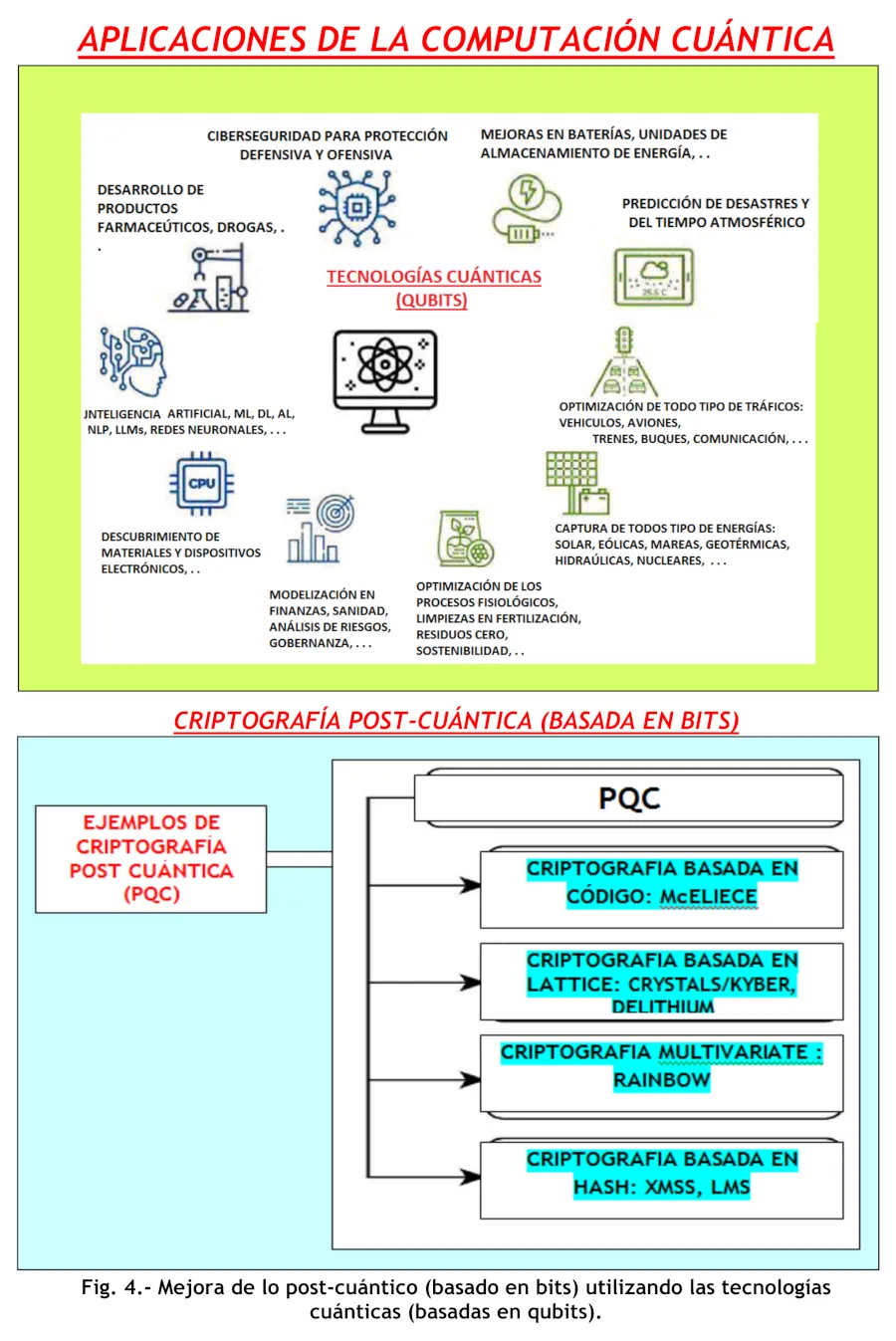
Post-quantum cryptography (PQC) is built using cryptographic algorithms with bits and more complex data manipulation techniques, as well as more difficult mathematical problems than traditional cryptography. Traditional cryptography for asymmetric encryption, such as RSA, employs the factorization of the product of two large prime numbers and can be broken with algorithms like Shor. Algorithms based on elliptic curves, discrete logarithms, and other methods can also be broken. Some traditional examples include RSA, DSA, Nbits-ECDSA, ECC, and DH. To break symmetric cryptography like AES/SHA (which uses Grover's algorithms), there are also quantum cyber threats targeting cellular communications (2.5G/3G/4G/5G/6G, etc.). Post-quantum algorithms include lattice-based cryptography (a lattice is a set of points in an N-dimensional space with a periodic structure), advanced hash function-based cryptography, isogeny-based cryptography based on supersingular elliptic curves, code-based cryptography (e.g., Goppa code, code-correcting codes like McElice, etc.), multivariate cryptography, and so on. Several classes of mathematical problems exist that could offer some resistance to cyberattacks originating from quantum computers/networks and have been used to construct public-key cryptosystems.
Quantum-Secure-Direct-Communication (QSDC) allows for the cybersecure transmission of information (under the quantum umbrella) without the need for cryptographic keys, offering the potential to provide a highly efficient and cybersecure form of communication. When parties exchange random keys instead of private information, QSDC can operate like a deterministic QKD. Unlike QKD, which focuses on constructing secure cryptographic keys, for example, for symmetric-key cryptosystems, QSDC enables the cybersecure direct transmission of quantum information between parties without the need for pre-established secret keys. While the implementation of QSDC protocols varies, the purpose is to cybersecurely transfer quantum states from one party or entity A to another B. To achieve this cybersecure communication, these methods employ the concepts of quantum entanglement or teleportation. Entity A can transmit quantum information to B (ground-to-ground/ground-to-space and vice versa, etc.) in such a way that any form of interception, such as a MITM/Man-In-The-Middle attack, of the information/data/metadata/intelligence is detectable using entangled particle characteristics or quantum entanglement "swapping" methods. QSDC maintains the secrecy and integrity of the transmitted quantum states using entanglement, teleportation, and other quantum phenomena, enabling cybersecure quantum communication for applications such as quantum cryptography and quantum computing protocols. QSDC provides direct, cybersecure communication channels that are completely resistant to eavesdropping. It eliminates the need for a prior shared key exchange, which is a requirement in protocols like QKD.
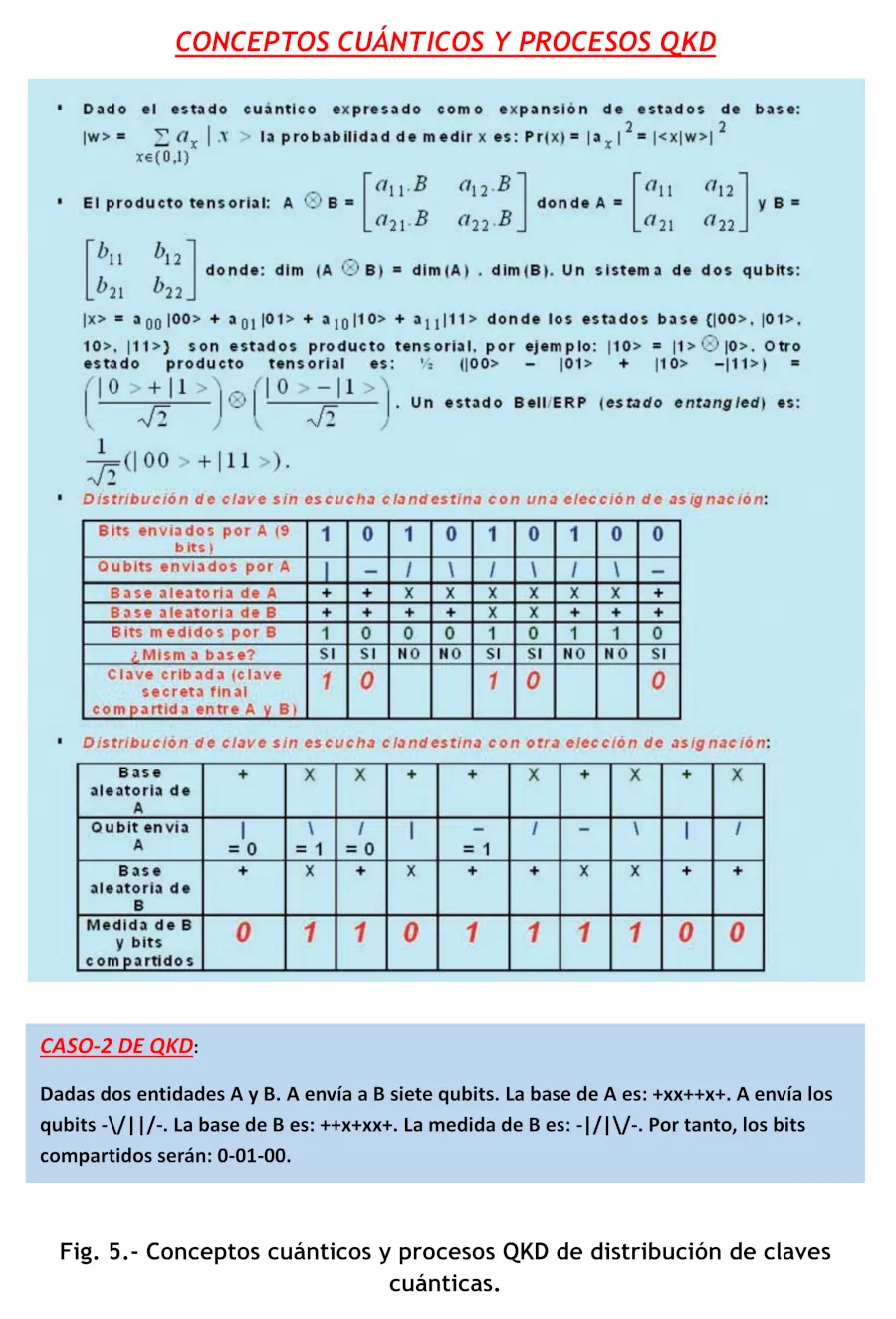
A QOTP (Quantum-One-Time-Pad) cryptosystem allows for the symmetric encryption of plaintext. It bears some resemblance to the classic bitwise OTP cryptosystem, where the goal is to encrypt a plaintext t consisting of an n-bit string. There is a shared secret key k of n bits between the two ends of the communication, and the resulting n-bit ciphertext c is obtained through the operation: c = (t+k) mod 2 = (t xor k). Decryption is performed using the expression: t = (c + k) mod 2. A QOTP cryptosystem uses as plaintext a string of n qubits |t> = |t1> . . . |tn>. It employs two n-bit strings, kyk`, as the shared secret key. The ciphertext is a string of n qubits: |c> = |c1> . . . |cn>. The encryption process is performed using the expression: |ci> = (px)^ki (pz)^ki´|ti>. The decryption process is performed using the expression: |ti> = (pz)^ki´ (px)^ki |ci> where the qubits |ti> = column matrix (ai bi) and ci = column matrix (di ei). Furthermore, (px, pz) are the Pauli matrices; the Pauli matrices are: px = 2x2 square matrix by rows: (0 1 / 1 0); pz = 2x2 square matrix by rows: (1 0 / 0 -1). The reason why the QOTP cryptosystem is absolutely cybersecure is the following: In a QOTP cryptosystem a qubit w is transmitted using a mixed quantum state: { (¼, |w>), (¼, px|w>), (¼, pz|w>), (¼, |pxpzw>) } whose density matrix is: (½ I2) which is the same as the density matrix for the mixed state { (½ , |0>), (½ , |1>)} which corresponds to the transmission of a random bit. QKD operates with algorithms such as: Two entities A and B wish to obtain a shared secret key: Entity A sends 2n bits to B, e.g., 11010010111100 (14 bits). A's quantum basis for each qubit is: +++xx+xxxx++++, B's quantum basis is: +x++x+x+xx++++, the bits received by B are: 1?0?001?111100. In this case, the correspondence of the same quantum bases has been: yes-no-yes-no-yes-yes-yes-no-yes-yes-yes-yes-yes. The bits of the sieved key are: 1- -0- -0-0-1- -1-1-1-1-0-0. The check is: yes- -no- -no-yes-no- -no-no-no-yes-yes-no. Therefore, the final shared secret key will be 7 bits: - - 0 – 0 – 1 – 111 - - 0.
QUANTUM COMPUTING
Quantum computing is an area focused on developing computer technology based on the principles of quantum physics, which explains the nature and behavior of energy and operates at the atomic/subatomic-quantum level. Current computers process data exclusively at the binary level, meaning in bits (0/1 bits). In a conventional computer, only one state can exist at a time. The only way to improve performance is to utilize the insights of quantum technology.
These laws give rise to various quantum phenomena such as teleportation, superposition of quantum states, non-cloning, quantum measurement, indistinguishability of non-orthogonal quantum states, Heisenberg uncertainty principle, quantum entanglement of states, etc. These capabilities give quantum computing unique characteristics for extremely fast computing.
Two fundamental quantum concepts attributed to Bohr-Heisenberg are:
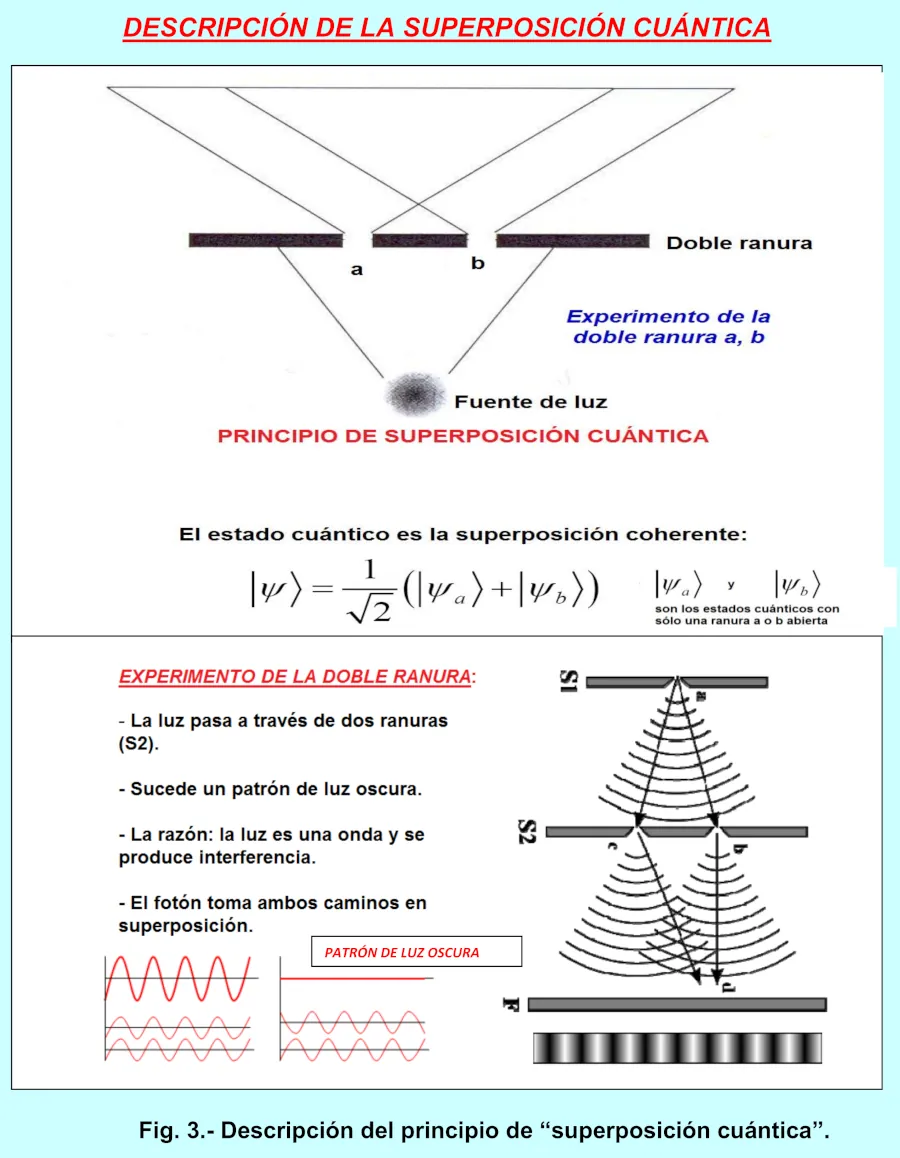
(1) An unobserved particle or system of particles exists in a state of superposition (all possible states existing at the same time).
(2) An observed particle or system of particles becomes superposition into a possible state in a randomly collapsed form. In the quantum world, a particle can be in multiple states at once; this is known as the property of quantum superposition. Typically, photons (photons have no electric charge), an electron, or any other type of subatomic particle with or without electric charge, such as protons (+), electrons (-), neutrons (0), leptons (l-mesons), positrons, bosons (gluons), quons (q-mesons), kaons (k-mesons), pions (pi-mesons), quarks (pieces of protons), etc., are used.
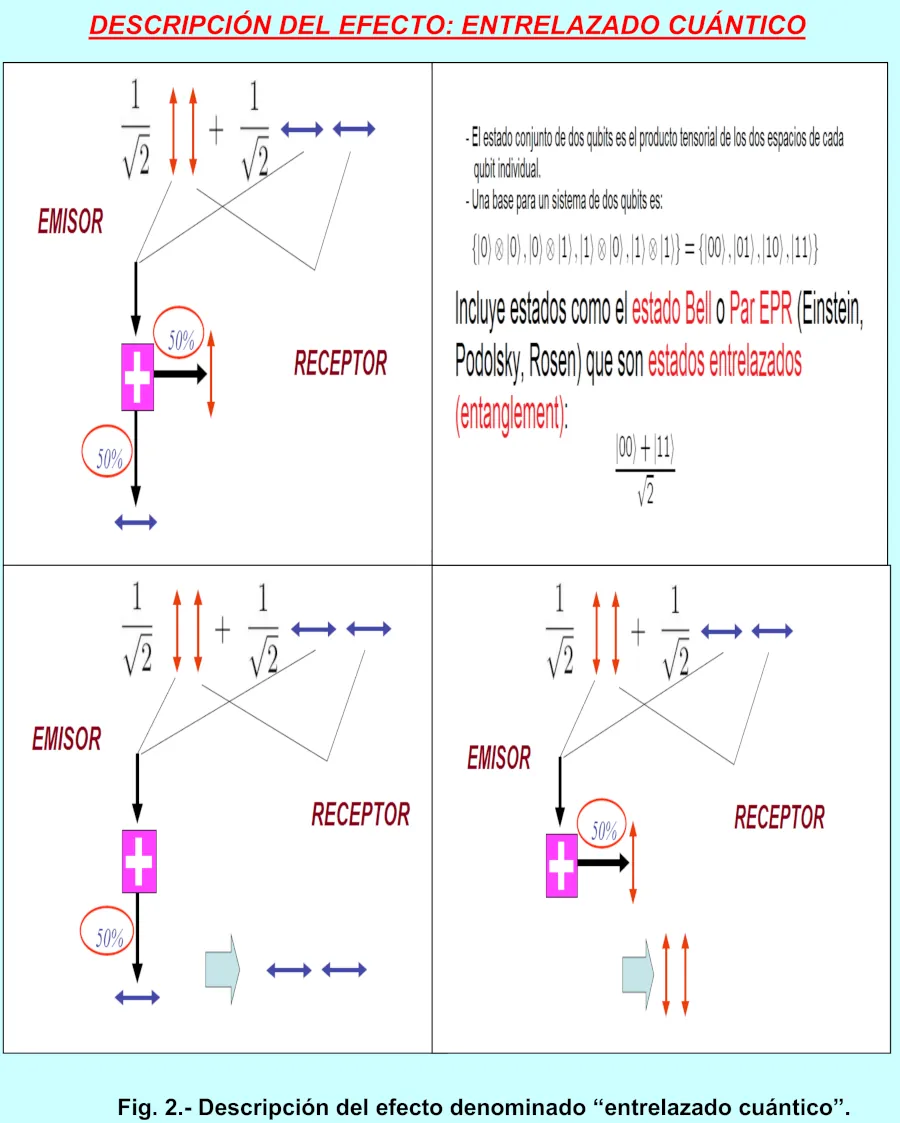
In quantum computing, these particles are called qubits. Based on this property, the same qubit can be in multiple quantum states simultaneously, where it can have a value of zero, one, or a superposition of both. This allows a single qubit to perform two computations at once, two qubits can perform four, three can perform eight, and so on. Following this pattern, the number of computations it can perform in a single stage is two raised to the power of the number N of qubits used. In current computers based on bits (0/1), only one computation can be performed at a time. To understand how particles interact with each other in the quantum world, the property of quantum entanglement is used. Two colliding photons of light create a system of particles, acting as one, having the same but opposite spin and electric charge (if the particles are charged, like the electron, which has a negative charge, or the proton, which has a positive charge, etc.). The fundamental concept of quantum entanglement is that the system of particles must maintain perfect equilibrium. A negatively charged particle must balance a positively charged particle. A particle with left-handed spin must be balanced by a particle with right-handed spin. Within a system, two particles are considered entangled regardless of their spatial separation. Measuring the quantum state of one particle will reveal the state of the other particle, regardless of their location. As a result, a change in the quantum state of one particle changes the state of the other particles, even if they are extremely far apart.
In quantum computing, this makes it possible to manipulate multiple qubits simultaneously, thus enabling extremely fast communication over very long distances and extreme computing power. An example of this property is defined in Bell's Theorem: Consider two particles A and B connected through quantum entanglement; their entanglement makes them correlated. Based on the superposition law, before measuring the state of a particle, each particle can be at ½ or -½. According to the theorem, by measuring the state of A, the state of B will also be known, and it will be the opposite of the state of particle A. Therefore, if particle A is measured as ½, then particle B will be at -½, and vice versa. This concept allows information to be communicated between the two particles. Combining the properties of superposition and entanglement results in a very powerful capability that is the basis of quantum computers. A quantum computer drastically improves the power and efficiency of a bit-based computer.
The quantum computer offers the potential to be a key exponential driver in applications such as AI (Artificial Intelligence) (ML/Machine Learning, DL/Deep Learning, Neural Networks, NLP/Natural Language Processing, ML/Machine Learning, etc.), computing, communications, and cyber-secure information storage, etc.). The capabilities of a quantum computer pose a cyber threat to current cryptography and some aspects of post-quantum/PQC. Among other areas, it affects the CIA: (1) Confidentiality (C). A cyber attacker can use an array of quantum computers to break cryptographic methods and gain access to critical/sensitive information that is stored, communicated, or processed. (2) Integrity (I). A cyber attacker can manipulate the cryptographic methods/primitives that authenticate information sources or data, allowing them to create or distribute fake communications/messages that appear legitimate (e.g., fake emails or instant messages from competent authorities with a legitimate digital signature, or modify/change sensitive information/data/intelligence in the clouds or databases of critical/essential data centers, etc.). (3) Availability (A). Cyber attackers can use quantum computers to cyberattack critical infrastructure and damage the availability (blocking/saturating, etc. with DoS/DDoS attacks) of important systems that provide essential services (energy, electricity, health, transport, industries, water, prevention of natural/artificial disasters via replicated sensors, etc.)
FINAL CONSIDERATIONS
The power of quantum computers makes current cryptography obsolete, and even some bit-based post-quantum cryptography to a degree.
A comparison between traditional and quantum computing reveals the following:
(1) In traditional computing: the basic unit of information is the bit (0/1); information processing is sequential; communication mechanisms are based on logic gates (NAND, NOR, XOR, AND, OR, NOT, etc.); “quantum entanglement”, teleportation, etc. do not exist; the growth of computing power is linear, etc.
(2) In quantum computing: the basic unit of information is the qubit (0, 1 or superposition of both); information processing is parallel via quantum superposition; communication mechanisms are based on quantum gates (unitary operations); “quantum entanglement” allows non-local correlations; the growth of computing power is exponential.
If we compare bits to qubits:
(1) Bits take values zero/0 or one/1; measurement reveals the value; bits can be copied; they behave probabilistically; strings are described as singular (local) bits.
(2) Qubits behave simultaneously as 0 and 1: a.|0> + b.|1> ; measurements perturb/modify the observed/measured values; qubits cannot be copied; strings cannot be described as unique qubits (non-local); they behave with extremely complex probabilities. Quantum physics has countless applications beyond protecting and defending all kinds of ecosystems: OT/CPS, IT, IoT (Internet of Things/IoIT (Internet of Industrial Things)/IoMT (Internet of Medical/Military Things)), QI/Quantum Internet, Q-clouds, etc., even extending to the study of quantum twins/QTs, EVP (Electronic Voice Phenomena), etc.
Quantum technologies use all kinds of channels to communicate information based on photon flows through optical fibers, air links, through water and fluids, via laser light (in all frequency spectra), through vacuum and through outer space between ground base stations, satellite networks, spacecraft, end users, etc.
Quantum technologies (based on qubits) do not trust anything or anyone; they always verify/check/monitor before, during, and after acting, preventing deception, cyber-attacks, fraud, confusion, cyber-threats, fake messages, etc. with extreme anticipation.
Quantum cybersecurity is of extreme importance both now and in the future. It possesses countless properties (some of which defy our intuition) such as teleportation, quantum entanglement, quantum superposition, the modification of everything observed and measured, etc. Qubit-based quantum cybersecurity is becoming established as highly valuable and, in certain applications, can coexist with both traditional and post-quantum bit-based cybersecurity.
REFERENCES .
- Areitio, J. “Information Security: Networks, Computing and Information Systems”. Cengage Learning-Paraninfo.2025.
- Areitio, J. “Empowering Cybersecurity/Privacy/Cyber-resilience through Quantum Technology” Revista-Conectrónica-Nº269-November/December.2025.
- Allen, TJ. “Quantum Computing: from the Series “The Science of Everything'”.Ed. Time-Sciences-Books.2025.
- Martin, R. “The Code of the Universe: How Quantum Computing will Redefine Everything”. Ed. IP-2025.
- Liu, C. “The Handy Quantum Physics Answer Book”. Ed. Visible Ink Press.2024.
- Raj, P., Herbert Song, H., Le, DN. and Vyas, N. “Quantum Machine Learning: Quantum Algorithms and Neural Networks (Quantum Computing)”-De Gruyter-2025.
- Press-2024
Amoris, A. “Quantum Computers: The New Age of Computing”.
. Zygelman, B. “A First Introduction to Quantum Computing and Information”.Ed. Springer-2024.
Author: Prof. Dr. Javier Areitio Bertolín. Director of the Networks and Systems Research Group