 Multi-layered security uses multiple distinct components, each serving a different purpose and protecting ICT infrastructures and services from different threats. The goal of a multi-layered security strategy is to ensure that each installed defensive component is not the sole protection measure for a given access point, thereby helping to mitigate any security failures or breaches.
Multi-layered security structures are characterized by the diversity of solutions used to protect connections and equipment. Designs must be tailored to the specific characteristics and needs of each company, taking into account employee location, data sensitivity, and connection quality. However, some key factors must be considered in all advanced security infrastructures: system monitoring, backup configuration, server interconnection, and access management.
Tools for optimal identity management
Digital identities contain the information and attributes that define an employee's role and grant them access to specific resources. C2 Identity is Synology's solution for protecting an organization with centralized management of devices and identities. It uses the Secure Remote Password (SRP) mutual protocol to authenticate users. SRP generates a secure encryption key each time a user logs in and provides authentication without sending password-equivalent data across the network, thus protecting against man-in attacks. User identities are further protected by enforcing strong passwords and enabling multi-factor authentication (MFA) via time-based one-time use (TOTP). Furthermore, all data is stored in high-security data centers that have achieved ISO 27001 or SOC 2 Type II certifications.
 In addition, Synology Directory Server allows you to turn a NAS into a domain controller (DC) to easily manage users, devices, groups, and domain policies.
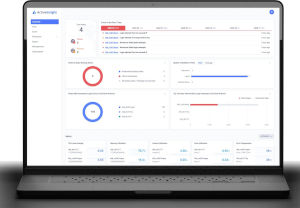
Active Insight: Activity monitoring with the advanced monitoring platform Active Insight is a cloud-hosted server management and monitoring platform. This solution helps protect Synology deployments worldwide against hardware failures, data loss, suspicious activity, software vulnerabilities, and more.
Active Insight has proven to be a powerful tool with a wide range of uses. The benefits of automated, centralized monitoring for large, distributed deployments are clear. It relies on telemetry data provided by host devices and requires no additional configuration or maintenance.
Video surveillance to ensure user safety
Synology, multi-layered security solutions and systems end-to-endin 2023, an advanced and secure video surveillance Surveillance Station 9.0solution. These cameras are designed to provide enhanced surveillance with simpler deployment options and expanded AI-powered capabilities. They enable tracking and identification through intelligent monitoring of perimeters, entry points, and key access points, detecting people (thanks to facial recognition) and vehicles (with license plate recognition), as well as intrusions. Furthermore, Deep Video Analytics (DVA), powered by GPU computing technology, expands the scope of motion detection applications, increases accuracy, and integrates multiple interactions with Surveillance Station features.
Synology C2, meanwhile, protects surveillance footage stored on your Synology NAS by enabling simultaneous cloud recording. Designed for Surveillance Station on Synology NAS, this solution ensures a remote copy of your security recordings, allowing for investigations even if the recording server is stolen or physically damaged.
 Network to revolutionize the network experience
Synology Router Manager (SRM) is the operating system that manages every router from the company. It features a best-in-class user interface, providing detailed information about what's happening on the network and helping to protect all connected devices against emerging threats. With SRM 1.3, users can secure their IT infrastructure by creating separate networks for different devices, users, and applications.
Remote work is facilitated by VPN Plus, which provides secure access to a local network from the internet and fast, stable connections for employees working remotely at any time of day. For companies with branches in different locations, Site-to-Site VPN allows resource sharing between different networks using secure IPsec tunnels.
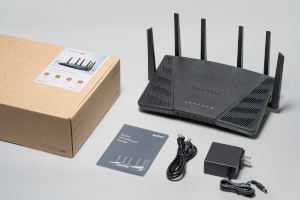
The newly launched RT6600ax router from Synology delivers high-speed, secure networks for homes and offices. It's fully equipped to handle the challenges of modern network environments, including the massive increase in connected devices and the resulting need to protect users from growing security threats. Furthermore, it features tri-band Wi-Fi to easily distribute your devices across different bands, optimizing range and performance while preventing bottlenecks.