
Answering the complex configuration question, such as determining the best RAID configuration for widely used 4-bay network-attached storage (NAS) systems, has been one of the latest projects.
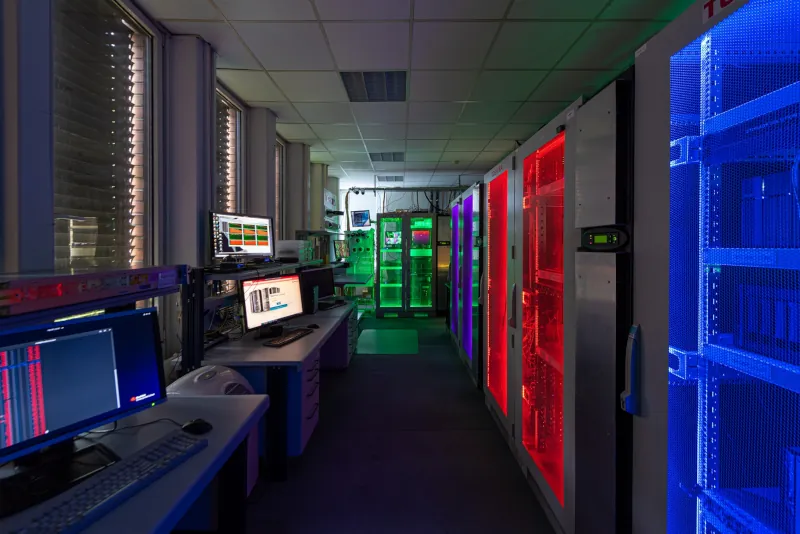
Toshiba's HDD Innovation Lab in Düsseldorf
Choosing the Right RAID:
Large enterprises and SMEs across various economic sectors use NAS systems to store data on the network and provide easy access to files. These systems contain multiple HDDs, often arranged in a RAID (Redundant Array of Independent Disks) configuration. Depending on the selected configuration, RAID technology can improve data redundancy with features such as parity or mirroring, offering greater resilience and potentially improved performance.
Configurations for 1- or 2-bay NAS systems are relatively straightforward: a single drive in a one-bay system without disk redundancy, or two drives in a two-bay system with data mirroring (RAID 1). However, the popular 4-bay NAS systems offer several configuration options. The choice of configuration, or what is considered the best RAID configuration for a 4-bay NAS system, is heavily influenced by the individual use case. To address this, the HDD Innovation Lab conducted a rigorous evaluation.

Setting up the Asustor AS5404T NAS at Toshiba's HDD Innovation Lab
Toshiba partner Asustor provided a unit of its AS5404T NAS system, a 4-bay model with 2.5GbE network connectivity. It supports up to four M.2 SSDs for caching. However, since the goal of the evaluation project was to measure the baseline performance of the HDD array in applications with a continuous data flow, the caching option was ruled out. It should be noted, however, that SSD caching improves random performance in short bursts of incoming data or repeated reads from the same location. Ultimately, though, sustained performance depends on the HDD speed and the chosen RAID configuration.
Two 256GB M.2 NVMe SSDs were installed to create Pool1 with RAID1. This Pool1 was used for the operating system, while the subsequently installed HDD Pool2 was reserved for user data. This configuration ensures that operating system disk interactions do not interfere with the storage workload.
For the test, the lab equipped the 4-bay NAS system (AS5404T) with four 8TB Toshiba N300 HDDs. The lab evaluated the three most common 4-disk configurations: RAID 5, RAID 6, and RAID 10.
For each RAID configuration, the lab configured an HDD storage pool on the NAS, waited for complete initialization, and created a thick-provisioned iSCSI block storage target, using 80% of the usable pool size. One iSCSI target was connected via the 2.5GbE network interface to an application server, and a Windows logical drive was created and populated with 2TB of test data. In a second round of benchmarking, two iSCSI targets were created in the HDD pool and connected to the application server using separate 2.5GbE connections, utilizing the full network bandwidth of the AS5404T, which has two 2.5GbE ports.
Three types of workload were evaluated: sequential writing and reading in 1MB blocks and mixed random read/write tasks.
Tested RAID Configurations:
Depending on the specific requirements of the NAS system, three techniques can be implemented in various RAID configurations. As the name suggests, “mirroring” involves copying data across multiple disks, ensuring redundancy. “Striping,” on the other hand, is a technique that divides data across multiple disks to improve performance. “Parity” is a calculated form of error checking that provides data redundancy. In the event of a drive failure, the NAS system reconstructs the lost or damaged data.
RAID 5:
In RAID 5, data is distributed across three disks, and the fourth disk contains parity information, allowing data reconstruction if a drive fails. This configuration offers 75% storage efficiency, providing 24TB of usable space with the four 8TB drives. While read speeds are fast, write speeds can be reduced because the parity must be calculated and written. During a rebuild, all parity must be recalculated, a resource-intensive process.
RAID
6, traditionally used for RAID arrays of six or more disks, stores two parity stripes, allowing the NAS system to tolerate the failure of two drives. This is useful when a second drive fails during the rebuild of a previously damaged drive. When used with only four disks, storage efficiency drops to 50%, resulting in a total usable capacity of 16TB. The increased tolerance to random drive failures may justify this choice even for systems with only four disks.
RAID 10:
A RAID 10 configuration achieves redundancy by duplicating data across pairs of disks and then distributing those duplications. This avoids resource-intensive parity calculations, but the trade-off is reduced storage efficiency, resulting in a usable capacity of 16TB. RAID 10 also tolerates the failure of two disks, but only if they do not belong to the same duplicated pair.
Identifying the best configuration
Lab tests revealed that the “best” configuration depends on the user’s primary goal: capacity, protection, or performance.
In tests using a single 2.5GbE connection, the sequential performance of RAID 5 and RAID 10 was limited by network bandwidth (~290 MB/s). RAID 6 showed slightly lower sequential write performance due to double parity calculations. Under random mixed workloads, RAID 10 performed best, followed by RAID 5 and RAID 6.
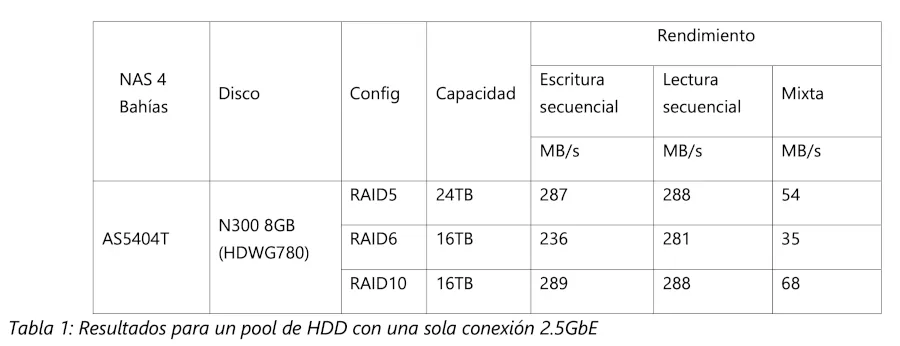
The recommendations are:
- For maximum capacity, use RAID 5, which offers 75% storage efficiency with reasonable speed and protection.
- For maximum data protection, use RAID 6; however, this comes at the cost of speed and capacity due to its tolerance of two simultaneous drive failures.
- For maximum performance in mixed workloads, use RAID 10, although this requires a compromise in capacity and protection.
The evaluation also explored the performance limits of the 4-bay NAS system using both 2.5GbE connections, overcoming network bandwidth limitations.
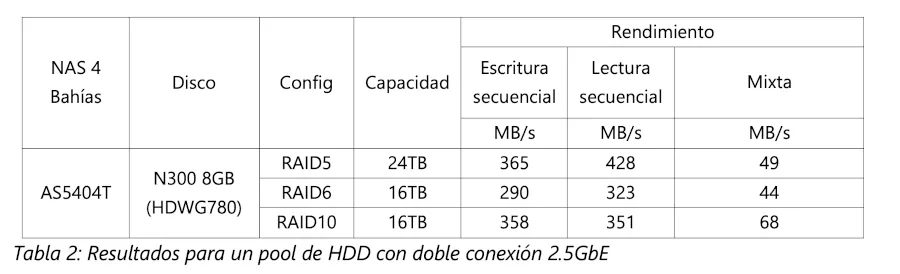
The results for RAID 5, RAID 6, and RAID 10 followed the same trends: RAID 5 for capacity, RAID 6 for protection, and RAID 10 for mixed workloads. However, the lab identified an advanced configuration that provided optimal sequential performance.
Unlocking Maximum Performance
: HDDs perform best in sequential operations; having two iSCSI blocks in the same HDD pool causes frequent seeks when both blocks are accessed simultaneously. Using two separate RAID 1 pools avoids this. This configuration, supported by the AS5404T, prevents frequent seeks. The lab created one iSCSI block per pool and connected them using separate 2.5GbE interfaces.
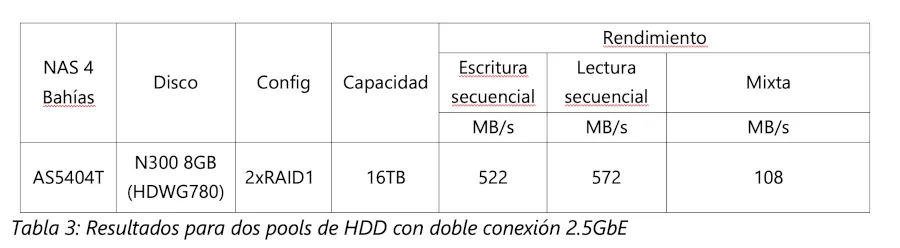
Using a 2xRAID1 configuration with dual 2.5GbE connections, the NAS system achieved sequential write speeds of 522MB/s and sequential read speeds of 572MB/s. This performance surpasses RAID10 and reaches the theoretical bandwidth of 2.5GbE. If the network and application support multiple logical storage entities, this configuration offers optimal performance while maintaining protection and capacity efficiency similar to RAID10.
Power and Cooling:
In sleep mode, without access to storage or the NAS GUI, power consumption is essentially that of the NAS processing unit, 20W. During full data operation, power consumption ranges between 50W and 60W. Both values are excellent, promoting energy efficiency and sustainability.
The AS5404T's cooling system keeps internal HDD temperatures below 50°C, even under load. While long-term HDD reliability can degrade above 45°C, longer periods of idle or sleep, at lower temperatures, help mitigate this effect. However, for continuous operation at full load, the ambient (external) temperature should not exceed 23°C to ensure the HDDs remain cool enough for maximum reliability and minimal probability of failure.
Conclusion
The Asustor AS5404T 4-bay NAS system, equipped with four Toshiba N300 HDDs, offers high capacity, solid performance, and effective protection against disk drive failures.
With a single 2.5GbE port, RAID 5/6/10 configurations saturate the network (~250 MB/s). With both ports, throughput reaches between 350 MB/s and 400 MB/s. Using two RAID 1 pools achieves more than 500 MB/s, which is the theoretical limit of dual 2.5GbE.
The unit's power consumption is relatively low (20W in sleep mode, ~50W in active mode) and the cooling is effective, keeping HDD temperatures within recommended limits for long-term reliability.
Toshiba's HDD Innovation Lab is available to support business partners interested in conducting their own tests or evaluating configurations.
Author: Rainer W. Kaese, Senior Director of HDD Business Development at Toshiba Electronics Europe GmbH