In this scenario, the evolution of enterprise SSD drives has become a critical element to sustain the growth of AI infrastructures.
I/O as a New Bottleneck in AI Systems:
Modern AI clusters rely on dense GPU architectures interconnected via high-speed networks (InfiniBand or 400/800 GbE Ethernet). However, while computing performance has grown exponentially, the storage subsystem has not always kept pace.
AI workloads exhibit particularly demanding patterns:
massive random accesses to training datasets;
intensive read operations with high concurrency;
the need for continuous data streaming to GPUs;
frequent writes associated with checkpoints and training logs;
and real-time inference with strict latency requirements.
When storage cannot supply data at the required rate, GPUs become underutilized, drastically reducing system efficiency.
Technical Requirements for AI Storage
In AI environments, storage must simultaneously meet several criteria:
Sustained high bandwidth: The transition to PCIe Gen5 and Gen6 directly addresses the need to overcome transfer limits per unit.
Ultra-low and predictable latency: Consistent latency is as important as peak performance, especially in distributed inference.
Horizontal scalability: The ability to integrate thousands of storage nodes under NVMe-oF architectures.
Energy efficiency: Power consumption per TB and per IOPS has become a strategic metric in AI data centers.
Density per rack: Consolidating capacity onto fewer devices reduces space, cabling, and power consumption.
Analysis of the latest SSD releases for AI:
The enterprise SSD market is responding with solutions specifically designed for AI workloads and hyperscale data centers.
PCIe 6.0 and the Performance Leap:
Micron Technology has begun production of its 9650 series, considered the first enterprise SSD based on PCIe 6.0. With read speeds approaching 28 GB/s and millions of IOPS, this generation is aimed squarely at massive training clusters.
Beyond bandwidth, the differentiating factor is thermal optimization, with air or liquid cooling options, reflecting the increasing thermal density of AI racks.
Technical Impact:
PCIe 6.0 reduces the risk of saturation in local storage nodes, but also requires compatible switches and backplanes to avoid upstream bottlenecks.

Ultra-high-capacity SSDs: Consolidation vs. HDDs.
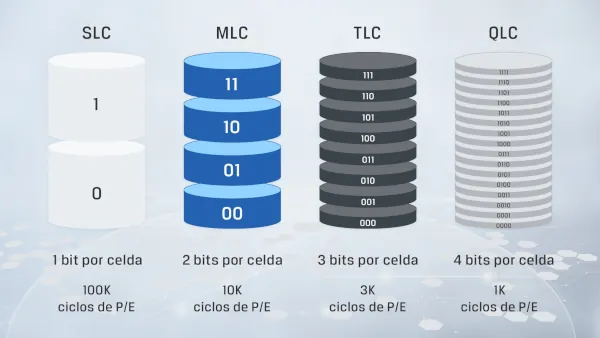
The evolution of QLC NAND is enabling enterprise SSDs exceeding 120 TB per unit, with roadmaps pointing to 200 TB+. This opens the door to partially replacing HDDs in "warm" storage environments.
Western Digital and Kioxia continue to develop hybrid strategies combining very high-capacity HDDs with high-density QLC SSDs.
Technical analysis:
Although the cost per TB of HDDs remains lower, the reduced latency and lower power consumption per operation position high-capacity SSDs as a viable alternative for AI datasets that require frequent but non-critical access.
SSDs optimized for direct GPU interaction:
Kioxia, in collaboration with NVIDIA, has developed architectures that enable peer-to-peer connectivity between SSDs and GPUs, reducing the load on the CPU and improving data flow efficiency.
This approach aligns with technologies like GPUDirect Storage, which minimize latency when accessing data from NVMe storage.
Structural advantage:
By eliminating intermediate layers, effective latency is reduced, and the utilization of accelerators in intensive training is increased.
Pressure on the NAND Supply Chain:
The rise of AI is also putting pressure on NAND memory production. High demand for enterprise SSDs is driving price increases and medium-term production commitments, which can directly impact the CAPEX of new AI data centers.
This necessitates planning deployments further in advance and designing more efficient hybrid architectures.
Emerging Architectures for AI Storage:
Beyond hardware, storage strategies for AI are evolving toward multi-tiered models:
Tier 0: ultra-high-performance local NVMe storage.
Tier 1: shared NVMe-oF cluster.
Tier 2: massive storage on high-capacity QLC HDDs or SSDs.
Tier 3: archive or cold storage.
The challenge lies in the intelligent orchestration of data movement between tiers, dynamically optimizing cost and performance.
Technologies such as automatic data tiering, distributed caches, and parallel file systems (Lustre, GPFS, BeeGFS) play a crucial role in massive training environments.
Key technical challenges in the medium term
: Cost/performance balance: exponential dataset growth can significantly increase TCO if the storage hierarchy is not optimized.
Thermal management in dense racks: PCIe Gen5/Gen6 SSDs increase heat dissipation.
Latency consistency under mixed workloads.
Interoperability in SDN and composable environments.
Energy sustainability.
Conclusion:
Storage has become a strategic component in AI architecture. The latest generations of SSDs—PCIe 6.0, ultra-high-capacity QLC, and solutions optimized for direct GPU interaction—are specifically designed to support the growth of increasingly demanding models.
However, the real challenge is not only technological but also architectural: how to design balanced infrastructures that maximize accelerator performance without skyrocketing costs or energy consumption.
In the next decade, competitiveness in artificial intelligence will depend as much on computing power as on the intelligence with which the storage subsystem is designed.