In addition to communicating wirelessly, the AS3955 can also harvest the energy needed to power the application from the NFC radio field, thus enabling the implementation of small applications without electrical contacts and without needing to incorporate any type of battery.
The main features of the new AS3955 are:
- It operates autonomously, incorporating the entire Type 2 tag protocol of the NFC Forum (it can also communicate as a Type 4 tag when controlled by an external MCU).
- It has 4kbit of high-endurance non-volatile memory for roaming data.
- It harvests electromagnetic energy to power small battery-free applications, providing up to 5mA at 4.5VDC.
- It can establish a direct wireless bus between the NFC-enabled mobile device and an SPI/I2C port of the application.
- It can operate in a completely passive mode, waking the application, powering it, and communicating solely through the proximity of the mobile phone.
The AS3955 can function independently as a bidirectional ISO14443A wireless tag, providing mobile devices with access to its internal, protected, non-volatile data memory.
It also features an SPI/I2C port that allows applications to access its internal memory to send or receive data that the AS3955 will exchange with the mobile device via NFC.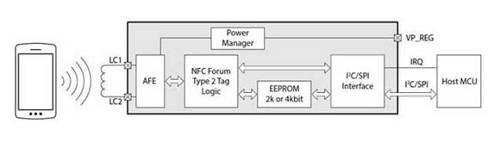 When a real-time wireless gateway between the mobile device's NFC and the application is required, the AS3955 can also establish this gateway directly, bypassing the memory, as shown in its block diagram.
The AS3955 offers robust read and write protection with a 32-bit key and complies with EMVCo data protection requirements, enabling it to function as a wireless credit card for payments or service access.
Its proximity sensor for mobile phone wake-up is entirely passive (zero power consumption), requiring no battery.
This functionality is configurable so the application only wakes up when intentionally.
The AS3955 is available in QFN8, Chip Scale miniature, or cut wafer format for COB assembly.
In addition to mobile phones, the AS3955 can also be powered and communicate wirelessly from an RFID or NFC reader based on one of AMS's RFID reader integrated circuits, such as the AS3911B. This means that the same NFC functionalities can also be implemented in industrial applications not involving mobile phones.