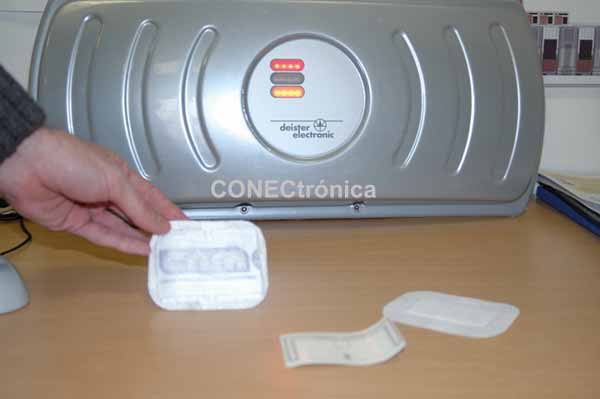
This device will allow for the monitoring of patients, both at home and in hospitals, using RFID technology. A reader will detect and identify the dressing containing the integrated RFID microcircuit, which, when activated, will transmit real-time readings of the measured physiological parameters (temperature and heart rate). This will allow for remote access to the information whenever needed, without disturbing the patient (for example, while they are asleep). The prototype is the result of a research project of excellence funded by the Regional Ministry of Economy, Innovation and Science with €119,168, and its results will be patented once the ongoing field trials are completed.
The novelty of the device lies in its use of radio-frequency identification (RFID) for monitoring. Currently, this technology is applied to object identification (it was initially conceived as a successor to the barcode introduced in the mid-seventies). However, the researchers in Seville are expanding its applications to the field of health and, specifically, to obtaining physiological patterns (temperature and heart rate).
The monitoring system includes two devices. The first is a reader that sends commands to a second: a microcircuit, called a transponder, embedded in the dressing. The designed transponder is passive, meaning it doesn't require a battery to measure physiological patterns or to respond to the reader's commands. Instead, the transponder reuses the signal radiated by the reader to generate and store its own operating energy. Furthermore, the transponder's response is achieved through the controlled reflection, according to the data to be transmitted, of the electromagnetic signal emitted by the reader. “The operating principle is similar to that of a flashlight illuminating an object. While the flashlight is off, we can't distinguish anything. However, when we turn it on, we can discern the shape and colors of what we are illuminating, and this is due to the way the object reflects the incident light, not because it has the capacity to radiate light itself,” explains the project coordinator, Manuel Delgado Restituto.
Communication with the bandage is established via UHF. “The prototype of the electronic bandage operates in the band around 869 MHz, has a range of over 5 meters, and is compatible with most commercial RFID readers in that band,” explains Manuel Delgado Restituto. He acknowledges that although this project does not include the development of dedicated readers or specific software, an Andalusian company has already expressed interest in the bandage.
Source: Andalucía Innova