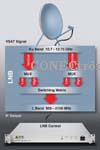
 There is also a model with LNB control, capable of switching the LNB converters (low noise level) of the satellite receiving antennas to the appropriate frequency range (low band/high band) and the desired polarization (horizontal/vertical).
I/Q Data Recording and Time-Based Analysis: The NRA-3000 and NRA-6000 analyzers, with the new "Scope and I/Q Data" option, continuously record signal characteristics over time, with a resolution bandwidth (RBW) of 100 Hz to 32 MHz. The time resolution is extremely precise, down to 31.25 nanoseconds. These analyzers can also display the real (in-phase) and imaginary (quadrature) components of the data online. With the appropriate external software, experienced technicians can extract virtually any information from this I/Q data.
LNB Control:
The "LNB Control" option on the NRA-3000 generates the control voltages necessary to switch the LNB to low or high band, and horizontal or vertical polarization. It is also possible to boost these voltages to compensate for cable losses. The LNB remote control functions are integrated into the analyzer's standard command set, so no additional equipment is required for the control software or signal path. The NRA-3000's "LNB Control" option also doesn't take up any additional rack space.
The NRA family
Narda remote spectrum analyzers (NRAs) cover a wide frequency range, from 9 kHz to 6 GHz, with bandwidth resolutions between 100 Hz and 32 MHz, depending on the device type. They can be integrated into any measurement environment thanks to their Ethernet interface (100BASETX) and remote control commands in ASCII language.
Rapid transmission of large amounts of data is possible in binary format. Application-oriented operating modes include spectral analysis, simultaneous multi-channel power measurement, RMS and peak value measurement, and recording of signal characteristics over time (optional "Scope and I/Q Data").
All NRA analyzers are 1U high and weigh less than 5 kg. They are silent and fanless, consuming less than 25 VA. Therefore, they are particularly suitable for mobile systems and space-constrained work environments.
About I/Q Data:
Modern wireless communication methods use various combinations of amplitude, frequency, and phase modulation.
To accurately verify the quality and integrity of transmitted and received signals, it is essential to measure the real (in-phase) and imaginary (quadrature) components of the signal and observe their variations over time.
About LNB Converters
: Low-noise block downconverters (LNBs) convert the Ku-band (10.7 to 12.75 GHz) signals received from the satellite to the L-band (950 to 2130 MHz), facilitating their transmission over coaxial cables and processing in receivers. The LNB is placed directly behind the dish and is powered, and receives control signals, through the coaxial cable. It changes polarization (vertical or horizontal) depending on the supplied voltage (14 V or 18 V). And if a 22 kHz signal is superimposed, it switches the reception range from low band (10.7 to 11.7 GHz) to high band (11.7 to 12.75 GHz).