Within its 40 MHz real-time bandwidth, the SignalShark remote module can detect even short pulse signals with a duration as short as 3.125 µs and a 100% POI (probability of interception), meaning it can detect them continuously. When transmitting I/Q data, 20 MHz of the bandwidth can be transmitted with a full 16-bit resolution in accordance with the VITA 49 standard. Furthermore, a scan rate of up to 50 GHz/s in Spectrum Mode ensures rapid signal detection even across wide frequency bands. Thanks to its analysis functions (real-time spectrum, spectrogram, and persistence analysis), these signals can be analyzed with high frequency and time resolutions.
The SignalShark remote unit's measurement core is identical to that of the handheld device. It integrates a Windows 10 computer and four switchable HF inputs, offering connection options for various directional antennas or antennas specific to a particular frequency range. The internal computer acts as an evaluation unit, ensuring that only processed, or qualified, data is transmitted to the central station. This allows the unit to perform all monitoring tasks on-site. Unlike the option of continuously transmitting all signals to the central station for further evaluation, this method requires less bandwidth because, as a rule, the process is successful in 99.99% of cases, with no errors. However, the technician can remotely connect to the device whenever needed.
The new remote module can also operate with an automatic antenna. It supports automatic orientation and Time Difference of Arrival (TDoA). These are techniques used, for example, by authorities to locate interference signals across large areas in metropolitan regions using several centrally controlled "spectrum monitoring" stations. With an automatic antenna, the direction of an interference source can be determined, while with a minimum of two antennas positioned at different measurement points, its exact location can be determined through triangulation. For this purpose, remote modules can be mounted, for example, on the rooftops of buildings located at various strategic points. Since these features are not usually required in such situations, the modules do not have a keyboard or screen, but they do include solar cells and a battery for self-sufficient power. Finally, the signal itself is transmitted via an LTE modem and the mobile network to the operator's remote computer.
To optimally implement all centralized monitoring, analysis, and guidance functions in remote maintenance, remote control with good time resolution is essential, including the representation of absolute time (e.g., synchronized via GPS), along with a universally understandable protocol for data transfer. One component to consider in this context is the SCPI (Standard Commands for Programmable Instruments) remote control language. This language enables communication with the SignalShark remote module and facilitates the development of corresponding controllers. Another factor to consider is the "VITA 49" transmission, which means that the output is also standardized, meaning the response is produced in a format that any software can understand.
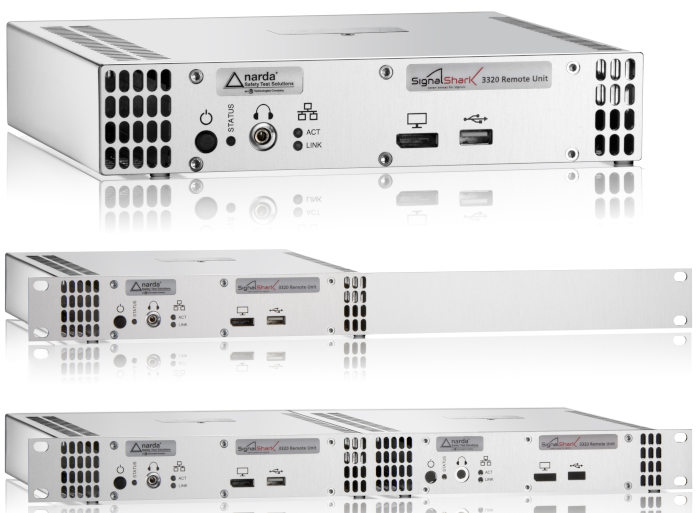
Thanks to its flexibility, the SignalShark remote unit can be used as a standalone component (basic) without the need for additional elements. In this configuration, the USB ports allow for the connection of an external keyboard and display. At the same time, the module, weighing only 2.1 kg (single) and well-protected by its compact aluminum housing, fits in any standard 19-inch rack system as a single unit, but can also be used as a double plug-in module (double), either side-by-side (1U) or stacked (2U). Racking two receivers is effective and cost-efficient when, for example, monitoring a wider bandwidth is required. This allows for scalability and cascading of multiple modules as an alternative to high-end equipment with the corresponding bandwidth. The first module covers the 360 to 400 MHz range, and the second, the 400 to 440 MHz range.
Its use is recommended for regulatory authorities, security services, national and regional criminal investigation administrations, the military and intelligence services, industrial and antenna measurement technology services, as well as for suppliers, operators and service providers in the mobile communications sector.