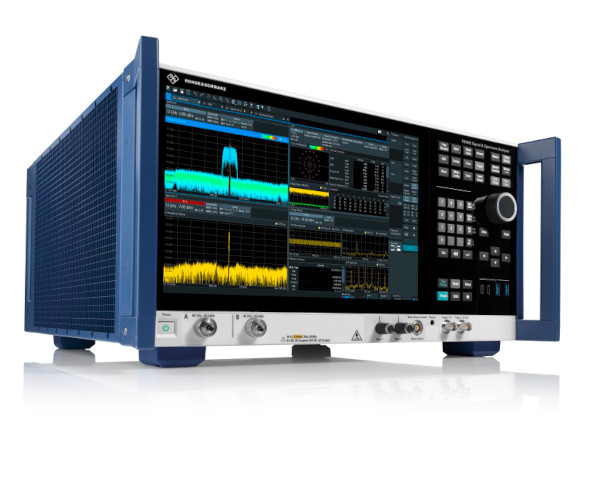
With high measurement speed and customized analysis tools, the FSWX brings new levels of performance and accuracy to signal analysis for modern RF applications, from testing active RF components to testing next-generation automotive radars and complex airborne radar installations and satellite testing in A&D applications, the latest testing in WLAN and cellular technologies such as 5G and beyond.
Michael Fischlein, Vice President of Spectrum and Network Analyzers, EMC Testing, and Antennas at Rohde & Schwarz, is pleased to introduce the new FSWX: “Our team has reinvented signal and spectrum analysis technology with our new FSWX. They have developed an innovative architecture and design that allows our customers to tackle complex measurement environments in the evolving landscape of wireless communications and radar technology that were previously inaccessible. In other words, the FSWX makes it possible to measure the impossible.” The instrument’s innovative design includes multiple input ports, cross-correlation capabilities, advanced filter banks, and wideband A/D converters (ADCs).
Multiple Input Ports:
The multi-channel FSWX offers the ability to measure multiple signal sources simultaneously, whether they operate at the same or different frequencies. Thanks to its synchronous input ports, each with a 4 GHz analysis bandwidth, users can fully analyze the interactions between various signals. This opens up new measurement scenarios, such as coherent phase measurements of antenna arrays used in beamforming for wireless communications, as well as in airborne and automotive radar sensors.
Multipath Architecture and Cross-Correlation:
Its internal multipath architecture enables cross-correlation mode, a novel feature of the FSWX. A single signal input is internally split into two independent signal paths, each incorporating its own local oscillator and ADC. This innovative design allows advanced cross-correlation algorithms to be applied in the digital section, effectively eliminating inherent noise from the measuring instrument. This feature reveals spurious signals that are not easily visible without cross-correlation. It is particularly useful, for example, for measuring the error vector magnitude (EVM), a critical factor in mobile communications. The added broadband noise in traditional signal and spectrum analyzers limits the accuracy and dynamics of EVM measurements. However, thanks to the cross-correlation function, the FSWX provides a clear view of the device under test (DUT) for accurate EVM analysis.
The internal multipath architecture also offers advanced triggering options. For example, users can apply IF or RF power triggering to different frequencies, as the multipath design allows for independent frequency adjustments for each receive path after the splitter. In this way, the FSWX can easily reveal the effects between two RF signals.
Advanced Filter Banks and Wideband ADCs:
Spectrum analyzers have traditionally relied on YIG filters for preselection in the microwave range. Known for their complex frequency response, YIG filters must be avoided for broadband signal analysis. However, the FSWX employs wideband A/D converters along with filter banks that cover the entire frequency range, enabling preselected signal analysis. This eliminates the need for YIG filters. The filter banks provide high accuracy and optimize instrument settings for each application, significantly reducing the risk of unwanted signal imaging that could distort the results. Users requiring narrowband applications still have the option of adding a YIG filter.
Firmware Applications:
The FSWX also provides innovative firmware applications such as the CrossACT (Cross Application Control and Triggering) function, which synchronizes multiple measurements on different input channels to enable simultaneous analysis with various tools. This capability simplifies comparisons such as determining whether higher harmonics in a radar signal affect the EVM of a 5G signal.
The FSWX's Linux-based operating system offers a high level of security and long-term support.