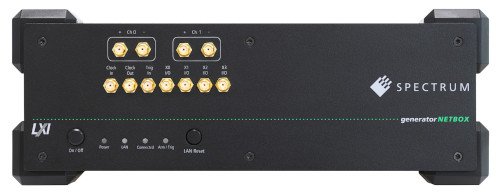
The AWGs are characterized by their compact size and light weight, requiring only a standard Ethernet/LXI cable for connection to any PC or network. The high-resolution 16-bit D/A converter (DAC) technology delivers exceptionally pure, low-noise waveforms, making these AWGs ideal for stimulus-response or closed-loop test setups. Each AWG channel has its own dedicated DAC and can be used in single-ended or differential output modes with fully programmable output ranges. In single-ended mode, waveform amplitudes reach up to ±500 mV into 50 Ω, and in differential mode up to ±1 V into 100 Ω. With high-impedance termination, output levels double, reaching up to ±2 V.
The DN2.63x models are available in single- or dual-channel configurations and include 2 Gsamples (4 GB) of standard memory, expandable to 8 Gsamples (16 GB). This allows for uninterrupted playback of long waveforms—up to 800 ms at 10 Gsamples/s. Users can choose from various triggering functions and intelligent generation modes, such as single-trigger, repeat, multi-trigger, and FIFO streaming. In FIFO mode, it is possible to load new data into the AWG and simultaneously play back a stored waveform.
All units are supplied with Spectrum's SBench 6 software for creating, controlling, and analyzing waveforms. Customers can define waveforms from equations, use the built-in function generator, or import data from digitizers, oscilloscopes, or simulation tools. Software development packages for C++, Python, MATLAB, LabVIEW, and other languages are included for custom development.
Integration into automated systems is achieved directly via front panel connectors for the external clock and trigger signals, as well as multifunction I/O lines that function as marker outputs for status indicators or synchronous/asynchronous signaling. A digital pulse generator option is also available. Weighing less than 7 kg and with optional rack-mount kits, these units are ideal for mobile, desktop, or rack-mount configurations.