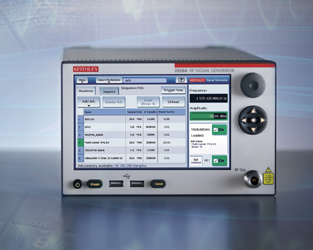
In contrast to other competing signal generators, which typically force users to choose between the best signal quality and maximum test performance, the 2920A models combine both capabilities in the same instrument without compromising design. Patent-pending technology allows the Model 2920A RF vector signal generator to support significantly faster frequency and amplitude switching speeds than competing systems. Unlike other systems optimized for development or production, the Model 2920A is a cost-effective solution whether used on the test bench for design verification or in production testing.
Providing signal generation bandwidth options up to 80 MHz with a frequency range of 10 MHz–4 GHz or 10 MHz–6 GHz, the Model 2920A adds to the capabilities of Keithley’s 2900 Series signal generator line. It expands the applications of the 2900 Series for testing wireless devices for performance, complex modulation, and current broadband telecommunications standards, including LTE, WLAN, WiMAX, WiBro, TD-SCDMA, DVB (Digital Video Broadcast), and GPS (Global Positioning System).
The 2920A is optimized for calibrating and testing components such as wireless amplifiers, filters, and receivers thoroughly across their entire operating range at exceptional speed. Several of its outstanding advantages, described below, enable higher test throughput than previous signal generation options.
Industry-Fastest Frequency Tuning:
A new, patent-pending technique that ensures rapid tuning of phase-locked loop synthesizers allows the 2920A to tune a new frequency on a device under test (DUT) in operating band in 300 µs or less. Competitive products typically require 600 µs or more to tune a new frequency.
Fastest Amplitude Switching of The
2920A provides electronic attenuation and fast tracking, an automatic level control loop to quickly stabilize a new power level, enabling switching to a new amplitude in as little as 150 µs (compared to other generators on the market that take 500 µs or more). This reduced settling time allows for rapid testing of a device across its entire operating power range.
Waveform switching in one clock cycle:
Because devices operating on multiple standards require rapid switching between numerous complex signals during testing, the 2920A's on-board arbitrary waveform generator includes 100 megasamples of memory to hold numerous single waveforms or very small multiple waveforms. This deep memory, combined with the instrument's optimized speed list mode and sequencer operating mode, supports switching from one waveform to another within a single processor clock cycle—even with waveforms based on different standards using different modulation schemes.
High-speed data transfer Signal Files:
The 2920A offers a direct link from its DSP circuitry to an external PC via USB 2.0 bus, maximizing operating speed. In Desktop Control Panel mode, an external PC takes control of the 2920A, acting as if it were the instrument's on-board processor controller. This mode supports signal file transfers from a PC directly to the 2920A's arbitrary waveform memory at 100 Mb/s, enabling the simple download of extremely large files (such as streaming video test signal files, channel model-modified signal files, and radar profile files). Combined with its high download speed and Keithley application software, the 2920A can perform a fast, efficient Dynamic Frequency Selection (DFS) compliance test on WLAN access points. This test package verifies a device's compliance with FCC, ETSI, and TELEC regulations to ensure that WLAN access point transmissions do not interfere with signals. from government radar, such as weather radar or air traffic control radar.
Users have the flexibility to create offline waveform files and download them to the Model 2920A's arbitrary waveform memory using a memory stick or the GPIB or LAN interfaces. This transfer flexibility will be useful when third-party tools, such as The MathWorks' MATLAB® interactive programming environment, are preferred for creating signal files.
The Model 2920A's high-speed performance does not compromise its phase noise performance.
Unlike other competing signal generators, which are typically designed to maximize either throughput (for production testing applications) or signal purity (for design verification applications), the Model 2920A includes new possibilities that allow optimization for either of the most critical performance aspects in specific applications:
Ultra-low phase noise option: High signal purity is essential when creating complex HSPA+, 802.11n WLAN, 802.16e, and LTE signals. To ensure The UPN Ultra Low Phase Noise option on the 2920A provides -135 dBc/Hz phase noise at a 300 kHz offset on a 2 GHz carrier. This allows for the generation of WCDMA signals with EVMs below 0.85%. This option also enables the 2920A to generate 5.8 GHz, 40 MHz bandwidth 802.11n WLAN signals with an EVM as low as -43 dB and WiMAX signals with a residual RCE (Relative Constellation Error) of 43 dB or less. Importantly, when the ultra-low phase noise option is used, the 2920A does not compromise on tuning times as fast as 750 µs.
Low Amplitude Range Option: The 2920A's wide signal range makes it ideal for testing a broad spectrum of receivers and components. The LAR Low Amplitude Range option on the 2920A It extends the generator's range for output signals as low as -130 dB or as high as +13 dB. Furthermore, the 2920A boasts excellent accuracy, repeatability, and stability specifications, allowing test system designers to implement tight band limits in their test protocols, contributing to high product quality:
- Absolute amplitude accuracy of +/-0.6 dB (typically +/-0.3 dB) from -110 dBm to +13 dBm up to 3 GHz.
MIMO Testing:
The 2920A is the latest addition to Keithley's MIMO (Multiple-Input, Multiple-Output) test system solutions. MIMO signals can be easily generated and analyzed using the SignalMeister™ RF Communications Test Toolkit software and the 2920A vector signal analyzer in conjunction with the 2920As.
2920A Applications: Applications for this advanced vector signal generator include R&D, product development, and production testing of a wide range of wireless products, including femtocells, access points, mobile devices, wireless modules and air cards, and wireless chipsets. The 2920A model is a good choice for MIMO devices and R&D applications, as well as for engineering education.
Spectrum AWG DN6.63x Arbitrary Waveform Generator
Spectrum Instrumentation introduces its new Arbitrary Waveform Generators (AWGs) with up to 6 channels at 10 GS/s or 12 channels with an output speed of 5 GS/s. The new AWG DN6.63x belong to the company's Netbox series, a line of...