The challenge lies in how to install PoE-compatible PDs that can work alongside existing 2- and 4-pair IEEE® 802.3bt PDs that comply with the pre-standard Universal PoE (UPOE) and Power-over-HDBaseT (POH) specifications. The industry has already bridged this interoperability gap, ensuring that both pre-standard PDs and new IEEE® 802.3bt-2018 compliant PDs can share the same Ethernet infrastructure without requiring changes to switches or cabling.
The Road to IEEE 802.3bt:
Since the approval of the first PoE standard in 2003, its use has increased dramatically and has been introduced into new applications. PoE offers significant advantages due to its ease of installation, savings in capital and operating costs, and the provision of a unified and secure power standard for use worldwide.
The main factor limiting the use of PoE in new applications is the available power. While the 15.4W of the power supply is sufficient for most IP phones and 802.11a/b/g access points, it is insufficient for IP video phones, 802.11n IP PTZ (pan-tilt-zoom) cameras. For this reason, the IEEE (Institute of Electrical and Electronics Engineers) announced IEEE 802.3at in 2009, which specifies 30W for the PoE power supply.
Currently, there is a demand for even greater power for additional devices connected to the Ethernet network, such as PTZ security cameras, kiosks, POS systems, thin clients, 802.11ac and 802.11ax access points, small cells, and connected LED lighting, all of which can leverage PoE. To meet this demand, the new IEEE 802.3bt standard increases the maximum available PoE power, primarily utilizing the four pairs of structured cabling. IEEE 802.3bt expands the power rating information exchanged during the initial negotiation to enable effective power management, compatible with various PoE classes and legacy installations. These improvements address the challenge posed by higher-power and more efficient PoE power systems.
The IEEE 802.3bt Call for Interest (CFI) activity began in early 2013, and the standard was ratified in September 2018. The new standard addresses the needs of the existing market and is considered an important catalyst for the growth of the PoE market, as it facilitates the expansion of PoE applications by raising the power limits for PSE and PD to 90W and 71.3W, respectively.
Prior to the IEEE 802.3bt initiative, however, parallel efforts were underway to increase the power delivered to device providers (DPs). This began with the IEEE 802.3af-2003 PoE standard, which supplied up to 15.4W of output power to each device via two pairs of Category 5e (Cat5e) cables. The IEEE 802.3at-2009 standard, also known as PoE+, introduced the "Type 2" PSE/PD, capable of delivering 30W of output power and 25.5W of charging power. This latter standard is essentially an extension of the first. Later, the HDBaseT Alliance standardized the HDBaseT protocol, enabling HDMI links up to 100m using Cat5e or higher-quality cables. In 2011, the HDBaseT Alliance created the Power over HDBaseT (PoH) standard, which increased the maximum power delivery to 95W over two pairs.
The following table summarizes the standards prior to IEEE 802.3bt:

Note 1: The higher power capacity allows the PD input power to reach up to 95W if the channel length is known.
IEEE 802.3bt adds capabilities by introducing Type 3 and Type 4 PSE/PDs and operating over four pairs. It supports single- and dual-signature PD configurations and adds classes 5 through 8 as part of an improved mutual identification process. It also incorporates automatic class selection, and power capacity has been increased when the channel length is known. Finally, it offers low standby power consumption and compatibility between 10GBASE-T and PoE. The table below shows the PoE capabilities available after the ratification of IEEE 802.3bt.
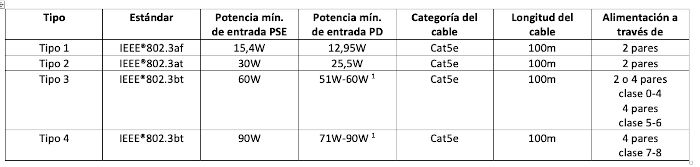
One of the goals of the IEEE 802.3bt standard is to meet the power delivery and Safety Extra Low Voltage (SELV) requirements as defined in ISO/IEC 60950. However, this compliance means that the power cannot exceed 100W per port. Despite this limitation, 100W per port is still sufficient for applications previously outside the scope of IEEE standards, thus expanding the potential number of PoE port installations.
Ensuring interoperability:
The IEEE 802.3bt specifications guarantee that the IEEE 802.3bt system will automatically work with legacy Type 1 and Type 2 devices, provided the Power Supply Equipment (PSE) is capable (in terms of power) of supplying the Device (PD) and complies with the standard. If the PD requires higher power (IEEE 802.3bt PD) and the PSE cannot provide it (IEEE 802.3af/at PSE), the PD will either remain off or power up and consume only the power supplied by the PSE.
One of the first examples of solutions offering this interoperability is a Microchip PSE circuit kit that enables compatibility between pre-standard switches and new IEEE 802.3bt-2018 compliant products. This circuit kit follows a previous Microchip PSE circuit kit for implementing the widely used four-pair PoH power standard for 95W PDs and also forms the basis of a range of IEEE 802.3bt-2018 compliant PoE injectors and midspans that bridge the interoperability gap for users.
IEEE 802.3bt-2018 compliant PoE injectors and midspans are installed between the power devices (PDs) and an existing switch, enabling users to power any combination of pre-standard and IEEE 802.3bt-2018 compliant PDs. The availability of one or more ports allows new IEEE 802.3bt compliant switches to power pre-standard PDs.
For system developers, IEEE 802.3af/at/bt PoE circuit kits offer the ability to incorporate the two- and four-pair systems required for both pre-standard and IEEE 802.3bt-2018 compliant PoE into a single-board design. These circuit boards must be capable of balancing heat dissipation across the entire system and should include all the necessary manager and controller functionality to create a Power Supply Equipment (PSE) capable of delivering 90 to 99.9 W of power per port, in addition to providing up to 48 ports for IEEE 802.3bt Type 3 (Classes 1-6) and Type 4 (Classes 7-8) applications. Another important consideration is the ability to upgrade these circuit boards from previous standards to IEEE 802.3bt via software without hardware changes.
A final factor for developers to consider is whether they can protect the Power Delivery Devices (PDs) against reverse polarity connections, as well as reduce the footprint and costs associated with delivering IEEE 802.3bt Type 4 and Class 8 power. This has also been addressed by the latest IEEE 802.3bt solutions with the availability of full-bridge rectifier devices used in the powered portion of the PoE connection.
The new IEEE 802.3bt standard allows PoE to deliver 90W over four pairs of Cat5e or higher cabling. This PoE level is expected to reach the maximum defined level, as higher levels may not be safe for existing cabling and connectors in current infrastructures. The standard will replace all pre-standard solutions currently delivering 60W/75W/95W, such as UPOE or 4PPoE. PoE system and device vendors plan to implement these new standards while maintaining backward compatibility with pre-standard installations, including those compliant with UPOE and POH specifications.
If implemented correctly, pre-standard and new IEEE® 802.3bt-2018 compliant PoE devices can share the same Ethernet infrastructure without requiring changes to existing switches or cabling.
 Galit Mendelson, Director of Marketing and Business Development for PoE, Microchip Technology (www.microchip.com)