 For some years now, technological advancements have introduced changes in user behavior, enabling them to utilize a wide range of cutting-edge mobile devices that facilitate the management of digital information and, in turn, allow for user mobility. Consequently, a vast array of mobile applications and technologies have been developed that facilitate the retrieval, transmission, and storage of information, enabling communication among users and providing services and tools that support work, academic, and entertainment activities, among others.
The integration of mobile learning as a complement to educational processes helps facilitate the development of new programs that incorporate mobile devices as an integral part of educational processes. Therefore, M-Learning tends to be a knowledge strategy that solves the geographical isolation of the user from study centers and facilitates learning from any point, helping to awaken the imagination of mobile users.
Rapid technological advancements offer ample opportunities for innovation when incorporated into educational designs and practices. For some years now, we have witnessed how technological progress has introduced various devices that handle digital information while simultaneously facilitating user mobility. Thus, the development of numerous mobile technology applications has contributed to the consultation, transmission, and storage of information among users, making these tools a constant support for their work and academic activities.
Consequently, mobile technologies generate greater acceptance of class attendance, allow students to develop new skills in the use of available technology, enable the correct combination of educational and technological aspects, offer a different vision of the educational process, giving flexibility of movement so that the user can stay up to date with their activities even when absent from the face-to-face class.
In this way, the Antonio Nariño University – UAN, enters the mobile technology sector with the use of mobile teaching platforms that will allow it to enter the world of mobile learning. For this purpose, the academic community will experience the performance of the interface developed to interact between the mobile device and the Moodle server. This interface is known as MLE (Mobile Learning Engine), whose features are integrated and improved to operate efficiently with mobile applications such as: Flashcard Trainer, Mobile Learning Objects, location-based mobile service labels, Mobile Community and Mobile Repository, among others.
Description of the Mobile Interface Prototype
As part of the evolution of this research, once the software development was completed, it was necessary to carry out several technical tests of the mobile application and the use of the concept called "mobile community," understood as a special course, which is made available to all mobile users of Moodle (students, teachers), aimed at testing the system in real time on the Moodle learning platform. For this, the user can enter by creating their own account and password from the mobile device through the following start link: http://186.28.225.31/moodle/, which allows them to enter the Moodle-MLE environment and continue their learning by creating courses and accessing the different academic services (Chat, social networks, email, among others) to facilitate their communication with the entire academic community in a mobile operating environment through the user's own cell phone or portable device.
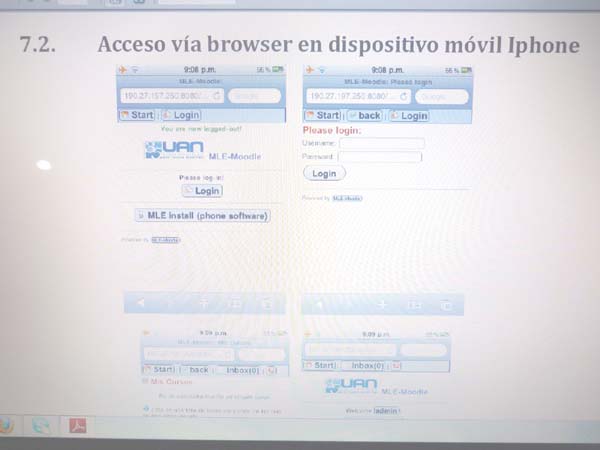
Access to the work and learning environment from your mobile device is done by entering the link whose IP address corresponds to the access server where the application is hosted, as follows: http://186.28.225.31/moodle/blocks/mle/browser.php
This service will be used for any activity within the Antonio Nariño University community, including mobile content, menus, assignments, projects, and schedules that can be easily made available to all mobile users for any type of event or task.
Additionally, the application will allow users to send SMS text messages from their mobile phones to other users in a collaborative and interactive work environment for students and faculty, enabling them to share important texts or messages with their students anytime, anywhere.
Interface Development:
This is a special program designed for mobile phones, which manages learning on the Moodle platform and offers several advantages, such as:
- Offline Learning: Download learning content to learn without any network connection.
- Ease of Use: Simply click on a symbol in your phone's menu to launch the learning application. It's important to note that a large-screen phone is recommended for optimal functionality.
- Improved Usability: All content and navigation are optimized for small devices, allowing for high-resolution images and high-quality sound. Data entry is also possible via a stylus, voice, or keyboard.
- Unified Management: With phones based on 3.5G and 4G technologies, no additional third-party applications are needed, so the application itself can be managed seamlessly.
- Transmission of compressed data using a special access server or gateway incorporates three fundamental mobile concepts: mobility, social interactivity, and connectivity. This includes systems such as Wi-Fi, Bluetooth, and mobile IP data, which guarantee online and offline data transmission and reception.  It should be noted that the MLE application on the University's Moodle platform may experience certain limitations related to the cellular network rather than the application itself. These limitations include: the cellular network's capacity to maintain a constant connection for its users, coverage limitations, potential interruptions, material download times, the software used to download lessons, high network access costs when using data packets (although the MLE application allows for packet downloads via Wi-Fi), and small screen sizes on mobile phones.
The MLE (Mobile Learning Engine) tool is a computational multimedia learning application developed for mobile devices. Its development is structured under Java 2 Micro Edition (J2ME). Because MLE is transparent to the mobile platform on which it is implemented, it is able to run on different mobile operating systems such as Symbian, MS Pocket PC, Palm OS, Android, etc., allowing it to be configured according to the screen resolution of the mobile phone.
MLE can be installed on any mobile device that ideally has the following characteristics: Java platform, compatibility with .jar and .jad file extensions, good screen resolution, a minimum of 2GB of RAM, Wi-Fi connectivity, Bluetooth connectivity, and at least 3G technology with HSDPA/WCDMA/UMTS protocols. The MLE-Moodle application is a Moodle extension; therefore, the minimum Moodle requirements are: Moodle Version 1.9.x, PHP 4.3.0, and a database of either MySQL 4.1.16, PostgreSQL 8.0, 9.0, or 9.0 MSSQL Oracle.
The learning materials are created on the central server at the UAN Circunvalar campus, which uses the Moodle learning platform, and are downloaded via MLE. Once downloaded, the materials can be accessed and manipulated without needing to reconnect to the server.
Project Details:
Antonio Nariño University aims to advance in the field of wireless mobile technology. This effort has been consolidated through the development of a communications interface that will enable interaction between professors and students, facilitate enrollment, development, and evaluation of virtual courses, and provide students with access to knowledge from anywhere. This will make learning easier and more flexible for members of the academic community. The design and implementation of this mobile communications prototype will transform classes into pedagogical activities that facilitate the virtual educational processes at UAN.
General Mobile Operating Environment
Currently, the UAN does not have a mobile communications interface that allows interaction between professors and students electronically to access the Moodle platform, register, download content, complete guides, and receive messages via mobile device from any time and place. Therefore, the developed application will complement the University's existing Moodle platform, which is currently accessed via wired means.
The project will promote the development of mobile virtual learning and facilitate communication within the University community. It aims to identify changes occurring in the teaching and learning process within the university (class transformations, their use, pedagogical adaptations, changes in teaching styles, and students' perceptions of technological tools). It will also stimulate the development of many more applications designed to address problems related to the use of mobile devices.
The project phases are:
Phase I (Pedagogical)
- Definition of the pedagogical model
- Integration of the e-learning model with the mobile learning component (m-learning
) - Identification of changes that mobile devices produce in distance learning.
Phase II (Technical)
- Operational characteristics and hardware and software requirements
- Development of the management application between Moodle and the mobile device
- Functionality and connectivity testing.
Final Phase
- Understanding the perceptions of students and professors regarding the use of the device in selected courses.
- To determine the strengths and weaknesses of using the device for information exchange between tutors and students.
As a result of the application's development, it was noted that, technically, once the development process was complete, mobile users were able to access the system's administration and service utilization environment via their cell phones. The following graphic illustrates the mobile-based work environment for accessing the University's Moodle server.
Prior to entering data into the system, users (students and/or teachers) must access the system from their cell phones by selecting the type of network connection, which can be through WiFi (the wireless communication network of the site where the user is located, such as the University's Wlan network) or through a data package contracted by the user from their service provider (ISP). After choosing the communication network, the user authenticates with a previous account and password to be able to log in to the University's Moodle system.
Conclusions
The use and application of mobile communications for learning and teaching have generated a great advance in the processing of information in the academic communities of higher education institutions; therefore, one of the purposes of this work is to allow the articulation of educational processes and encourage the development and use of mobile technology in traditional and distance education.
Likewise, computer services and applications on mobile environments will drive new developments in this area within the UAN, because they will make it possible to use the available technological tools in a complementary way to make learning more efficient, more reliable and more secure, and above all to put said learning into practice from anywhere without the need for a forced relocation to the university.
Author:
Author: Fernando Contreras, Systems Engineer
References
- Aguilar, F. (2008). Mobile Phones, the new window for integrated communication.
- Carballar, J. (2010). WiFi, What you need to know.
- Delgado, H. (2009). Wireless Networks.
- Garcia, L. & Ruiz, M. (2007). From distance education to virtual education. Barcelona 2007
- Gros, B. (2003). The impact of digital games in education. First Monday, volume 8, number 7. Retrieved in October 2006 from URL: http://firstmonday.org/issues/issue8_7/gros/index.html
- Vladimir, J. & Lozano, A. (2010). Educational technology and collaborative learning networks.
- Heilcsen, S. & Jensend, S. (2007). Designing for networked communications: Strategies and development.
- Larisa, E. & Vázquez, L. (2008). Mobility and education: m-learning.
- Ramirez, C. (2004). Educational Models with New Technologies, Pedagogical Structures. National Pedagogical University.
- Ramirez, MS (2008). “Mobile learning devices for virtual environments: implications for design and teaching” Year 8, Number 9. New Era.
- Soler, Y. (2009). Visualization tools in support of virtual education for engineers.