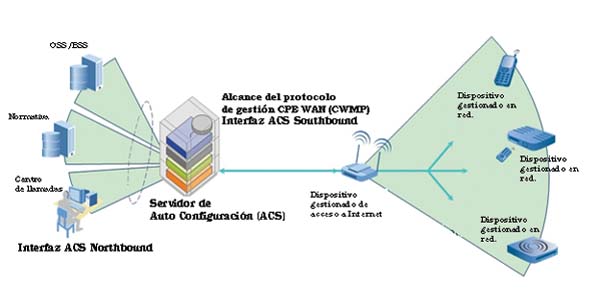
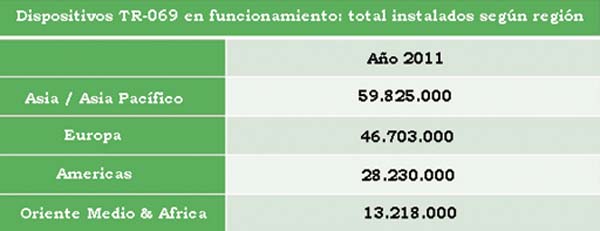
 Throughout the industry, TR-069, the Broadband Forum's CWMP protocol, is recognized as the "gold standard" for remote management, enabling the efficient and cost-effective management, monitoring, and control of a wide range of devices and systems. A recent study by Ovum indicates widespread use of TR-069 across all continents, reporting that 150 million devices are managed by TR-069 and that this number is growing rapidly.
TR-069 as the Gold Standard:
The development of the CPE WAN Management Protocol (CWMP), the Broadband Forum's flagship standard, also known as the TR-069 technical specification, has already made it one of the most widely implemented broadband standards. Originally conceived for the burgeoning home networking market, TR-069 has been extensively updated and expanded to cover business services, M2M, and cloud environments. The protocol is poised for even greater penetration following the launch later this year of the Broadband Forum's first TR-069 CPE certification program.
TR-069 was initially ratified by the DSL Forum (now the Broadband Forum) in May 2004, amended in 2006 and 2007, and recently updated for M2M services in Amendments A3 and A4. The extensive and modularly manageable TR-069 family of data models continues to grow, defining a wide range of device and software module functions. This technical specification is referenced by many industry bodies, including 3GPP, ATIS, CCSA, ETSI, HGI, and ITU-T, among others. TR-069 was approved by ETSI as a European standard in 2010 and is currently referenced in the ETSI M2M architecture as a device management protocol. The Broadband Forum and ETSI M2M are continuously working to develop new data models.
Certification means security for operators and users.
The popularity and use of TR-069 will increase dramatically later this year, when TR-069 certified products become available under a new certification program to be launched by the Broadband Forum. The Broadband Forum has just announced the development of its first TR-069 compliance testing plan and has begun beta testing with several devices.
The program aims to verify that devices are compatible with the TR-069 protocol and ready for market entry. It will also encourage industry adoption of TR-069, including by organizations such as ETSI, 3GPP, ITU-T, and ultimately, cable operators. The primary objectives are to improve device management and interoperability, making it more cost-effective and simpler for service providers to provision and manage the ever-increasing number of connected devices.
 In this initiative, the Broadband Forum will work closely with the prestigious University of New Hampshire InterOperability Laboratory (UNH-IOL), the independent laboratory dedicated to testing data networking technologies through industry collaboration. The Broadband Forum selected UNH-IOL as the official testing laboratory for TR-069 because UNH-IOL has been actively driving the evolution of the Broadband Forum's test plan for years and has a distinguished track record of conducting tests for the Forum. With its in-depth knowledge of the TR-069 protocol and test plan, UNH-IOL will be a valuable partner in the conformance testing process.
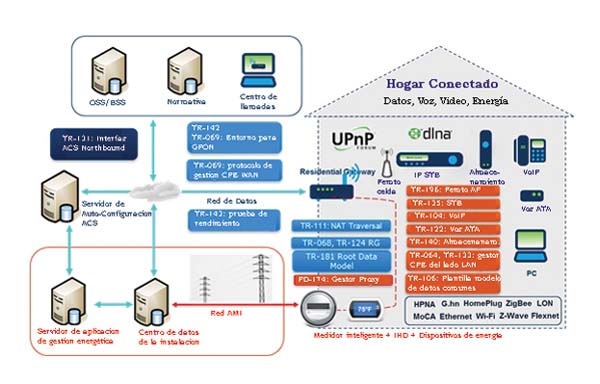
The TR-069 certification program will launch later this year, and the first group of vendors and products to achieve certification is likely to be announced shortly thereafter. The launch of the certification program reflects, in part, the success of TR-069 and how its application is expanding beyond broadband access gateways to include other devices such as set-top boxes (STBs), IP telephony devices, analog telephone adapters, femto access points, energy meters, and a variety of M2M modules. For the first time, CPE devices of many different types will be able to obtain certification, fully implementing the TR-069 protocol.
The Broadband Forum's certification program offers substantial advantages for all participants in the value chain. TR-069 certification for products will provide operators and service providers with added assurance when making investment decisions. The program will guarantee network compliance and quality, and will also offer service providers greater confidence that certified devices deployed in customers' homes will interoperate more effectively with their remote Automatic Configuration Servers (ACS), making it easier than ever to automatically provide information and manage a much wider range of devices.
The TR-069 certification will expand the service provider's management capabilities beyond the broadband access gateway, facilitating interaction with other devices such as set-top boxes, IP phones, and NAS devices connected to the home network. This broadens the provider's ability to configure, manage, and troubleshoot devices, thereby maximizing the value of the services delivered. Essentially, this can provide a significant step in the migration path for a broadband service provider, moving from simply offering broadband access to also providing high-value-added services.
The automated remote management enhancements enabled by TR-069 across home networks promise simplified service provision, troubleshooting, and updates for consumers. Furthermore, TR-069 certification offers the potential to expand the range of services that telecommunications operators and communication service providers (CSPs) can offer to consumers.
 TR-069 certification sends a simple and clear message to the industry about a device's market availability. It also helps equipment and systems vendors reduce testing overhead and more easily market their products, thus increasing their overall ability to serve a larger market. The program will also make integrating home networking systems and equipment into vendor networks much easier. There is also a benefit to the bidding/request for proposals (RFP) process, as CSPs can specify TR-069 certification as a requirement, and CPE and other equipment manufacturers can demonstrate compliance.
In this sense, it seems that the new certification program will expand and validate TR-069 credentials as the gold standard for home network management.
TR-069 - Market Demand Is Increasingly Complex.
The so-called Broadband Home, or connected or digital home, has become a reality in most markets worldwide. The idea of connecting multiple devices of different types in the home and providing services using combinations of managed broadband access, mobile networks, other access methods, and the Internet is a significant draw for a number of stakeholders: consumers themselves, content providers, manufacturers of networking equipment, devices and consumer electronics (CE), home automation companies, utilities, and telecommunications service providers (CSPs).
For consumers, home networks sound appealing in light of modern lifestyles characterized by a growing demand for content, information, and communications delivered and available anytime, anywhere in the home, and on any device or terminal within easy reach. The offering could provide home networking, voice, data, and video interconnection, interconnection of digital media and entertainment devices, remote control of household appliances, managed utility supply and usage, environmental monitoring and security system services, and even telemedicine solutions.
 For service and device providers, there is enormous market potential in home networking. A new analysis by ABI Research, for example, suggests that in 2014 orders for home networking equipment (home routers, adapters, bridges, network interface cards (NICs), integrated local area networks (LANs), and network-attached storage (NAS) devices), along with network-enabled communication and entertainment devices (CE devices with network connectivity, excluding computers and mobile devices), will exceed one billion units. A report by IHS iSuppli estimates that worldwide orders for gateways and thin clients could reach 4.2 million units in 2012, up from 345,000 last year, and will continue to grow rapidly over the next two years: projected to increase to 6.7 million units in 2013, 10.4 million in 2014, and 12.6 million in 2015.
 As a result, manufacturers of smart home solutions, CE-certified equipment, and "smart" meters and appliances have an opportunity to sell more products by ensuring they can be easily integrated into a home network and effectively controlled remotely. Interestingly, according to consumer data from market research firm Ovum, the average number of different types of connected devices already exceeds three per broadband subscriber.
Content providers have a similar opportunity to increase sales as consumption grows and the multi-screen, multi-device home ecosystem expands. As noted in the Visiongain report “Connected Homes Report 2011-2016: A Paradigm Shift in the Way We Live,” interoperability in the home environment allows content and services to be delivered to more endpoints, thereby increasing revenue opportunities for content and service providers.
From the perspective of CSPs, home networks offer the opportunity to provide more managed services and devices, both as a way to increase sales of basic broadband and to reduce user support costs for equipment and the network through remote administration. Less tangible but no less important, an extended service provider can leverage this type of unified management to increase customer loyalty.
Utility providers have a similar opportunity to expand their service offerings and provide home monitoring and control features. Meanwhile, various government-sponsored initiatives around the world plan to deploy smart meter networks in homes to improve energy management and optimize consumption, potentially reducing household bills.
M2M – over 13 million connected devices by 2016
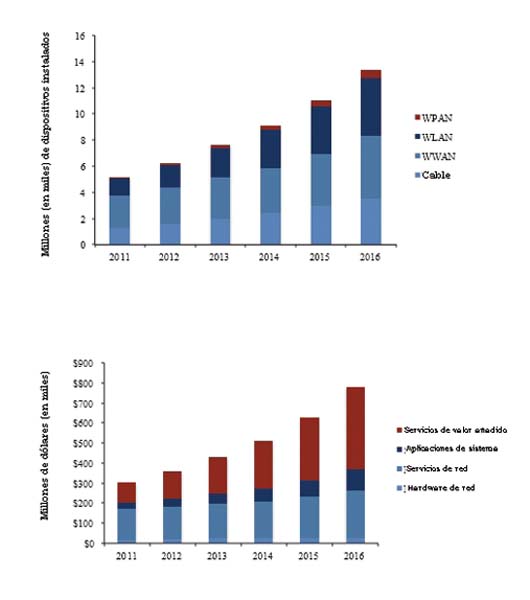
Looking specifically at smart devices and the M2M market, this sector is estimated to be growing rapidly. By 2016, there will be more than 13 million connected devices worldwide, with service revenues growing to nearly $780 billion. Applications across a wide range of environments include security and infrastructure, IT, healthcare, transportation, buildings, energy production sites, and industrial facilities, and forecasts indicate growth in all of these sectors.
M2M enables a range of devices to communicate with each other and is typically used in smart grid applications, where at least one device captures or measures and records an event within an environment, such as temperature, light levels, or stored parts. This data is then communicated to other devices that can interpret it and trigger an action, such as adjusting, heating, or reordering goods.
The Broadband Forum views this broadband network in three stages: the terminal or device (perception and assessment), the network (ubiquitous access and interconnection), and the application that provides data analysis and control. It's easy to see how implementing the TR-069 management protocol in networks and the requirement for TR-069 Broadband Forum certification will help this market achieve more stable and rapid growth.
Managing Expectations and User Experience:
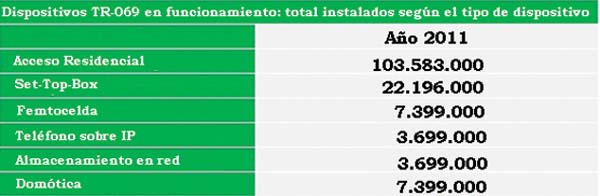
Home broadband networks, M2M networking, and cloud computing are expanding not only in terms of the number of connected homes, businesses, and subscribers, but also the total number and types of devices connected in each environment. A recently published report for Ovum, commissioned by the Broadband Forum, assesses the importance of TR-069 in the increasingly complex market for connected home devices and confirms the widespread market adoption of TR-069. The report, based on surveys of fixed-line operators, ACS and CPE manufacturers, as well as Ovum's own forecasts and a wide range of other data, shows that by the end of 2011, TR-069-enabled devices had reached 147 million. This is three times the figure initially projected by the Broadband Forum. One conclusion is that more and more organizations, operators, service providers, and equipment manufacturers are developing increasingly complex services and are looking to this specification to ensure their networks and devices are market-ready and adhere to global standards.
According to Ovum's analysis, broadband gateways constitute the majority of devices managed via the TR-069 protocol in the current market, representing approximately 70% of TR-069-managed equipment. However, Ovum predicts this percentage will decline over time as service providers become more actively involved in managing the entire home network experience, thus encompassing a growing number of devices. Ovum also estimates that TR-069 is being used to some extent by the vast majority of fixed-line operators worldwide to manage CPE across their broadband networks.
The role of TR-069 is therefore fundamental to providers' ability to monitor, manage, and control an increasingly complex array of connected devices, terminals, and equipment. This allows service providers to maintain high levels of end-user experience quality and provides them with tools to improve customer service—two important prerequisites for the successful marketing of bundled and multi-screen service offerings. With the advent of Broadband Forum certification, TR-069 provides the key to accelerating the exciting growth and potential of connected home services worldwide.