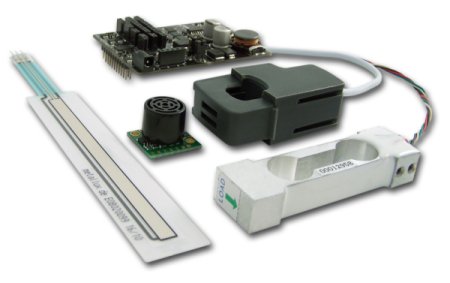
The new board expands upon existing features by supporting the measurement of the following key parameters: electrical current, water flow, weight of materials and goods, liquid level, distance, and object displacement. Applications include water and electricity consumption management, supply chain management, and manufacturing.
The European Union considers the widespread adoption of smart metering vital for reducing energy costs and carbon emissions. The 2009 Electricity Directive will ensure that every EU household is equipped with smart meters by 2022. Smart meters allow for precise monitoring and real-time control of energy consumption and are equally important for residential and industrial customers.
Most existing smart metering products are closed systems with limited wireless range, making them unsuitable for many industrial applications. Libelium's managing director, Alicia Asín, believes that "combining the new sensor board with Waspmote's extensive range of radios enables the measurement of electricity and water consumption in even the most remote environments." A wide range of ZigBee radio modules is available, including, for long-range applications, 868 MHz (for Europe) and 900 MHz (for the US). Asín adds: “Waspmote allows monitoring to be carried out wherever it is required, such as in garages, basements, remote machinery, or even inside walls.”
Industrial systems must be configurable and highly reliable. The modular Waspmote platform is easily configurable to meet a customer's specific needs. Users only need to purchase the boards and sensors required for their particular application. Many smart meters on the market rely on the electrical grid, meaning that if the power fails, the smart meter cannot function and therefore cannot send alarms. Asín adds, “With a battery-powered system and extremely low power consumption, Waspmote is completely reliable for alerting users in any situation. The electrical current sensor is suitable for both domestic and industrial use, as it supports up to 150 A.
The water flow sensor (capable of measuring flows in pipes from 0.15 to 60 liters/minute) is appropriate for measuring water consumption, detecting pipe leaks, and for irrigation in agriculture.
The term 'smart metering' often refers to monitoring electricity and water supply; however, it is a much broader technical challenge. Smart metering can not only be used to control urban supply but also offers the benefits of monitoring liquid tanks, warehouses (such as grain in silos), and the movement of goods.
For these other applications, the new board can be combined with a wide range of sensors. We can cite several examples: weighing goods during the manufacturing process with the load cell sensor up to 600 kg; checking liquid levels in a tank with the level sensor; measuring distances to objects with the ultrasonic sensor; and measure the movement of objects with the pressure displacement sensor.
Waspmote's modularity and transparency allow customers to install Smart Metering projects themselves. The new, versatile board, ideal for small and medium-scale installations, supports up to 6 sensors; the customer can choose the type and number of sensors to use. For larger-scale projects, Libelium offers a development service to create customized smart metering boards with one or two sensors.
Wireless Sensor Networks
Wireless sensor networks consist of battery-powered electronic devices with wireless communication (known as "motes") that collect data through sensors. Sensor networks are self-organizing to ensure high availability, scalability, and ease of installation. Applications are very diverse, ranging from environmental monitoring, fire or gas detection, livestock, agriculture, logistics, and security.
Waspmote
Waspmote is a modular platform for building wireless sensor networks. The platform comprises: the Waspmote board with microcontroller, Memory, battery, accelerometer and sockets for adding modules; open source API and compiler; different wireless communication radios with the Zigbee protocol with ranges of up to 40Km; various optional modules to add Bluetooth, GPRS and GPS communication; finally, a wide variety of sensor boards to measure gases, physical events and parameters needed in agriculture and smart metering.