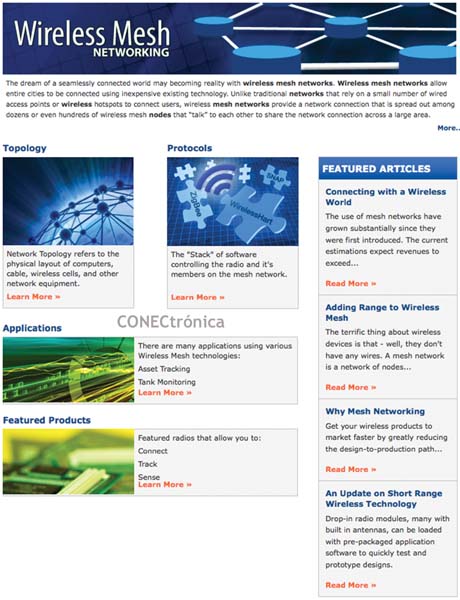
 Each device creates a "node" that can generate its own information, but also relays data from other devices across the network. Previously, mesh networks were wired, but wireless networks are low enough power and cost, and robust enough to ensure a reliable connection.
Revenue and Orders:
The use of mesh networks has grown considerably since their introduction. Current estimates project revenues will exceed $7 billion in 2014, with 100% growth in municipal infrastructure alone in 2010. Considering that there were over 8 million smart meter orders in North America in 2009, this represents a significant growth rate. Nearly 70% of utility bills could be influenced by wireless sensor networks, which could control heating and lighting to reduce energy costs.
Applications:
There are many applications for mesh networks besides the military, which is where the technology was first implemented. Industrial systems rely heavily on the certainty that the critical information they use to operate efficiently is always available. For example, smart gas meters use mesh networks to ensure that billing information is sent, even if there is a problem with some of the meters between the home and the meter.
Asset tracking is another application where it's vital, not only for knowing the location of assets within the chain of custody, but also for ensuring nothing is lost in transit.
This is another rapidly growing area, projected to reach $845 million in 2014, which in turn can save companies millions through its implementation.
Implementations:
Two of the most common types of wireless networks are ZigBee and Wi-Fi, but many others have also made their mark in this area. A controversial study by GE showed that ZigBee systems consume only 0.39 W over 24 hours, compared to the 0.87 W used by Wi-Fi solutions.
While this amount may seem small, given the size of the networks, it could equate to over $315 million when deployed across 1 billion devices. There has been some debate about the validity of the report, but it's clear this is a hot topic for many people.
ZigBee
was created with a mesh topology in mind. It leverages extremely low power consumption to ensure the network operates for a long time on a single battery, typically years before needing to be replaced. It can operate in the ISM band as well as the 2.4GHz range.
The Laird Z100S1, with an external antenna, has an outdoor range of 4.8 kilometers.
There have been some changes to the ZigBee stack. To make network creation easier, companies like Digi International have created a programmable module that simplifies the development of ZigBee applications by integrating an RF code-independent processor.
SNAP
is an abbreviation for Synapse Network Application Protocol. SNAP has a very small memory footprint of only 40 KB, leaving more memory available for other applications.
The Panasonic PAN4561, an application solution compatible with the Panasonic PAN4455, offers extended range through the use of low-noise power amplifiers.
CEL produces a single-chip RF transceiver with a baseband modem, a hardwired MAC, and an integrated 8051 microcontroller with internal flash memory for a complete solution.
WirelessHART
While there are 30 million HART devices, until the integration of WirelessHART, they were not used to their full potential or configured to provide device diagnostics.
The wireless aspect allows devices to be placed in more locations than before, while still getting all the benefits that HART offers.
RFM offers a transceiver module for WirelessHART. The XDM3620HP, which requires no onboard programming, is designed for industrial applications where long battery life is required.
alternatives
in the field of mesh networks include Bluetooth, Ultra Wide Band, wireless USB, and IR. Currently, there is no single solution that meets all market needs, although new developments are underway across all products to provide better coverage at a lower price while consuming less power. And while it will be years before mesh networks become a true "winner" in this space, the industry is still moving forward to take advantage of the many benefits they offer.
Greg Quirk has been a technical writer since 2004, focusing on semiconductor components, consumer devices, and business trends. He has written numerous articles for industry publications and presented at technical conferences.
His expertise has been sought by the financial community on multiple occasions to predict winning designs in popular consumer products.
Author:
By Greg Quirk, Mouser Electronics