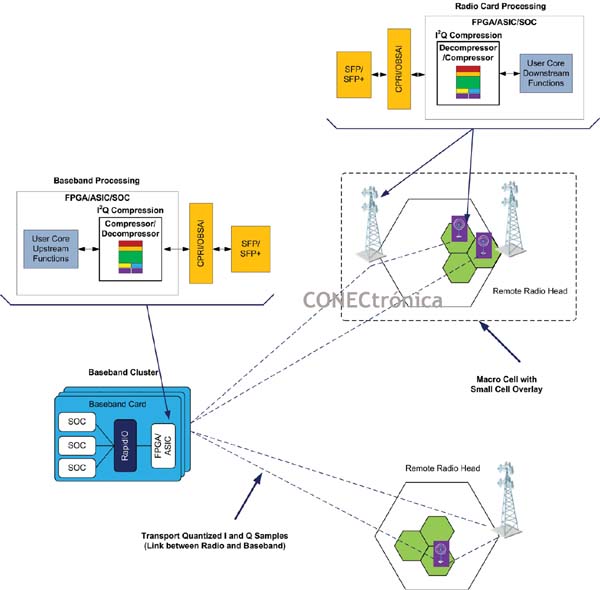
 Network architects can support a range of network topologies based on the C-RAN concept. Specifically, when deployed alongside macrocellular and microcellular networks, C-RAN-based small cell architectures are expected to deliver significant savings in capital expenditure and operating costs, which, in turn, could translate into savings for end users.
Link Requirements and Installation Options:
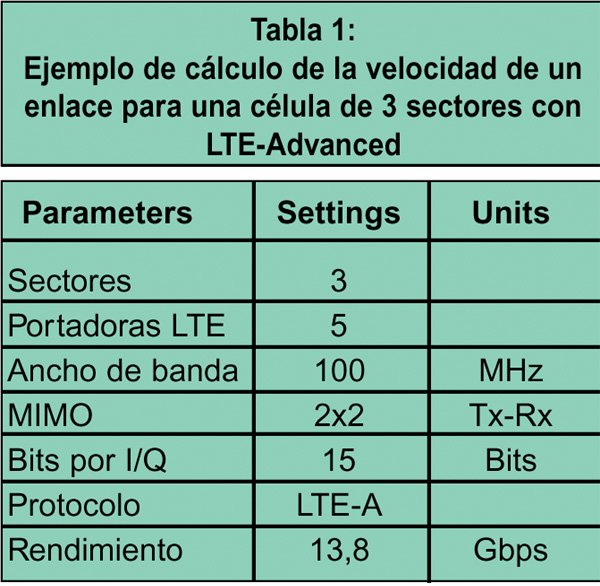
To improve network capacity and quality of service, both traditional and emerging architectures will meet the higher data transmission speed requirements offered by the LTE and LTE-Advanced protocols. These protocols offer significantly higher spectral efficiency thanks to a set of PHY and MAC layer techniques, such as Carrier Aggregation (CA), MIMO, Coordinated Multi-point (CoMP), interference cancellation, and others. Specifically, LTE-A offers the aggregation of up to five 20 MHz LTE carriers. When combined with MIMO, CA techniques can achieve speeds of up to hundreds of gigabits/s between the radio and baseband units (i.e., the local or front-haul link). Once I and Q sample quantization is available, the receiver can apply various types of interference cancellation, MIMO decoding, and CoMP algorithms to improve the signal-to-noise ratio in the network. Table 1 shows an example for calculating a 3-sector LTE-A system with five 20 MHz carriers.
For data transport over the local link, operators can use existing fiber or cable connections. Alternatively, they can employ emerging technologies such as wireless front-haul. The decision to implement these technologies is generally influenced by infrastructure limitations. For example, in densely populated urban areas, installing new fiber is complicated, or a space-saving solution is needed; in such cases, a wireless link would be more suitable. On the other hand, in areas that already have fiber optic connections, operators can leverage the existing infrastructure.
Regardless of deployment, equipment suppliers must provide an efficient, low-power solution that can be easily adopted by larger-capacity systems. These efficient solutions typically result in the use of low-cost optical connectors, a reduction in the number of links, and improvements in spectral efficiency in the local link network. One way to achieve these savings is through data compression. For example, with 2:1 compression in the local link in C-RAN and small cell networks, it is possible to achieve data transmission speeds of up to 4.9152 Gbps while using an optical connector that only supports up to 2.5 Gbps. By using optical connectors with lower data transmission speeds and fewer links, both cost and power consumption can be reduced. Furthermore, with this configuration, it is easy to transport 15-bit I<sub>I</sub> and 15-bit Q<sub>Q</sub> samples for up to three sectors with 2x2 MIMO and two LTE component carriers (one at 10 MHz and one at 20 MHz) in a single system. This, in turn, offers the opportunity to apply advanced interference cancellation and load management techniques, based on the quantization of I and Q samples, which reduce the cost and power consumption of the system in the radio access network. Figure 1 illustrates an example of a system architecture based on C-RAN and a small cell with I2Q compression.
Performance Requirements:
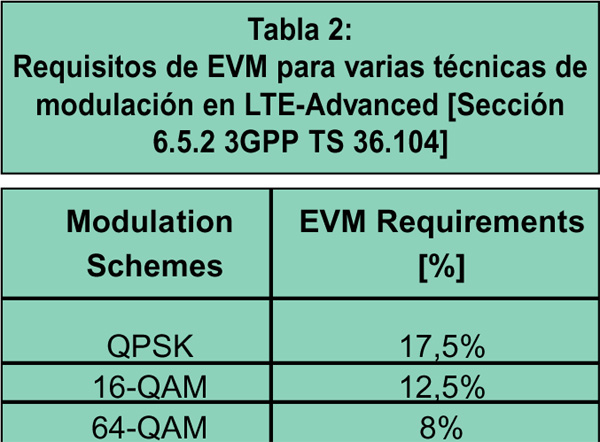
Along with improved spectral efficiency, wireless protocols maintain a certain signal quality (e.g., error vector magnitude or EVM) to ensure a specific quality of service across the network. Furthermore, EVM requirements can vary depending on the modulation techniques. Table 2 summarizes the LTE-A EVM requirements for various modulation techniques. Other wireless protocols, such as WCDMA and GSM, have similar requirements.
Example of Performance:
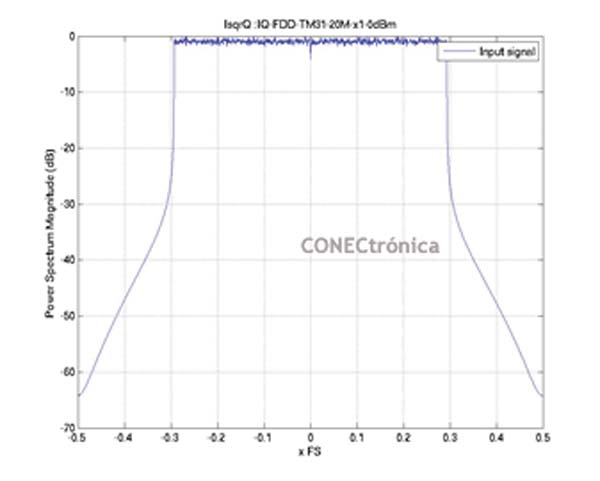
To achieve a higher level of quality of service, the compression technology used in the front-haul network should meet the EVM requirements specified by the wireless protocols. Furthermore, the chosen compression methods should maintain sufficient headroom for other modules in the signal chain, so that operators can achieve EVM performance along with improved network throughput. Figure 2 shows a typical example of signal spectrum in the 3GPP E-TM3.1 downlink and the corresponding EVM performance with I2Q data compression technology. In this example, a 20 MHz LTE-A signal is compressed and decompressed with an EVM of less than 1% RMS for a compression ratio of 2:1. This leaves sufficient headroom for the other modules in the signal chain to meet the EVM requirements in the system.
Abstract:
Organizations and operators are evaluating various compression techniques for a simple evolution to higher-capacity systems in traditional and emerging radio access networks. With a higher level of EVM (Enhanced Value Management), it is possible to achieve data compression in wireless networks while maintaining sufficient headroom for other modules in the signal chain. Based on available I and Q samples in a compression-ready solution, system architects and OEMs will have the opportunity to optimize system performance through a suite of advanced signal processing and network resource sharing techniques in emerging C-RAN (Computer-Aided Rank-to-Radio) and small cell networks.
Author:
By: Mohammad Akhter, Chief Architect, Integrated Device Technology, Inc.