

Consequently, an increasing fraction of internet traffic is transmitted wirelessly. How to cope with this growth is one of the most important challenges for future wireless networks.
In contrast to wired networks, where network capacity can be increased simply by installing additional fiber optic lines, increasing the performance of wireless systems is much more difficult. Wireless links already operate near their theoretical physical limit, and further efficiency gains are unlikely. Consequently, the most promising option for substantially increasing capacity is to increase communication bandwidth, since the achievable data rate is directly proportional to bandwidth. While some efforts are focused on reallocating lower-frequency radio spectrum, which is currently used for purposes other than data communication, sufficient bandwidth to support the exponential growth in mobile data traffic is available only in the very high frequency (VHF) portion of the wireless spectrum. At the same time, achieving efficient spatial reuse is of paramount importance, and it is estimated that this has increased wireless capacity by a factor of 1600 over the past 50 years. In the past, this has been achieved primarily by reducing the size of mobile network cells—that is, the area served by a single mobile base station. Mobile networks are also increasingly using base stations of varying cell sizes (a practice known as "overlap")—macro-, micro-, and femto-cells—to improve network efficiency and spatial reuse.
The push toward higher frequencies is evident, for example, in the evolution of the IEEE 802.11 standard (on which wireless products using Wi-Fi are based). To date, widely used standards such as IEEE 802.11 (namely, IEEE 802.11b/g/n) utilize the unlicensed 2.4 GHz and 5 GHz bands. The forthcoming IEEE 802.11ac standard, however, operates only in the 5 GHz band, as the available bandwidth at 2.4 GHz is insufficient to achieve the anticipated data rates. While these two frequency bands have desirable radio propagation properties, they simply do not provide enough bandwidth to meet future capacity demands, even considering that regulators may make unlicensed spectrum available for Wi-Fi in the near future. The latest IEEE 802.11ad standard takes a significant step forward by focusing on the unlicensed 57-64 GHz spectrum, known as the 60 GHz band. At 7 GHz, it provides 80 times the bandwidth compared to the lower frequency bands used for 802.11 and promises data rates of nearly 7 Gbit/s. Recent advances in CMOS design (a technology widely used for building integrated circuits) enable the construction of low-cost 60 GHz radio hardware, and therefore there is significant commercial interest in bringing 60 GHz devices to market in the coming years.
Despite possessing advantageous properties, this part of the spectrum suffers from high attenuation and signal absorption, which restricts communication primarily to relatively short line-of-sight connections. (Line-of-sight, commonly known as LOS, is the high-frequency radio propagation characteristic whereby, in general, any obstruction between the transmitting and receiving antennas will block the signal.) Consequently, IEEE 802.11ad use cases typically involve the use of high-gain directional antennas to compensate for this loss. Such directional antennas work particularly well in static point-to-point scenarios such as cable replacement, providing high-definition video streaming between a Blu-ray player and a television screen, or transferring files at high speed for data synchronization with a mobile device. Switching to other technologies (for example, if a line-of-sight path becomes unavailable) is explicitly supported through the Fast Session Handover feature. This allows for the complete transfer of a session from IEEE 802.11ad to the legacy IEEE 802.11, which operates at lower frequencies. It also supports implementations where IEEE 802.11ad provides small, high-speed communication islands, while overall coverage is achieved using low-frequency technologies.
To cope with the exponential increase in wireless data in the future, significantly higher bandwidths (with higher carrier frequencies) and efficient space utilization are necessary, requiring a radical rethink of wireless networks. Further reductions in cell size and similar measures used to improve capacity in the past are far from sufficient to provide the necessary gains. Analogous to the evolution of Ethernet cabling from a shared medium to a fully switched network, we believe wireless networks must evolve from using the wireless channel as a shared medium to providing highly optimized channels to wireless devices.
The key to scalability in future wireless networks is therefore providing a large number of highly directional individual channels for communication between access points (APs) and end devices. This has two main advantages. First, highly directional antennas provide the antenna gains necessary for efficient high-speed communication in the very high frequency domains, which experience a high degree of attenuation. At such frequencies, communication primarily requires line-of-sight channels. Second, due to their directionality, such a system imposes very little or no interference on other end devices and thus enables spatial reuse that is several orders of magnitude greater than that of current technology. All these considerations apply even more to future terahertz communication systems, which will operate at even higher frequencies, above 300 GHz.
The main challenge for this type of approach is the dynamic nature of the radio environment. Combined with mobile end devices and human movement, even an indoor environment is extremely dynamic, and channels can appear and disappear for very short periods. At the same time, since such channels experience very little interference, the resources (time, frequency, signal processing, etc.) that would otherwise be used to manage interference can now be used to further increase the achievable data rate between the transmitter and receiver. To provide sufficient line-of-sight channels, access points may need to be deployed ubiquitously and may far exceed the number of mobile devices.
IMDEA Networks' research focus in this area is the design of a wireless network architecture that maintains a number of directional line-of-sight channels between multiple access points and end devices, as shown in Figure 1. Data is transmitted simultaneously across all these channels. An end device uses multiple antennas to receive and decode several of these data streams, and the greater the number of streams received, the higher the data rate achieved at the receiver. The main design complexity lies in the selection of access points and the beamforming configuration of their antennas, given the large number of end devices that future wireless networks will need to support. As a backup, when directional channels cannot be established and for the timely transmission of control information, the system also employs a conventional wireless local area network that does not require line-of-sight channels or directional antennas.
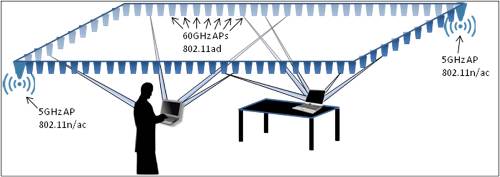
Spectrum for the masses: networks in the millimeter wave band
Compared to state-of-the-art wireless systems, we expect this type of architecture to:
Be scalable to very high bandwidths and allow unprecedented levels of spatial reuse, while maintaining very low levels of interference.
It can be scaled to a much larger number of access points than current implementations, by centralizing intelligence and processing in the wireless network controller and encoder/decoder module, thus keeping the cost and complexity of the access point low.
It can operate at a similar or lower energy consumption level compared to current systems thanks to sleep mode mechanisms, despite the large increase in the number of access points.
We believe this project will have a substantial scientific impact by providing a promising pathway for advancing the design of next-generation wireless networks. It addresses the major challenges in wireless communication—bandwidth, interference, spatial reuse, and processing complexity—to deliver a more scalable, energy-efficient, and cost-effective wireless network design. This research is being conducted as part of the SEARCHLIGHT project, a €1.7 million ERC Consolidator Grant awarded by the European Research Council (ERC). ERC Grants are the most highly funded individual grants for researchers in Europe and a major indicator of excellence in scientific research. This project runs for five years, from April 2014 to March 2019.
*Complementary metal–oxide–semiconductor.
By Joerg Widmer, Research Professor & Research Strategy Manager, IMDEA Networks Institute








