During the event, Teo Holguín, Applications Engineer at Vertiv Spain, presented these innovative solutions and affirmed that the data center market is experiencing constant growth and development. Therefore, Spanish engineers are opting for products that maximize cooling density and ensure continuity. One of the options offered by Vertiv is cooling solutions for data centers without raised floors, which offer numerous advantages.
An option that addresses the challenges
Despite global challenges such as supply chain crises, rising raw material and product costs, and a shortage of skilled labor, the construction of large data centers is becoming increasingly prevalent in the country. Most of these data centers utilize floor-free cooling technologies.
This type of cooling focuses on four fundamental objectives that address the needs of data centers. First, it seeks standardized solutions that can be implemented in all data centers worldwide, significantly minimizing construction time and time to market, reducing costs (CAPEX and OPEX), and decreasing resource consumption.
Installing a high-quality raised floor is expensive and time-consuming, so technologies that deliver air directly into the room are increasingly being chosen. However, in applications that do not use a raised floor, air distribution throughout the room is more complex than in traditional raised floor air delivery systems. Therefore, the design of these types of applications is often more complex, requiring CFD studies to validate the room layout and ensure that the required redundancy is maintained against various failure scenarios.
Two distinct cooling architectures
Another topic of discussion during the day was the observed need for larger air supply surfaces. Based on this premise, two different cooling architectures have been developed:
Perimeter Units: This type of air conditioning is a concept developed from the adaptation of a conventional, high-capacity CRAH (computer room air handler) and is used in data centers requiring air conditioning units with a capacity of up to 250kW, although they can be adapted to smaller systems. The unit consists of two modules: the fan module, located at the top of the unit, and the coil module, which has a large air outlet surface on the front or back to adapt to different layouts. This solution eliminates the need for a technical corridor because the units can be located within the IT room. The goal of this solution is to minimize the CAPEX (capital expenditure) of the air conditioning system.
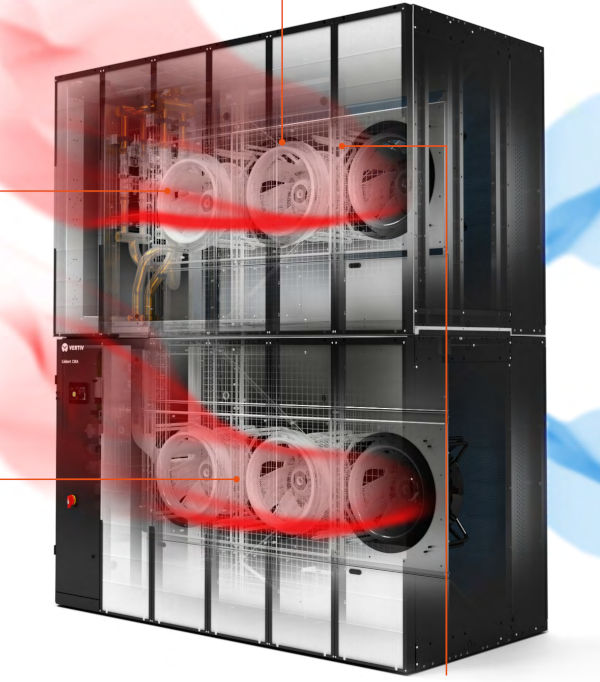
Thermal wall units installed in service corridors: This is a standardized product, previously implemented in the USA. Currently, they have been adapted to European market standards using dedicated laboratories specifically designed for this type of product. The launch of these products reinforces Vertiv's mission of technological innovation, enabling customers to optimize the design and operation of their data centers. The concept was developed by adapting an AHU (air handling unit): air passes through filters, fans, and a coil, and the equipment must be installed in a technical corridor. While taller than the mega CRAH, these units will achieve greater power and efficiency, thus reducing the operating expenses (OPEX) of the air conditioning system.
Finally, Teo Holguín spoke about one of the solutions recently launched by Vertiv:
Vertiv™ Liebert® CWA is a cooling wall solution designed to raise the technological bar for water-cooled air handling units in floorless applications. By implementing this product, customers can take full advantage of floorless layouts, including cost and time savings, as well as increased cooling capacity and density. It was designed to provide uniform air distribution in floorless applications while also allowing for more space for rack installation and increased computing density.