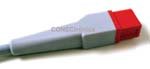
 To meet this challenge, many equipment manufacturers use a cable shield for their cable assemblies. A shield improves electrical and mechanical integrity, as well as overall performance, by facilitating the transition from a flexible cable to a rigid connector or connection point.
A properly designed cable protector, sometimes referred to as a cable clamp, prevents mechanical forces to which the cable is exposed from being transferred to the electrical terminals inside the connector or device.
This design serves a vital function because mechanical forces can cause cable assembly failures and incorrect outputs in medical devices. The protector is essential for improving healthcare because it helps ensure that devices provide accurate patient data to medical professionals.
Prefabricated or Custom-Made
Protectors: Protectors can be prefabricated or custom-designed and manufactured for a specific application. For example, a custom protector that functions as a separate unit can be placed or molded over a cable, typically covering part of the connector.
Prefabricated protectors are typically placed over the cable before the connector termination. After the cable conductors are terminated in the connector, the protector is screwed or glued to the connection system. Most standard conductors have prefabricated protectors for various cable diameters and are often available in different colors.
Generally, a well-designed, custom-molded protector offers more advantages than a prefabricated protector:
- Greater flexibility
- Greater tensile strength
- Excellent moisture protection
A cable gland with an integrated protector is generally used when a cable is permanently connected to a device. Cables anchored to a device by passing through a hole typically use a cable gland for anchoring and are protected from damage caused by axial loads. If the cable is subject to bending, a cable gland is usually used in combination with a protector for through-hole applications.
Design considerations
Raw wires and cables typically withstand more bending cycles and have higher tensile strength than wire assemblies. The cable termination is generally considered the most likely point of failure. A well-designed protector addresses this challenge by insulating the electrical terminations to prevent force from impacting these points.
Design considerations also include the geometry of the part, the interaction between the protector and the cable jacket material. Tensile strength will be further increased if the protector is chemically bonded to the cable jacket and the connector body, and the bond strength between the protector and the connector can be further enhanced by incorporating features that allow the protector to physically bond to the connector body.
Cable assembly designers can achieve even higher tensile strength levels by crimping a clamp into the cable sheath before molding. By overmolding the sheath, the clamp incorporated into the molding material significantly increases the tensile strength of the assembly.
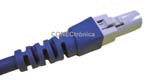 Solid or Segmented:
Shields also offer the flexibility of choosing between a solid, smooth design and a segmented one. A solid shield is easier to clean, which can be an important consideration in many medical applications. Conversely, using the same materials, sizes, and geometries, a segmented shield offers greater flexibility but with the drawback of being more difficult to clean.
Appropriately designed segmented protectors consist of walls and spaces that allow for longer distances between the bend radius and the connector or connection point. The size of the solid sections and the distances between them vary to achieve the desired bend radius. These protectors are designed so that the segment closest to the fixed point closes first, and the segment farthest from the fixed point closes last. This provides optimal bend protection while also protecting the electrical terminations inside the connector.
Cable protectors typically flex on one axis (unidirectional) or two axes (multidirectional). A unidirectional protector works best when the cable or wire exiting the protector is not round, as is often the case with spliced cables or wires. In this case, the cable design, not the protector, limits the flex to one axis.
The length of the protector also contributes to performance. As a general rule, a longer protector is more effective than a shorter one. However, attention should be paid to how the cable is stored in clinical applications.
As experience shows, cables that remain attached or coiled around a portable device subject the assembly to continuous tension. In this case, a shorter protector may be more effective as it allows for a larger bend radius at the protector's cable end.
Customized or standard.
A molded over-the-cable protector offers superior performance on several levels compared to a prefabricated protector:
- Enhanced moisture protection thanks to the physical and chemical bonding of the molded shield over the cable jacket and connector, an important consideration for cables that are frequently cleaned or exposed to liquids.
- Increased tensile strength due to the molded bond.
However, there are two more factors that may lead designers to opt for a prefabricated protector, instead of a custom overmolded solution: the time required to design and manufacture the device and its production costs.
Author: Hank Mancini, Marketing Manager at Affinity Medical, a Molex subsidiary
About the author:
With over 30 years of experience in the healthcare industry, Hank Mancini, Marketing Manager at Affinity Medical, a Molex subsidiary, understands virtually every facet of the medical business. He has experience in marketing, manufacturing, new product development, sales, and strategic management.