Let's take CubeSats as an example. These are very small, cube-shaped satellites, each side measuring 10 cm and weighing less than 2 kg. CubeSats have been deployed by the International Space Station or launched as secondary payloads. To date, thousands of CubeSats have been launched.
Naturally, size and weight are extremely important, but since the CubeSat's goal is low-cost launch into space (launch costs range from $60,000 to $100,000, with construction costs starting at just $50,000), minimizing component costs is also essential. If we consider the consumer electronics sector, such as cameras and other portable personal electronic devices, we find numerous examples of very inexpensive, lightweight, and miniature connectors. However, in an aerospace or space application, these connectors would not be able to withstand the shock and vibration levels of launch. An article by Dave Pignatelli of California Polytechnic State University, titled 'Improving Launch Vibration Environments for CubeSats', explains that "the levels (of shocks and vibrations) experienced by a CubeSat vary due to several factors, including the characteristics of the launch vehicle and the test, the method of payload dispensing and limiting, as well as the implementation of the isolation," but "the levels for an internally isolated CubeSat ranged from 3.7 Grms to 4.4 Grms," although in other applications and configurations it will be much higher. There is also the problem of temperature change. A satellite's flight path could cause the CubeSat to experience very high or sub-zero temperatures when exposed to direct sunlight or when passing, as Pink Floyd sang, the far side of the Moon.
It's clear that a different type of interconnect is needed, and often the preferred option is a commercial device that meets the performance requirements set by organizations like NASA or the military, but which may not fully comply with the standards. These devices are often much cheaper than fully certified devices for defense applications but withstand the high demands of the harsh environments in which they will be used.
There is also another issue to consider: the connectors that are NASA certified may have been designed 30 or 40 years ago.
In the commercial space market, a connector designed in the 1980s might not be the best component for the application in terms of size, weight, performance, and cost (SWaP-C). It might also be necessary to acquire prototype design devices from a distributor (such as Powell), who can supply samples from their stock. High-reliability connector manufacturers like Harwin often contact companies in the commercial space sector, which desperately try to avoid NASA and ESA standards whenever possible for this reason, and because older, high-reliability connectors would become unsuitable. What worked for the Voyager 2 space probe to investigate Neptune 40 years ago is unlikely to work for deploying a constellation of 300 low-Earth orbit communications satellites to provide broadband to Africa. The challenge is entirely different.
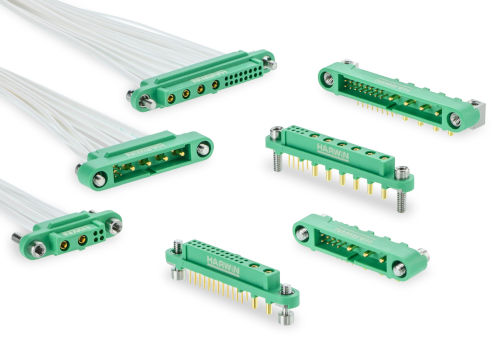
Therefore, it is clear that we need a modern interconnect solution with the environmental properties (shock, vibration, temperature) of military devices, but also with the space, weight, and cost advantages of a much newer design. Powell distributes products from Harwin plc, a well-established supplier of high-reliability interconnect solutions. The company maintains key production facilities at its Portsmouth, UK, plant, enabling it to guarantee the highest quality standards. Several years ago, the company introduced its Gecko family of 1.25mm pitch connectors. These connectors offered significant space savings compared to traditional Micro-D connectors. Furthermore, because their design is based on robust plastic rather than metal, they allow for considerable weight and cost savings.
 Gecko
Gecko
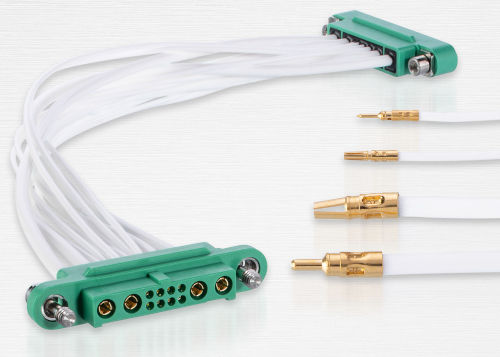
family with the addition of mixed-type versions. By complementing the data contacts with two or more power contacts (in 1+8+1 or 2+8+2 power/data configurations), the Gecko-MT connectors further reduce the space and weight required in electronic hardware. Harwin has also recently added six new contact arrangements consisting of 2 to 6 power contacts and 4 to 24 signal contacts. Their structure is not symmetrical; the power contacts are located at one end and the data contacts at the other. All configurations are characterized by a maximum current rating of 10A and 2.8A per contact for power and data, respectively.
The Gecko-MT connector range comprises female and male cable connectors, as well as vertical female and right-angle male connectors for printed circuit boards. These components incorporate robust, screw-on stainless steel fasteners (in both conventional and reverse configurations) to ensure interconnect integrity even in the harshest application environments. They withstand 20G vibrations and 100G shocks, while their operating temperature range is from -65°C to 150°C. They also feature low outgassing.
Gecko-MT connectors, which handle both data and power in a single, compact, and lightweight solution, are highly optimized for aviation, defense, space, and motorsports applications. Key applications include robotics, unmanned aerial vehicles, battery management, and satellites. They are available from stock and through Powell, Harwin's distributor. Harwin's wiring products are also available through Powell. Tools for reliably joining cables and connectors can be expensive, so purchasing a complete, proven product offers users significant cost savings and greater peace of mind.
Robert Webber, Product Specialist, Powell Electronics