HARTING maintains a long-standing collaborative relationship with wind turbine system manufacturers and their suppliers. The company works closely with manufacturers and suppliers to develop new and innovative system solutions.
All HARTING systems meet the stringent requirements of the wind energy sector. The systems are designed to operate in temperatures ranging from -40°C to +80°C and to provide high electrical and mechanical immunity to rotational stress, vibration, and shock. Recent examples include a slip-ring plug-in coupling and a rechargeable battery backup with lithium-ion cells.
 Part 1: Plug-in Slip Ring Coupling.
Slip rings connect the hub (rotating) to the nacelle (fixed) and are among the components that are regularly replaced in wind turbine systems.
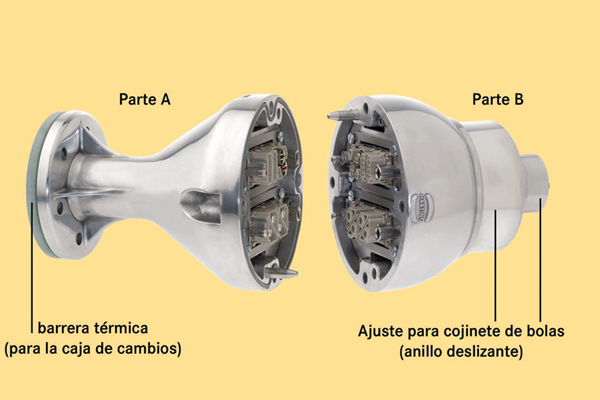
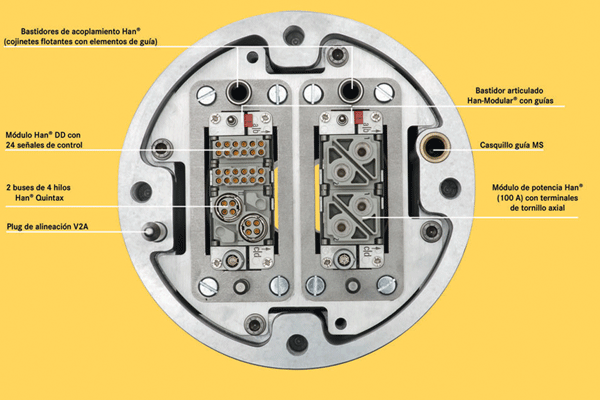
The new plug-in coupling simplifies the installation and replacement of slip rings, reducing downtime. The slip rings can be changed during a single service intervention without interfering with the tilt system or disconnecting any cables. No special tools are required. Two stainless steel bolts in two brass bushings act as guides during the coupling operation. Subsequently, two Han® coupling frames with floating bearings and the Han-Modular® articulated frames ensure that the electrical contacts are correctly aligned, guaranteeing high operational reliability of the connection.
 In addition to providing an electrical connection, the HARTING slip ring coupling has a built-in thermal barrier that offers enhanced protection against excessive oil reservoir temperatures. Existing power generation systems can be easily retrofitted with the slip ring coupling.
The interface between parts A and B provides IP65 protection against water splashes. The housing is permanently cast from a special aluminum alloy.
The electrical interface, which carries signals to the tilt control system in the hub, uses Han-Modular® contact insulators. The interface has 100 A modules for three-phase power transmission, as well as a Han®-Quintax for the two 4-wire buses (from CAN bus to Fast Ethernet), and also carries 24 control signals. The number of control signals can be increased to 34 using Han® DDD modules.
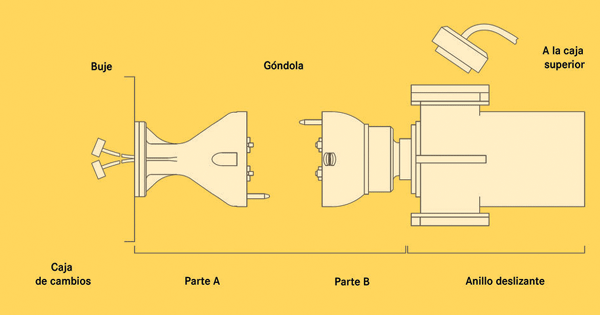 The coupling is supplied as a complete solution, including the necessary cable length. The two parts are assembled and tested separately. Part A is installed on the wind turbine. Part B is initially connected to the slip ring. The advantages of the plug-and-play technology are quickly apparent on-site.
The two parts simply need to be connected during the commissioning phase, eliminating the need for on-site installation or assembly, thus saving time (Figure 3)
The same principle applies to maintenance. Service technicians only need to loosen four bolts, remove the old slip ring, and install the new one. The wind power generation system can then be reconnected to the grid with minimal downtime. The old slip ring can be refurbished in the workshop or at the plant.
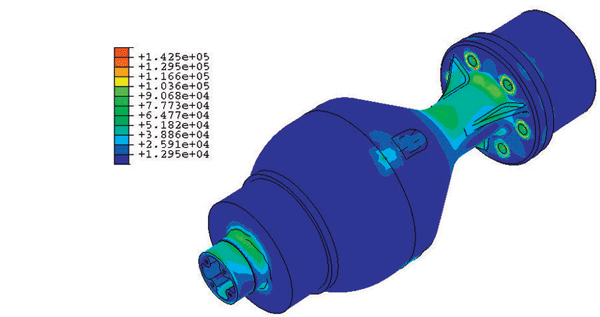
A simulation is performed during the conceptual phase to optimize the design. Virtual prototypes can be created to design components that can handle high currents, withstand vibrations, and offer good stability. Finite element analysis is used to optimize and verify the coupling design.
 A 150 kg weight was placed on the end of the sliding ring to simulate different load scenarios. The entire solution was designed to withstand the loads generated during commissioning and maintenance activities. The simulated values were evaluated on first-product samples in a HARTING-approved laboratory, which in this case meant conducting mechanical load tests. The results showed that the actual values were considerably better than those predicted by the
theoretical model.
Part 2: Rechargeable Battery Backup Box (Worst-Case Lithium)
There are further opportunities to improve the energy storage units that supply power to the tilting system of wind turbines. Backup power ensures that the rotor blades can be repositioned if a power failure occurs during a storm or some other catastrophic sequence of events takes place. In this type of emergency, the turbine must stop immediately, and the rotor blades must be turned away from the wind within seconds. This functionality is crucial because a failure in the tilting system could cause a total wind turbine failure.
Each axis of the tilting system shifts to a neutral position in an emergency. A wind turbine typically has three battery backup units, and the modular design facilitates their replacement.
Conventional energy storage solutions, such as lead-acid batteries, are not ideal for achieving a compact design and maintenance-free lifespan. The new battery backup unit incorporates lithium-ion cells, which are largely immune to the type of rotation and vibration that occurs in wind turbines.
A robust, electrostatically coated metal casing provides effective protection against mechanical and thermal stresses and prevents contact with hazardous components. HARTING's connector technology reduces the total internal resistance to RI < 24 mW.
A CAN bus (9-pin, Sub-D) handles communication with the central control unit. Additional interfaces are available for monitoring and configuration. The BMS status can be accessed via an RS232 port (9-pin, Sub-D). HyperTerminal functionality provides information on the status of each battery.
A Han® 3A interface provides redundant monitoring of the battery's state of charge. The 24 V control voltage is supplied via a second Han® 3 A connector.
Particular attention was paid to the effects of vibration and shock on contact resistance during testing in the HARTING-approved laboratory during the engineering phase. The aim was to design the contacts and cable cross-sections for optimal performance under extreme conditions.
The following standards were used during the design phase:
- Impacts: DIN 60 068-2-27.
- Shocks: DIN EN 60 068 -2-29.
- Accelerated service life: DIN EN 61 373.
The authors
Key Account Manager System Integration
HARTING Technology Group
Project Manager VAB, Germany
HARTING Technology Group
Director, Project Manager, VAB, Germany,
HARTING Technology Group