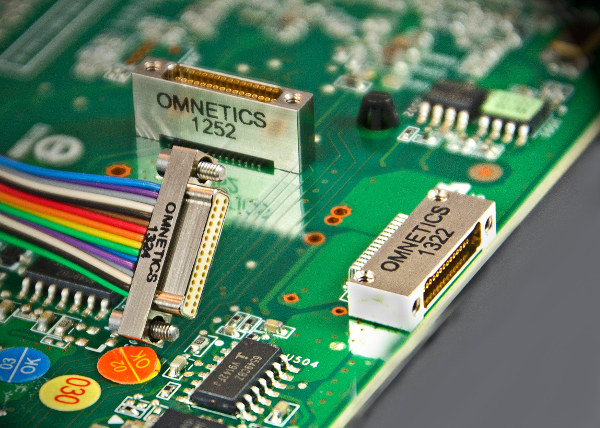
Omnetics Connector Corporation has achieved exponential sales growth for its Metal Nano-D connector series, developed in compliance with military standard 32139 for robust, compact, high-density interconnects. Nano-D connectors are distinguished by their 0.635mm pin pitch, unlike the older, twice-sized Micro-D connector.
Overall, the connector market is growing in six areas collectively known by the acronym FESTER, which stands for 'Faster', 'EMI-shielded', 'Smaller', 'Tough', 'Easy to lock', and 'Rapid design and delivery'. The Nano-D connector meets all these requirements and can also be quickly modified to suit any customer's or application's design criteria.
Among the applications driving demand for Nano-D are wearable electronic devices, used in numerous sectors, from mountaineering to ground troops. Electronics installed in soldiers' helmets and vests help the military maintain constant contact with battlefield control and receive maps, images, and other critical information.
Another application fueling the Nano-D connector boom is in unmanned aerial vehicles (UAVs), primarily due to the demand for robustness and light weight. For the same reasons, robotics manufacturers are also adopting Nano-D. Notably, this connector is large enough to deliver 3 A of current per pin if needed, and simultaneously, it can handle high-speed differential signal processing data, such as USB signals up to 5 Gbps.
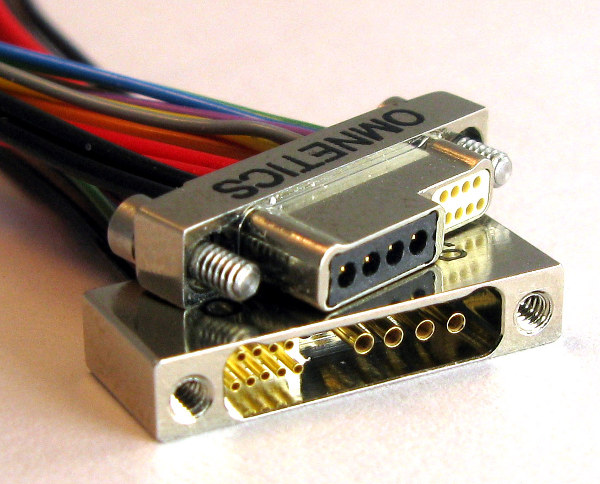 Looking to the Future:
Among the most important areas for Omnetics is the robust miniaturization of high-speed digital signal processing. This area is considered a priority because an evolution of highly portable Ethernet systems, single-board computers, portable surveillance systems that capture large volumes of data, and emerging chip technologies focused on processing data at increasingly higher speeds will likely become available.
Among the new products available are HDMI and USB-C connectors that are smaller and more robust than their existing standard-type counterparts. There are often requirements for a standard USB connector on one end of a copper cable and a high-density connector on the other. With this in mind, Omnetics is working closely with various cable designers to establish a new level of innovation and performance that surpasses currently available commercial products.
For good reason, design engineers are often eager to learn about the special features of hybrid connectors and cables, which reduce the number of cables in the system, require less space where the connector connects to the module, and ultimately allow the customer to save money. At Omnetics, hybrid connectors focus on quick, custom configurations that integrate various signal technologies into a single connector and cable.
Special Designs
Although Omnetics offers a number of standard hybrid connectors, the increasingly shorter lead time between design and product means the company is working more with designers who try to meet specific criteria. For example, a common requirement is the need to combine power, signal, and speed in the same connector.
Once this requirement is received, Omnetics can work closely with the design engineer to determine the magnitude of each signal type and the power required to optimize the connector's performance and functionality for each application. The process typically begins with the design of a standard micro or nano-sized connector before modifying the insulation, pins, and socket. Solid modeling software is used to accelerate this phase of the project, and once completed, the design is sent directly to the customer. After review, a rapid prototyping tool is used to machine the correct holes in the insulation so that the pins fit the selected sockets.
It is crucial to have experts in the main technical aspects involved at all stages of these projects. For example, when speed and power requirements are combined, cable design becomes a key element. High-speed differential signal pairs must be twisted together in a wrapping process that accelerates performance before adding drain wires. The three wires are then shielded with a metallic foil to prevent noise interference to and from adjacent cabling. Power signals are also known to generate hum, noise, or jitter in the cable and connector. Therefore, hybrid elements are isolated or placed separately from lower-voltage signal cables.
Compact size, light weight, robustness, and higher signal transmission speeds are some of the key features of Omnetics hybrid connectors. As a result, interest in hybrid connectors has grown significantly, especially since custom prototypes can be developed to meet specific customer requirements. With these connectors, engineers no longer have to choose between size and function.
Chip Technology:
In the future, chip technology could prove to be the driving force behind the development of cables and connectors. It is noteworthy that CMOS (Complementary Metal-Oxide Semiconductor) technology has achieved higher speeds, and the market offers a greater number of GaAs (gallium arsenide) and GaN (gallium nitride) devices, especially for lower voltages and currents. As speed and voltage requirements increase, increasingly smaller cables and connectors will be needed.
The miniaturization of hybrid interconnects and connectors certainly brings some challenges. When using hybrid cables and connectors, the printed circuit board must be designed to accommodate different signals received from nearby sources. Power signals typically enter the board from the back, while high-speed signals arrive from the front. Although design engineers want to take advantage of combining signal and power, they must also manage the signal entering and leaving the board. Furthermore, the high-speed differential signal arrives via a pair of wires, so both signals must be the same length for the processor. Any difference in the signal's arrival time causes signal skew, eventually leading to pixilation or signal loss.
Miniaturization Trends
The miniaturization of hybrid connectors has increased the demand for small but robust retention or locking hardware between the connector and the socket. Clearly, finding space and avoiding tools is important, which is why Omnetics' new retention connectors have been developed and tested to exceed the same shock and vibration standards as older, screw-required connectors.
All of this leads to the next question: when will miniaturization reach its limits? To arrive at an answer, it's important to remember that signal integrity management has always been the key element in connector technology. Omnetics has tested the number of plug-in/plug-out cycles a connector can withstand, a key characteristic for potential failure. Connectors manufactured by Omnetics achieve more than 10,000 plug-in/plug-out cycles without failure, while some competing miniaturized connector designs fail at a much lower number.
Finally, physical retention and connection will continue to pose challenges to the industry as connectors decrease in size. Furthermore, cable robustness and reliability—due to the reduction in the size of internal connecting wires and cable diameter—may impose limitations on some designs. In the long term, proximity-based inductive coupling may become more or less commonplace, similar to how many mobile phones are charged by bringing them close to a power source.
Author: Bob Stanton, Chief Technology Officer, Omnetics Connector Corporation