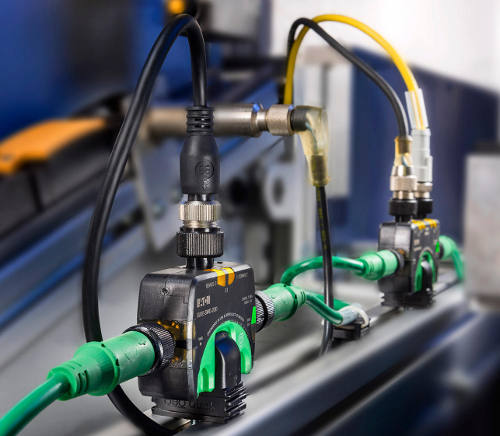
As a result, system manufacturers now have new possibilities that provide them with greater freedom of choice and enhanced diagnostic capabilities in an integrated system architecture.
The new devices provide users with much simpler configurations from design to assembly: building new systems and modifying existing machinery can now be done with less wiring and reduced material usage.
Conventional methods for connecting sensors and actuators to machine control systems present numerous challenges. With centralized control, all but the simplest systems require significant materials and labor, especially if the machine covers a large area. However, with decentralized control using remote I/O modules, the module design often doesn't align with the number and type of peripheral devices at each location, leading to unnecessary machinery costs. In both cases, another problem arises: the difficulty of scaling and modifications.
With the addition of the IP67 I/O module to the SmartWire-DT network, Eaton has addressed these issues. SmartWire-DT allows up to 99 devices to be connected directly to the control system using a single cable up to 600 m long. The new module enables these devices to incorporate any sensor from Eaton's extensive portfolio, ranging from mechanical position switches to high-performance inductive, soft, and optoelectronic sensors.
Because the IP67 I/O module has a standard M12 power connector, it can also be used to connect all standard sensors and actuators with M12 connectors to the SmartWire-DT system. For sensors with their own power supply, a power meter can be used to confirm that the sensor is correctly connected, simplifying and speeding up system testing. The module's status and diagnostic messages can be displayed from any connection point within the SmartWire-DT system.
The benefits of the SmartWire-DT approach are evident in a wide range of applications. For example, when using a combination of digital and analog sensors and actuators, the new I/O module enables an optimized and cost-effective architecture, as each sensor or actuator is connected individually.
With distributed applications, such as conveyor belts, all sensors can be connected to the same SmartWire-DT cable, up to a maximum length of 600 m. Direct connection of the sensors to the IP67 I/O module significantly reduces the required cabling. This also allows machine builders to configure cables more easily and install individual sensors and actuators wherever needed. Digital and analog inputs and outputs can be combined as required.
When it becomes necessary to add more sensors or actuators to an existing SmartWire-DT installation, additional I/O modules can be installed quickly and easily. This means that machine manufacturers supplying new equipment no longer need to take special and potentially costly steps for future expansions.
The SmartWire-DT product range now includes options for connecting one, two, or four sensors or actuators. The connectors can be attached to any suitable surface using screws, and clips are also available for mounting on standard rail guides.
The SmartWire-DT system provides users with exceptional flexibility in designing their control system. They can utilize virtually any touchscreen interface via a portal (Profibus-DP, CANopen, Modbus-TCP, Ethernet/IP, Profinet, Powerlink, or EtherCAT) or choose an Eaton controller, such as those included in the innovative XV100 series, with an integrated SmartWire-DT interface. Using simple, optimized concepts, this approach delivers efficient solutions with fewer components, in line with Eaton's Economic Solutions strategy.