


By examining specific use cases and security architectures, it becomes clear how "ambitious thinking" can also become a reality in the process industry, and why now is the right time to start.
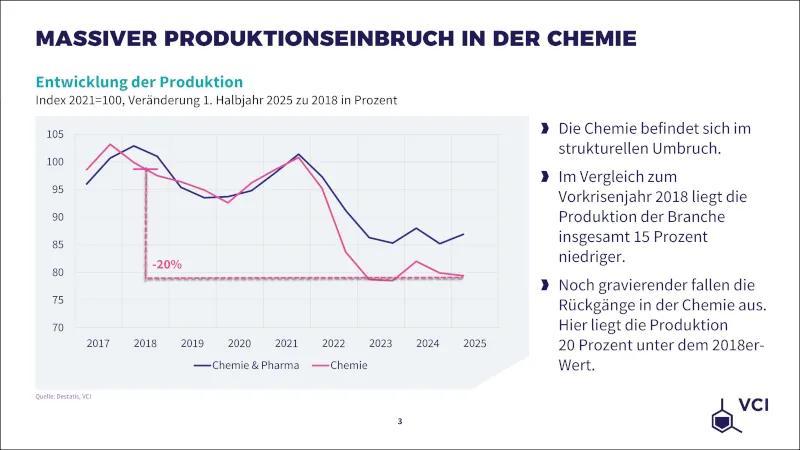
What does the "X" in GAIA-X, Manufacturing-X, and Process-X stand for? Initially, the focus was likely on "eXchange," the idea of sharing information. However, given the 20% decline in production experienced by the German chemical industry since 2021, something else would make sense: the "X" could represent the Silicon Valley tech industry, specifically the "moonshot" thinking of radical innovation scaled by "10X."
These are grandiloquent words that seem to completely ignore the technical and financial realities. However, there are reasons for optimism: decades of intense collaboration among a number of important user, manufacturer, and standards organizations have enabled the increasingly automated integration of devices, systems, processes, and applications within and beyond core industrial processes, providing a solid foundation for a true digital revolution in the process industry.
NOA as a basis for secure OT/IT data exchange.
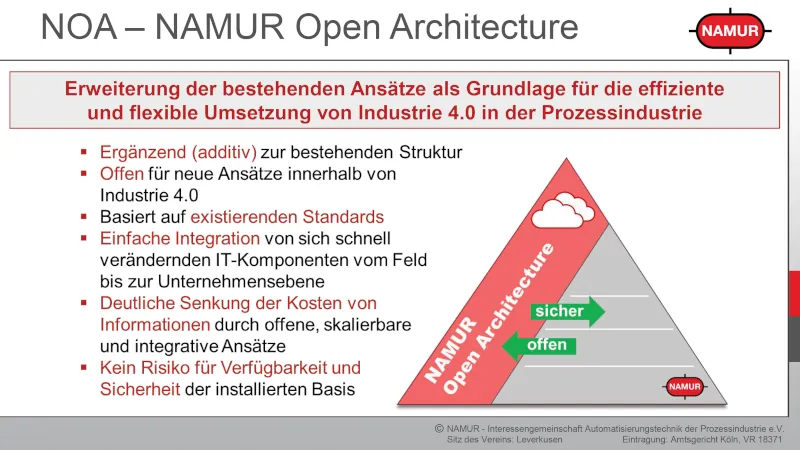
NAMUR Open Architecture (NOA) is a concept introduced in 2016 and continuously developed since then. It enables IT applications to securely access data from process control systems—the heart of chemical, petrochemical, and pharmaceutical production—without compromising the integrity of the control systems. NOA separates the traditional automation domain from a new domain of monitoring and optimization (M+O), more closely aligned with the world of IT and the IoT.
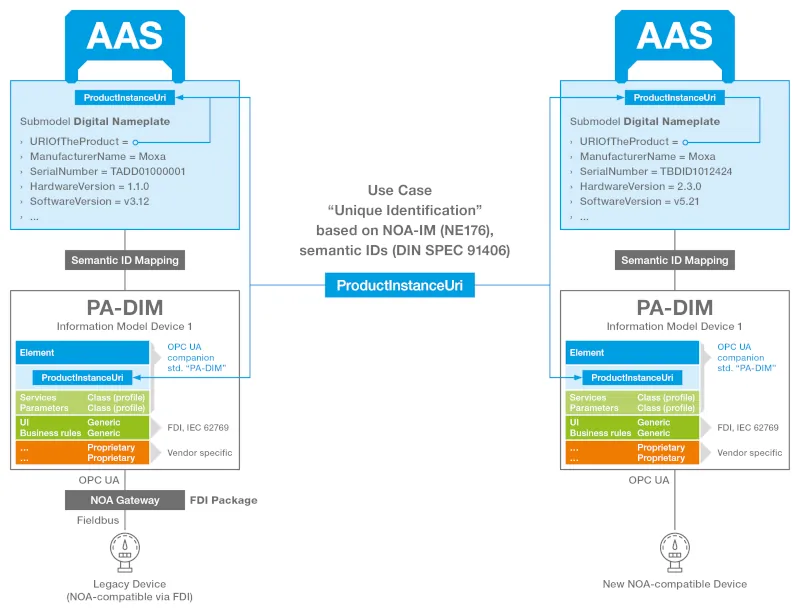
A central element is the use of PA-DIM (Process Automation Device Information Model) as an implementation of the NOA information model. It enables a semantically standardized description of the most important data from OPC UA-based field devices, representing a revolutionary shift for interoperability and resulting from collaboration between the FDT Group, FieldComm Group, ISA 100 WCI, NAMUR, ODVA, OPC Foundation, PROFIBUS and PROFINET International, VDMA, and ZVEI.
NOA for new and existing installations:
NOA enables two things: In new (greenfield) installations, which increasingly rely on modern technologies such as the Module Type Package (MTP) approach and Ethernet-based APL field devices, significantly faster exchange of large amounts of data can be extended to the M+O domain. In existing (brownfield) plants, process data can be easily and reliably extracted from the central process automation and thus used for monitoring and optimization applications outside of the process control systems. In a pilot project at the Höchst industrial park, an existing plant is currently being retrofitted to be NOA-compliant using 4-20 mA-based field devices that can transmit data externally via the NOA channel with minimal effort using HART, PROFIBUS, and a NOA gateway. This is part of the ongoing NOA implementation project, a collaboration between NAMUR and ZVEI. The results will be presented at the NAMUR General Meeting in November 2025.
Process-X: Automated Digital Collaboration Between Companies
If NOA is now accelerating digital transformation within a manufacturing company, what could be achieved if companies across the supply chain could collaborate digitally in an automated way?
ZVEI presented an innovative example at this year's Hannover Fair: the "Predictive Steam Production" use case from NAMUR's Process-X initiative. Through intelligent networking of energy companies, the industrial park operator, and various process heat users, available energy can be reconciled with required process heat in advance. This saves CO2 emissions and reduces costs.
Data rooms provide a reliable environment and form the basis of this digital collaboration between companies. Here, companies can share information securely, confidentially, and in a standardized way, while maintaining full control over their data. This means that data is not centrally stored in a cloud, but rather exchanged directly between companies, without them having to develop the necessary infrastructure themselves. The first data room providers have consolidated, for example, Cofinity-X for the Catena-X initiative in the automotive industry. But even without a consolidated data room provider, companies in the process industry can and should create the conditions for automated data exchange between companies internally. In addition to NOA (Network of Architecture), this can be achieved through a management interface infrastructure with semantic parameter setting.
Administration
Shell (AAS) was developed and continues to be developed as a digital twin or digital management interface for industrial assets, as part of a collaboration between the Industry 4.0 platform and numerous research institutions, industrial partners, and standards bodies. The Industrial Digital Twin Association (IDTA) coordinates the description of the AAS itself and the creation of so-called sub-models for the AAS, which ensure data interoperability for specific use cases. A good example is the ZVEI sub-model "Digital Nameplate for Industrial Equipment," which is also used in the KI-sy Twin project.
The Asset Asset Management (AAS) is a digital repository of all relevant information about an asset, divided into submodels. It is modular, machine-readable, and based on standardized submodels. Like the NOA PA-DIM information model, it uses semantic identifiers such as IEC CDD (Common Data Dictionary) or eCl@ss to uniquely describe data and can utilize established formats like JSON, XML, and OPC UA. This makes it ideal for securely extracting data that previously existed in process control systems but was inaccessible externally without considerable effort, such as NOA automation pyramid data, and then exchanging it between companies via the AAS without translations or manual data mapping.
The KI-sy Twin project: comprehensive communication from the field device to the cloud.
In the KI-sy Twin project, Fraunhofer IFF and IOSB-INA, together with industry partners, are creating a new mobile demonstrator for digitalization. The actual industrial hardware of a mobile demonstrator (see photo) is combined with machine learning models, AAS, and data space technology in a production-like system. AAS is the key interface.
Information from industrial sensors and field devices that are part of the control system, as well as from newly added sensors, is transferred to PA-DIM format and assigned to the AAS via a NOA gateway. For components where this cannot be done automatically, or for further comparison, component AASs are created using Large Language Models (LLMs). These are also used to assign the plant structure as an AAS. All components are securely integrated with a Moxa firewall certified according to IEC 62443. The demonstration plant architecture is based on the NOA security concept.
Production-related systems, such as CAE, ERP, and Datahub, are connected to this digital image. If changes are made to the AAS, for example, due to a device replacement, these systems are notified. The systems then decide for themselves the extent to which user involvement is necessary or whether the changes can be applied automatically. Sven Schiffner, from the Fraunhofer Institute for Factory Operation and Automation (IFF) in Magdeburg, explains: “Based on the implementations planned in the project, it’s easy to use digital tools even in existing plants. Plant operators can deploy valuable human resources more efficiently and easily collect additional data by integrating new sensors. We are creating a language that all systems speak: AAS.” At the NAMUR general meeting in November 2025, project participants will present the challenges and best practices, providing valuable advice for similar projects. The demonstrator will be showcased there, and participants will have the opportunity to try it out for themselves.
Security as an Enabler:
A well-thought-out security concept is an absolute necessity for the digital transformation of the process industry. Before NOA, opening up the automation pyramid was unheard of. With a robust security concept for NOA and the integration of AAS, digital cooperation between companies through data spaces can become a reality, without incalculable risks to production.
Conclusion and Outlook:
The combination of technologies such as NOA, AAS, and standardized information models forms the technical and semantic basis for the scalable digitalization of the process industry. It enables the reduction of CO2 emissions, decreases energy consumption, and conserves resources, while also intelligently meeting regulatory requirements. It also provides employees with a platform for the automated exchange of data, knowledge, and innovations, which can significantly increase productivity.
This represents a historic opportunity for the German process industry, from chemicals and petrochemicals to pharmaceuticals and food production. In Europe, and especially in Germany, there is an ecosystem of associations, research institutions, and companies, as well as a network of experts, all making remarkable efforts to jointly develop new standards and technologies that will set global benchmarks. Standardization and implementation still require a bit more innovative thinking. This means that everyone can look forward to the VCI's economic report for 2030 with great anticipation.






