
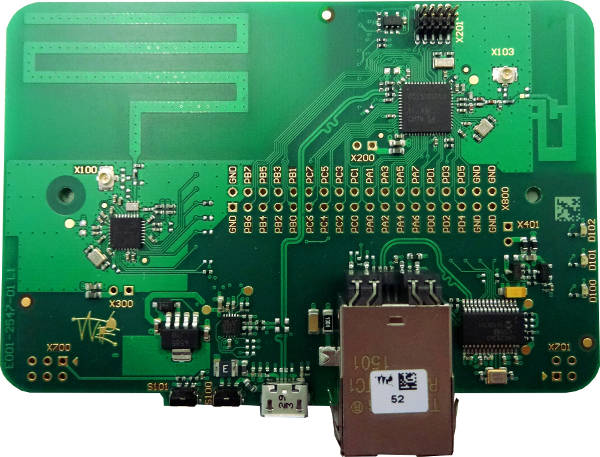
The 6LoWPAN gateway functions as a border router in 6LoWPAN-based networks and connects IPv6-based wireless networks to the internet. This board simplifies the routing procedures necessary to integrate an IPv6 mesh network, including small, low-power wireless devices, into the overall IP network; it also allows users to connect up to 32 secondary 6LoWPAN nodes to the network.
Furthermore, it offers native IPv6 operation (bridge mode) and uses the Plug and Play NAT64 IPv6 to IPv4 translation mechanism, which allows IPv4-based server addressing from any 6LoWPAN node; thus, data from radio network sensors can be transmitted to servers located anywhere on the Internet.
In terms of hardware, the board consists of a TI CC2538 microcontroller with an ARM Cortex-M3 architecture, which provides an AES and SHA encryption engine and integrates 512 kB of flash memory and 32 kB of RAM. The board offers dual-band operation with two radio interfaces: the CC2538 MCU integrates an 802.15.4 compliant radio interface in the 2.4 GHz band; and an additional TI CC1200 transceiver allows operation in the 868 or 915 MHz frequency bands. Internet connectivity is enabled by Microchip's ENC28J60a Ethernet controller. The board also features a USB 2.0 port, which also serves as a 5V power supply interface.
RS offers its customers two versions of the 6LoWPAN gateway: the first with a desktop/wall-mount enclosure measuring 110 x 76 x 29.5 mm, which is ideal for use in industrial control, home automation and 6LoWPAN sensor networks; and a second version without an enclosure intended for use as a development platform.
The free software for this board is based on the open-source Contiki OS, whose source code is available for download via GitHub.





